Kojima Wataru
Graduate School of Arts and Sciences, The University of Tokyo, 3-8-1 Komaba, Meguro-ku, Tokyo, 153-8902, Japan.
PLoS One. 2015 Nov 4;10(11):e0141733. doi: 10.1371/journal.pone.0141733. eCollection 2015.
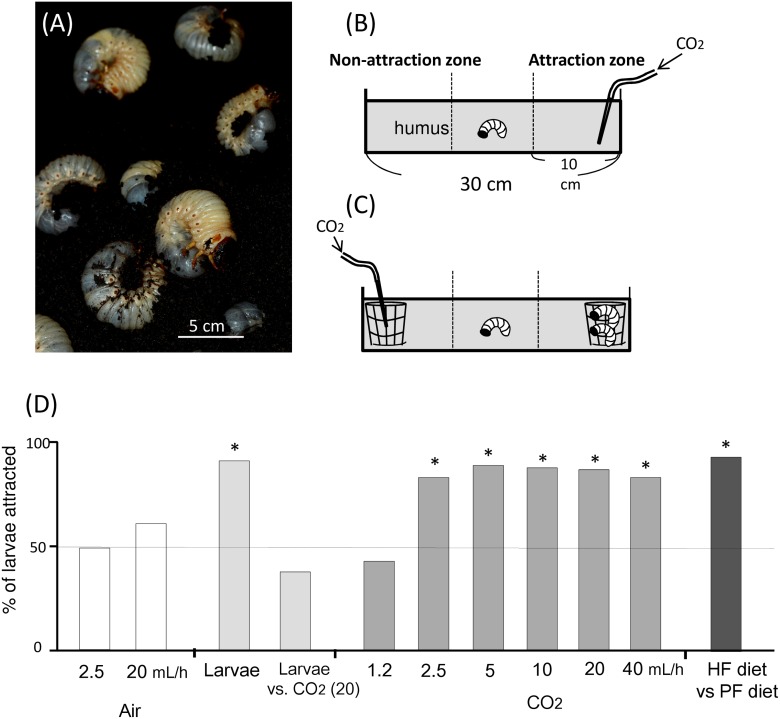
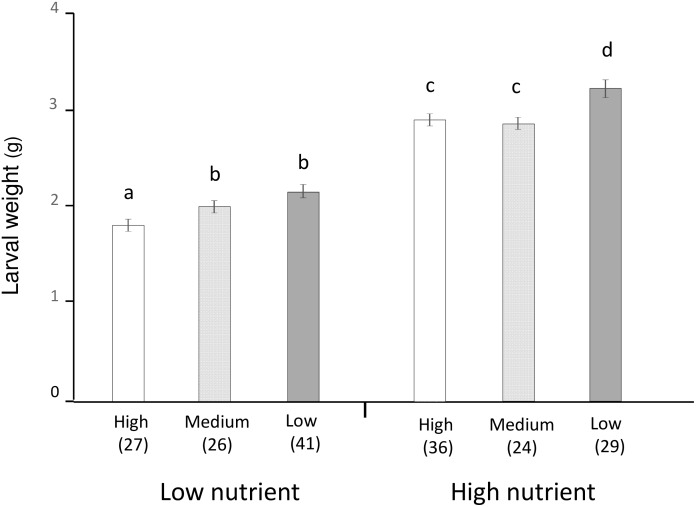
Saprophagous (feeding on decaying matter) insects often use carbon dioxide (CO2) as a cue for finding food. Humus-feeding larvae of the giant rhinoceros beetle Trypoxylus dichotomus exhibit a clumped distribution in natural microhabitats, but the mechanisms driving the distribution were unknown. Herein, I examined whether larvae use CO2 as a cue for fermented humus and aggregate in the vicinity of the food. I found that (i) larvae of T. dichotomus are strongly attracted to CO2, (ii) larvae orient toward highly fermented humus when given a choice between highly and poorly fermented humus, (iii) the highly fermented humus emits more CO2 than the poorly fermented humus, and (iv) larvae grow larger when fed highly fermented humus rather than poorly fermented humus. The clumped distribution of larvae is probably formed along the concentration gradient of CO2 induced by heterogeneity of fermented organic materials in soil. My laboratory experiments also revealed that larvae are chemically attracted to each other. Moreover, CO2 concentrations in soil were increased by the larval respiration, and small amounts of CO2 (much less than emitted during respiration by a single larva) were sufficient for larval attraction. These results suggest that not only response to fermented food resources, but also respiratory CO2 from conspecifics may lead to aggregation. Enhanced densities resulted in reduced weight gain under experimental conditions. However, exploiting a high-value resource at enhanced densities still led to greater body weight compared to individually exploiting a low-value resource. This demonstrates the adaptive value of the response to CO2 sources in this species.
腐食性(以腐烂物质为食)昆虫通常利用二氧化碳(CO₂)作为寻找食物的线索。独角仙Trypoxylus dichotomus以腐殖质为食的幼虫在自然微生境中呈现出聚集分布,但驱动这种分布的机制尚不清楚。在此,我研究了幼虫是否利用CO₂作为发酵腐殖质的线索并在食物附近聚集。我发现:(i)独角仙幼虫对CO₂有强烈的吸引力;(ii)当在高度发酵和低度发酵的腐殖质之间进行选择时,幼虫会朝向高度发酵的腐殖质;(iii)高度发酵的腐殖质比低度发酵的腐殖质释放更多的CO₂;(iv)以高度发酵的腐殖质为食的幼虫比以低度发酵的腐殖质为食的幼虫长得更大。幼虫的聚集分布可能是沿着土壤中发酵有机物质的异质性所诱导的CO₂浓度梯度形成的。我的实验室实验还表明幼虫在化学上会相互吸引。此外,幼虫的呼吸会增加土壤中的CO₂浓度,少量的CO₂(远低于单个幼虫呼吸时释放的量)就足以吸引幼虫。这些结果表明,不仅对发酵食物资源的反应,而且同种个体呼出的CO₂都可能导致聚集。在实验条件下,密度增加导致体重增加减少。然而,与单独利用低价值资源相比,在较高密度下利用高价值资源仍能导致更大的体重。这证明了该物种对CO₂源反应的适应性价值。