Lee Young-Sun, Yi Hyon-Seung, Suh Yang-Gun, Byun Jin-Seok, Eun Hyuk Soo, Kim So Yeon, Seo Wonhyo, Jeong Jong-Min, Choi Won-Mook, Kim Myung-Ho, Kim Ji Hoon, Park Keun-Gyu, Jeong Won-Il
Laboratory of Liver Research, Graduate School of Medical Science and Engineering, Korea Advanced Institute of Science and Technology, Daejeon 305-701, Korea.
Department of Internal Medicine, Korea University College of Medicine, Seoul 136-705, Korea.
Mol Cells. 2015 Nov;38(11):998-1006. doi: 10.14348/molcells.2015.0218. Epub 2015 Nov 4.
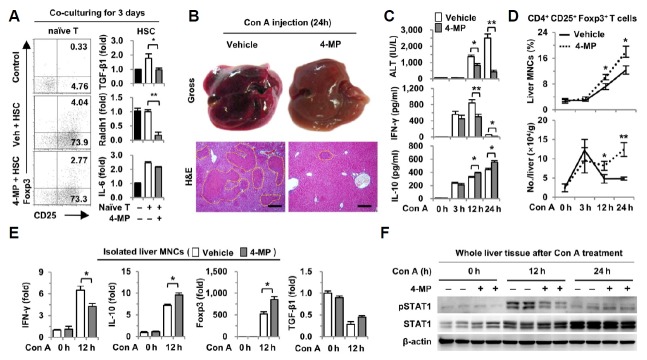
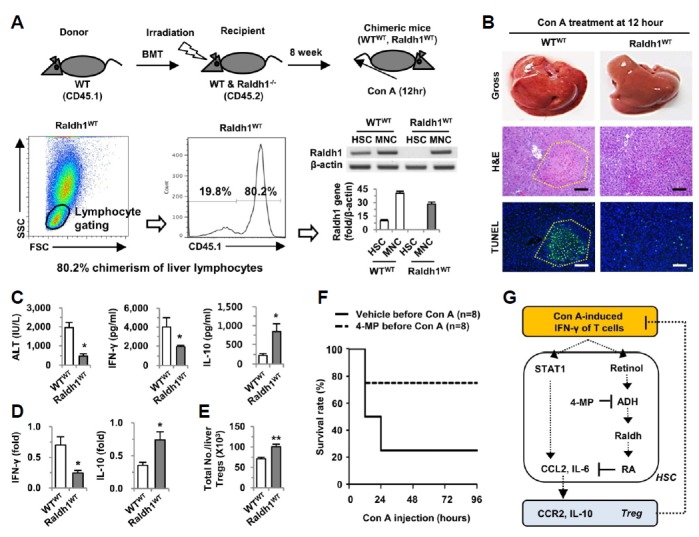
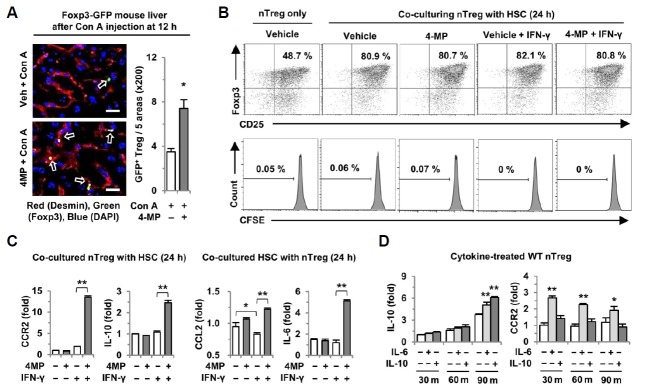
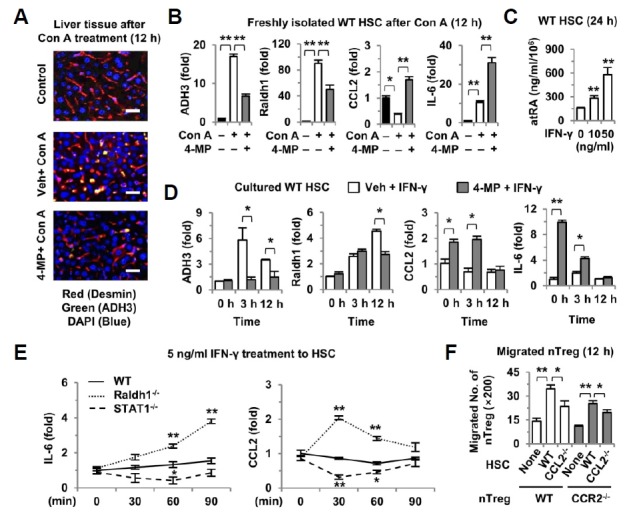
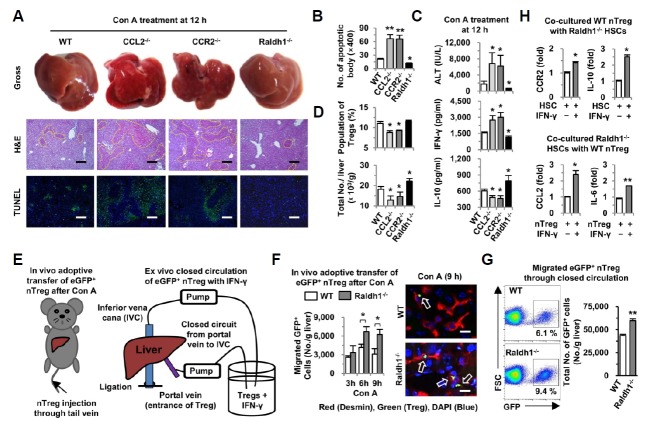
Retinols are metabolized into retinoic acids by alcohol dehydrogenase (ADH) and retinaldehyde dehydrogenase (Raldh). However, their roles have yet to be clarified in hepatitis despite enriched retinols in hepatic stellate cells (HSCs). Therefore, we investigated the effects of retinols on Concanavalin A (Con A)-mediated hepatitis. Con A was injected into wild type (WT), Raldh1 knock-out (Raldh1(-/-)), CCL2(-/-) and CCR2(-/-) mice. For migration study of regulatory T cells (Tregs), we used in vivo and ex vivo adoptive transfer systems. Blockade of retinol metabolism in mice given 4-methylpyrazole, an inhibitor of ADH, and ablated Raldh1 gene manifested increased migration of Tregs, eventually protected against Con A-mediated hepatitis by decreasing interferon-γ in T cells. Moreover, interferon-γ treatment increased the expression of ADH3 and Raldh1, but it suppressed that of CCL2 and IL-6 in HSCs. However, the expression of CCL2 and IL-6 was inversely increased upon the pharmacologic or genetic ablation of ADH3 and Raldh1 in HSCs. Indeed, IL-6 treatment increased CCR2 expression of Tregs. In migration assay, ablated CCR2 in Tregs showed reduced migration to HSCs. In adoptive transfer of Tregs in vivo and ex vivo, Raldh1-deficient mice showed more increased migration of Tregs than WT mice. Furthermore, inhibited retinol metabolism increased survival rate (75%) compared with that of the controls (25%) in Con A-induced hepatitis. These results suggest that blockade of retinol metabolism protects against acute liver injury by increased Treg migration, and it may represent a novel therapeutic strategy to control T cell-mediated acute hepatitis.
视黄醇通过乙醇脱氢酶(ADH)和视黄醛脱氢酶(Raldh)代谢为视黄酸。然而,尽管肝星状细胞(HSCs)中视黄醇含量丰富,但其在肝炎中的作用尚未阐明。因此,我们研究了视黄醇对刀豆蛋白A(Con A)介导的肝炎的影响。将Con A注射到野生型(WT)、Raldh1基因敲除(Raldh1(-/-))、CCL2(-/-)和CCR2(-/-)小鼠体内。为了研究调节性T细胞(Tregs)的迁移,我们使用了体内和体外过继转移系统。给予4-甲基吡唑(一种ADH抑制剂)的小鼠以及Raldh1基因缺失小鼠中视黄醇代谢的阻断表现为Tregs迁移增加,最终通过降低T细胞中的干扰素-γ来预防Con A介导的肝炎。此外,干扰素-γ处理增加了HSCs中ADH3和Raldh1的表达,但抑制了CCL2和IL-6的表达。然而,HSCs中ADH3和Raldh1的药理学或基因缺失后,CCL2和IL-6的表达反而增加。事实上,IL-6处理增加了Tregs的CCR2表达。在迁移试验中,Tregs中CCR2缺失显示其向HSCs的迁移减少。在体内和体外Tregs的过继转移中,Raldh1缺陷小鼠的Tregs迁移比WT小鼠增加得更多。此外,在Con A诱导的肝炎中,与对照组(25%)相比,视黄醇代谢受抑制使存活率提高(75%)。这些结果表明,视黄醇代谢的阻断通过增加Tregs迁移来预防急性肝损伤,这可能代表了一种控制T细胞介导的急性肝炎的新治疗策略。