Division of Chest Medicine, Department of Internal Medicine, Taichung Veterans General Hospital, Taichung, Taiwan.
Department of Medical Technology, Jen-Teh Junior College of Medicine, Nursing and Management, Miaoli, Taiwan.
NPJ Prim Care Respir Med. 2015 Nov 5;25:15063. doi: 10.1038/npjpcrm.2015.63.
The group assignment of chronic obstructive pulmonary disease (COPD) may differ depending on whether the COPD assessment test (CAT) or modified Medical Research Council dyspnoea scale (mMRC) is used.
This study intended to clarify how different patient characteristics influence the differences, to determine the relationships between CAT and mMRC and to characterise COPD patients by both CAT and mMRC.
This was a retrospective, cross-sectional study. The data, collected by Taiwan Obstructive Lung Disease consortium, were managed and analysed.
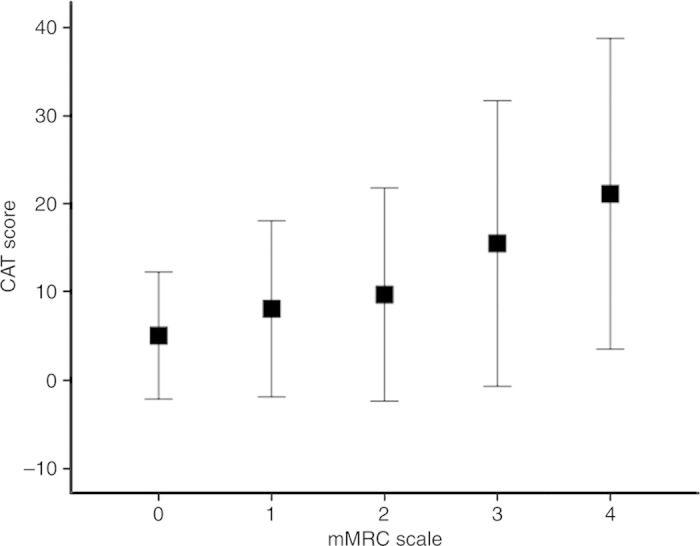
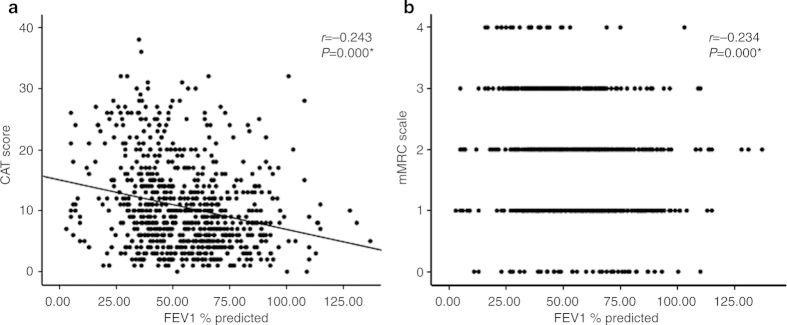
Of the 757 participants, COPD group assignment was not identical as well as no substantial agreement presented when categorised based on the cut-point CAT score ⩾10 and each mMRC cut-point. In all, 38.2% of participants had discordant group assignments together with a lower mean CAT score, less severe airway obstruction and less severe airflow limitation compared with those with concordant group assignments. In the discordant group, the CAT⩾10/mMRC 0-1 subgroup had more wheezing than CAT<10/mMRC⩾2 subgroup. Only moderate correlations existed between CAT and mMRC. More-symptom groups and combined high-risk group had better correlations than less-symptom groups and combined low-risk group, respectively. A modest negative correlation existed between forced expiratory volume in 1 s percentage (FEV1%) predicted and CAT score and between FEV1% predicted and mMRC scale in parallel with a significant positive relationship existing between the CAT score and mMRC scale. Notably, a significant proportion of COPD patients with each scale of mMRC had health status impairment.
The Global initiative for Chronic Obstructive Lung Disease committee should redefine the applications of CAT and mMRC in the management of COPD.
慢性阻塞性肺疾病(COPD)的分组可能因使用 COPD 评估测试(CAT)或改良的医学研究理事会呼吸困难量表(mMRC)而有所不同。
本研究旨在阐明不同的患者特征如何影响差异,确定 CAT 和 mMRC 之间的关系,并通过 CAT 和 mMRC 来描述 COPD 患者的特征。
这是一项回顾性、横断面研究。数据由台湾阻塞性肺病联盟收集和管理,并进行分析。
在 757 名参与者中,根据 CAT 评分≥10 和每个 mMRC 切点分类时,COPD 分组不一致,也没有实质性的一致性。总体而言,38.2%的参与者分组不一致,他们的 CAT 评分较低,气道阻塞程度较轻,气流受限程度较轻。在不一致的分组中,CAT≥10/mMRC 0-1 亚组比 CAT<10/mMRC≥2 亚组更常出现喘息。CAT 与 mMRC 之间仅存在中度相关性。症状较多的组和联合高危组的相关性优于症状较少的组和联合低危组。FEV1%预计值与 CAT 评分之间存在适度的负相关,与 mMRC 量表之间存在显著的正相关。FEV1%预计值与 CAT 评分之间存在显著的正相关。值得注意的是,相当比例的 COPD 患者在每个 mMRC 量表上都存在健康状况受损。
全球慢性阻塞性肺疾病倡议委员会应重新定义 CAT 和 mMRC 在 COPD 管理中的应用。