Sasahara Kazutoshi, Tchernichovski Ofer, Takahasi Miki, Suzuki Kenta, Okanoya Kazuo
Department of Complex Systems Science, Nagoya University, Furo-cho, Chikusa-ku, Nagoya 464-8601, Japan Laboratory for Biolinguistics, RIKEN Brain Science Institute, 2-1 Hirosawa, Wako-shi, Saitama 351-0198, Japan
Department of Psychology, Hunter College, City University of New York, 695 Park Avenue, New York, NY 10065, USA.
J R Soc Interface. 2015 Nov 6;12(112). doi: 10.1098/rsif.2015.0802.
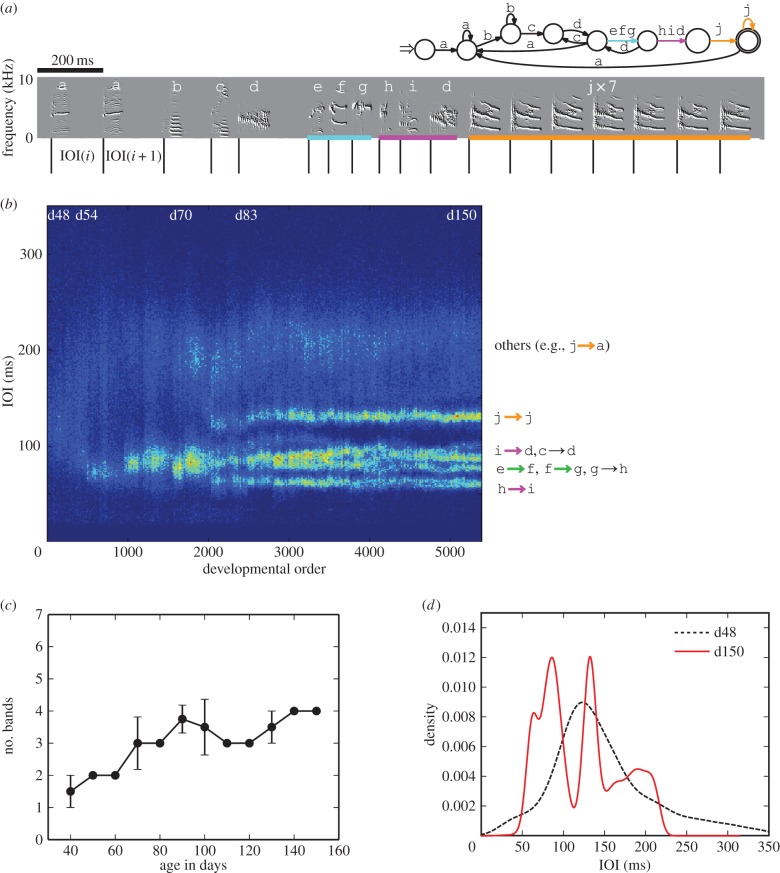
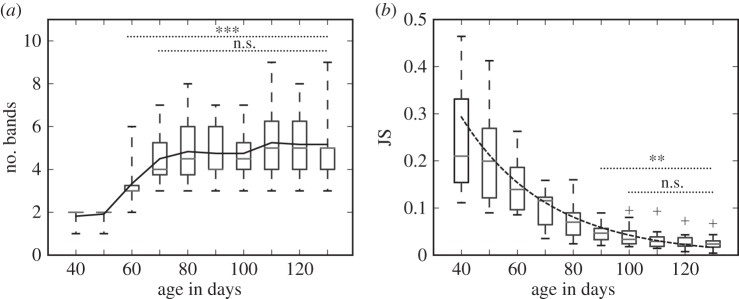
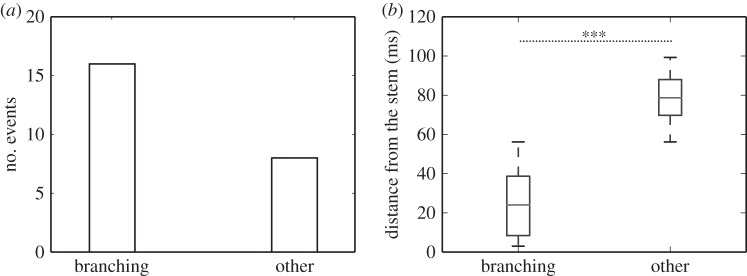
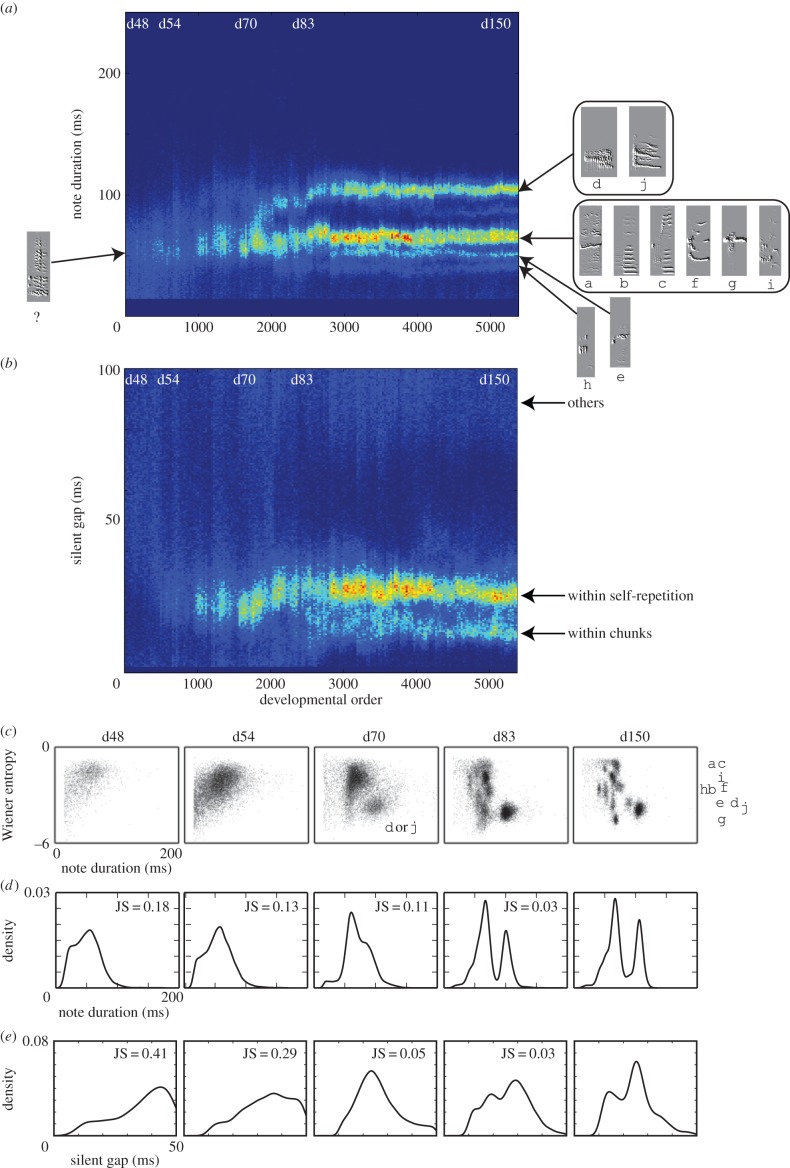
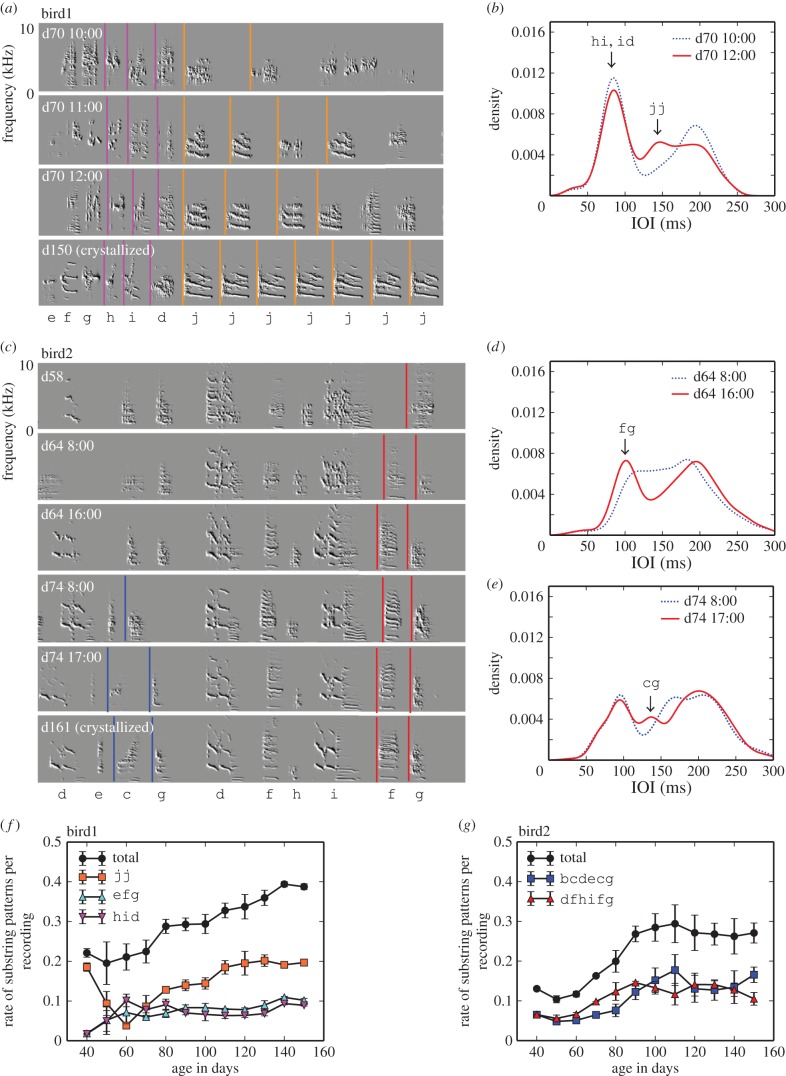
Unlike simple biological rhythms, the rhythm of the oscine bird song is a learned time series of diverse sounds that change dynamically during vocal ontogeny. How to quantify rhythm development is one of the most important challenges in behavioural biology. Here, we propose a simple method, called 'rhythm landscape', to visualize and quantify how rhythm structure, which is measured as durational patterns of sounds and silences, emerges and changes over development. Applying this method to the development of Bengalese finch songs, we show that the rhythm structure begins with a broadband rhythm that develops into diverse rhythms largely through branching from precursors. Furthermore, an information-theoretic measure, the Jensen-Shannon divergence, was used to characterize the crystallization process of birdsong rhythm, which started with a high rate of rhythm change and progressed to a stage of slow refinement. This simple method provides a useful description of rhythm development, thereby helping to reveal key temporal constraints on complex biological rhythms.
与简单的生物节律不同,鸣禽歌声的节奏是一种通过学习获得的、由多样声音组成的时间序列,且在发声个体发育过程中动态变化。如何量化节奏发展是行为生物学中最重要的挑战之一。在此,我们提出一种名为“节奏景观”的简单方法,用于可视化和量化节奏结构(以声音和沉默的时长模式来衡量)在发育过程中是如何出现和变化的。将此方法应用于 Bengalese 雀的歌声发育研究,我们发现节奏结构始于一种宽带节奏,这种节奏主要通过从前体分支发展成多样的节奏。此外,一种信息论度量—— Jensen-Shannon 散度,被用于表征鸟鸣节奏的结晶过程,该过程始于较高的节奏变化率,并逐渐发展到缓慢细化的阶段。这种简单方法为节奏发展提供了有用的描述,从而有助于揭示复杂生物节律的关键时间限制。