Shin Seung Heon, Kim Yee Hyuk, Jin Hyo Sung, Kang Seung Hyun
Department of Otolaryngology-Head and Neck Surgery, School of medicine, Catholic University of Daegu, Daegu, Korea.
Allergy Asthma Immunol Res. 2016 Jan;8(1):63-8. doi: 10.4168/aair.2016.8.1.63. Epub 2015 Aug 21.
Chronic rhinosinusitis with nasal polyps is a chronic inflammatory disease with markedly increased eosinophils, Th2-type lymphocytes, fibroblasts, and goblet cells. Fungi are commonly associated with airway inflammatory diseases, and thymic stromal lymphopoietin (TSLP) is important in the development of Th2 inflammatory responses. The aim of this study was to investigate the interaction between airborne fungi and nasal fibroblasts in TSLP mRNA and protein expression.
Inferior turbinate and nasal polyp fibroblasts were stimulated with Alternaria and Aspergillus, respectively, for 48 hours, and TSLP mRNA and protein expressions were measured. The reverse transcriptase polymerase chain reaction was performed for the Toll-like receptor (TLR) mRNA expression of the nasal fibroblasts. To determine the role of TLR in the induction of TSLP, the fibroblasts were transfected with siRNA against TLR2 and TLR5.
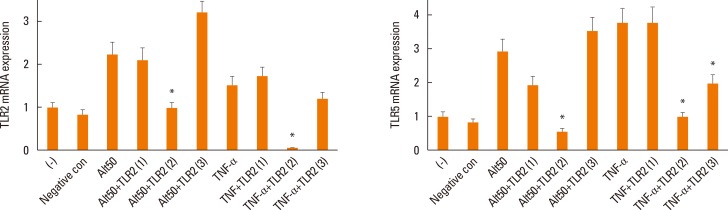
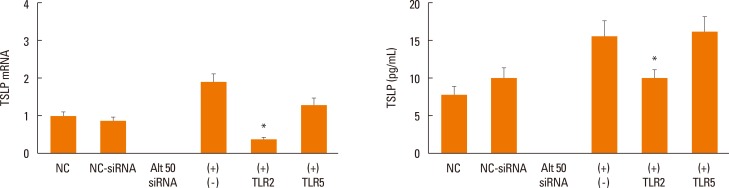
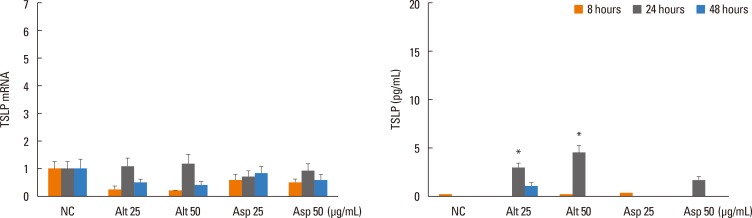
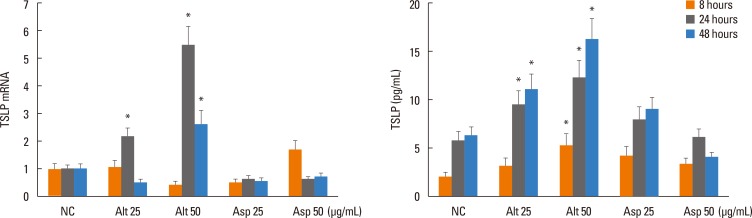
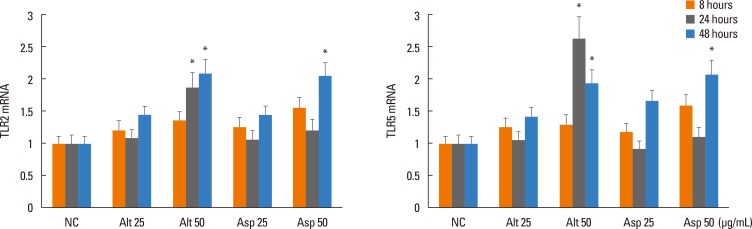
Alternaria induced TSLP mRNA and protein expression in both inferior turbinate and nasal polyp fibroblasts. The nasal polyp fibroblasts responded more strongly to the fungi. TLR2 and TLR5 mRNA expressions were significantly increased with fungal stimulation and TSLP production was significantly inhibited by siRNA against TLR2.
The results of this study show that TSLP expression could be induced in nasal fibroblasts by exposure to Alternaria and that TLR2 may be involved in the process. The promotion of TSLP production in nasal fibroblasts by airborne fungi may facilitate the development or exacerbation of Th2-type nasal inflammation, especially in CRS with nasal polyps.
伴鼻息肉的慢性鼻-鼻窦炎是一种慢性炎症性疾病,其嗜酸性粒细胞、Th2型淋巴细胞、成纤维细胞和杯状细胞显著增多。真菌通常与气道炎症性疾病相关,而胸腺基质淋巴细胞生成素(TSLP)在Th2炎症反应的发展中起重要作用。本研究的目的是探讨空气中的真菌与鼻成纤维细胞在TSLP mRNA和蛋白表达方面的相互作用。
分别用链格孢属和曲霉属刺激下鼻甲和成鼻息肉成纤维细胞48小时,检测TSLP mRNA和蛋白表达。对鼻成纤维细胞的Toll样受体(TLR)mRNA表达进行逆转录聚合酶链反应。为确定TLR在TSLP诱导中的作用,用针对TLR2和TLR5的小干扰RNA转染成纤维细胞。
链格孢属诱导下鼻甲和成鼻息肉成纤维细胞中TSLP mRNA和蛋白表达。鼻息肉成纤维细胞对真菌的反应更强。真菌刺激后TLR2和TLR5 mRNA表达显著增加,针对TLR2的小干扰RNA显著抑制TSLP生成。
本研究结果表明,暴露于链格孢属可诱导鼻成纤维细胞中TSLP表达,且TLR2可能参与此过程。空气中的真菌促进鼻成纤维细胞中TSLP生成可能会促进Th2型鼻炎症的发展或加重,尤其是在伴鼻息肉的慢性鼻-鼻窦炎中。