Huang Gang, Wu Lin-wei, Yang Shi-Cong, Fei Ji-guang, Deng Su-xiong, Li Jun, Chen Guo-dong, Fu Qian, Deng Rong-hai, Qiu Jiang, Wang Chang-xi, Chen Li-zhong
Department of Organ Transplantation, The First Affiliated Hospital, Sun Yat-sen University, Guangzhou, Guangdong, China.
Department of Pathology, The First Affiliated Hospital, Sun Yat-sen University, Guangzhou, Guangdong, China.
PLoS One. 2015 Nov 6;10(11):e0142460. doi: 10.1371/journal.pone.0142460. eCollection 2015.
Polyomavirus associated nephropathy (PVAN) is a significant cause of early allograft loss and the course is difficult to predict. The aim of this study is to identify factors influencing outcome for PVAN.
Between 2006 and 2014, we diagnosed PVAN in 48 (7.8%) of 615 patients monitored for BK virus every 1-4 weeks after modification of maintenance immunosuppression. Logistic or Cox regression analysis were performed to determine which risk factors independently affected clinical outcome and graft loss respectively.
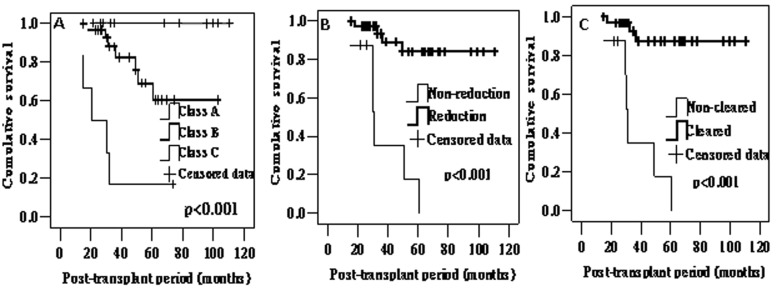
After 32.1±26.4 months follow-up, the frequencies of any graft functional decline at 1 year post-diagnosis, graft loss and any graft functional decline at the last available follow-up were 27.1% (13/48), 25.0% (12/48), and 33.3% (16/48), respectively. The 1, 3, 5 year graft survival rates were 100%, 80.5% and 69.1%, respectively. The mean level of serum creatinine at 1 year post-diagnosis and long-term graft survival rates were the worst in class C (p<0.05). Thirty-eight of 46 (82.6%) BKV DNAuria patients reduced viral load by 90% with a median time of 2.75 months (range, 0.25-34.0 months) and showed better graft survival rates than the 8 patients (17.4%) without viral load reduction (p<0.001). Multivariate logistic regression analysis showed that extensive interstitial inflammation (OR 20.2, p = 0.042) and delayed fall in urinary viral load (>2.75 months for >90% decrease) in urine (OR 16.7, p = 0.055) correlated with worse creatinine at 1 year post-diagnosis. Multivariate Cox regression analysis showed that extensive interstitial inflammation (HR 46988, p = 0.032) at diagnosis, and high PVAN stage (HR 162.2, p = 0.021) were associated with worse long-term graft survival rates.
The extent of interstitial inflammation influences short and long-term graft outcomes in patients with PVAN. The degree of PVAN, rate of reduction in viral load, and viral clearance also can be used as prognostic markers in PVAN.
多瘤病毒相关性肾病(PVAN)是移植肾早期丢失的重要原因,其病程难以预测。本研究旨在确定影响PVAN预后的因素。
2006年至2014年期间,在615例接受维持性免疫抑制调整后每1 - 4周监测BK病毒的患者中,我们诊断出48例(7.8%)PVAN。进行逻辑回归或Cox回归分析,以确定哪些危险因素分别独立影响临床结局和移植肾丢失。
经过32.1±26.4个月的随访,诊断后1年移植肾功能任何下降、移植肾丢失以及最后一次可用随访时移植肾功能任何下降的发生率分别为27.1%(13/48)、25.0%(12/48)和33.3%(16/48)。1年、3年、5年移植肾存活率分别为100%、80.5%和69.1%。C组诊断后1年血清肌酐平均水平和长期移植肾存活率最差(p<0.05)。46例(82.6%)BK病毒尿症患者中有38例病毒载量降低90%,中位时间为2.75个月(范围0.25 - 34.0个月),其移植肾存活率高于8例(17.4%)病毒载量未降低的患者(p<0.001)。多因素逻辑回归分析显示,广泛的间质炎症(比值比20.2,p = 0.042)和尿中病毒载量下降延迟(>2.75个月下降>90%)(比值比16.7,p = 0.055)与诊断后1年肌酐水平较差相关。多因素Cox回归分析显示,诊断时广泛的间质炎症(风险比46988,p = 0.032)和高PVAN分期(风险比162.2,p = 0.021)与较差的长期移植肾存活率相关。
间质炎症程度影响PVAN患者的短期和长期移植肾结局。PVAN的程度、病毒载量降低率和病毒清除情况也可作为PVAN的预后标志物。