Beretov Julia, Wasinger Valerie C, Millar Ewan K A, Schwartz Peter, Graham Peter H, Li Yong
Cancer Care Centre, St George Hospital, Kogarah, Australia.
St George and Sutherland Clinical School, Faculty of Medicine, University of New South Wales (UNSW), Kensington, Australia.
PLoS One. 2015 Nov 6;10(11):e0141876. doi: 10.1371/journal.pone.0141876. eCollection 2015.
Breast cancer is a complex heterogeneous disease and is a leading cause of death in women. Early diagnosis and monitoring progression of breast cancer are important for improving prognosis. The aim of this study was to identify protein biomarkers in urine for early screening detection and monitoring invasive breast cancer progression.
We performed a comparative proteomic analysis using ion count relative quantification label free LC-MS/MS analysis of urine from breast cancer patients (n = 20) and healthy control women (n = 20).
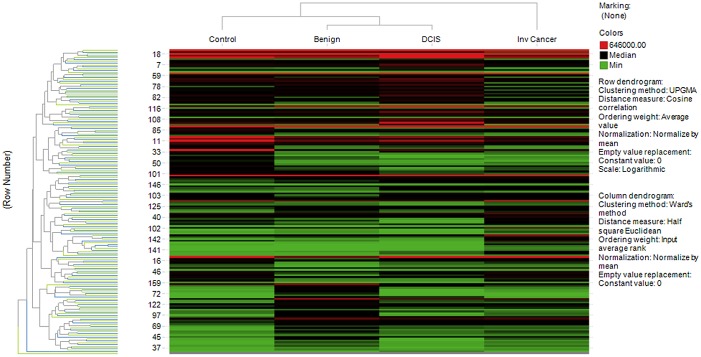
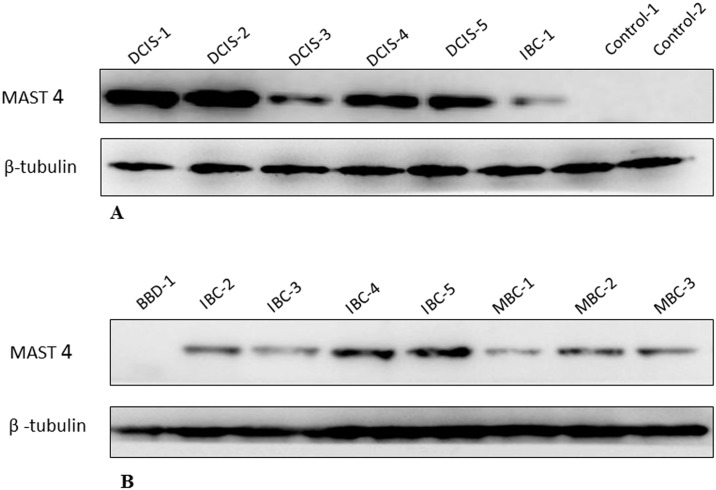
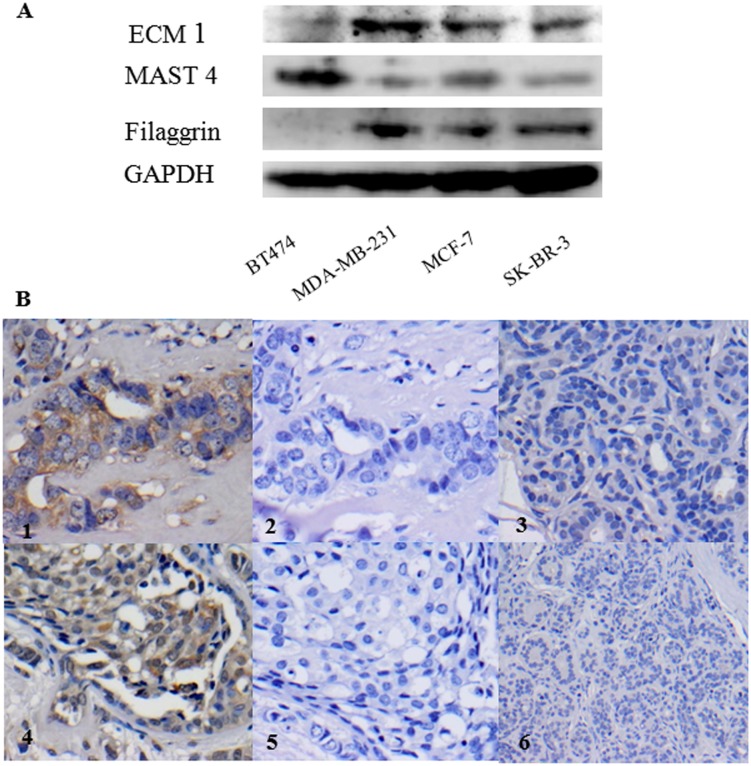
Unbiased label free LC-MS/MS-based proteomics was used to provide a profile of abundant proteins in the biological system of breast cancer patients. Data analysis revealed 59 urinary proteins that were significantly different in breast cancer patients compared to the normal control subjects (p<0.05, fold change >3). Thirty-six urinary proteins were exclusively found in specific breast cancer stages, with 24 increasing and 12 decreasing in their abundance. Amongst the 59 significant urinary proteins identified, a list of 13 novel up-regulated proteins were revealed that may be used to detect breast cancer. These include stage specific markers associated with pre-invasive breast cancer in the ductal carcinoma in-situ (DCIS) samples (Leucine LRC36, MAST4 and Uncharacterized protein CI131), early invasive breast cancer (DYH8, HBA, PEPA, uncharacterized protein C4orf14 (CD014), filaggrin and MMRN2) and metastatic breast cancer (AGRIN, NEGR1, FIBA and Keratin KIC10). Preliminary validation of 3 potential markers (ECM1, MAST4 and filaggrin) identified was performed in breast cancer cell lines by Western blotting. One potential marker MAST4 was further validated in human breast cancer tissues as well as individual human breast cancer urine samples with immunohistochemistry and Western blotting, respectively.
Our results indicate that urine is a useful non-invasive source of biomarkers and the profile patterns (biomarkers) identified, have potential for clinical use in the detection of BC. Validation with a larger independent cohort of patients is required in the following study.
乳腺癌是一种复杂的异质性疾病,是女性死亡的主要原因。早期诊断和监测乳腺癌进展对于改善预后很重要。本研究的目的是鉴定尿液中的蛋白质生物标志物,用于早期筛查检测和监测浸润性乳腺癌进展。
我们使用离子计数相对定量无标记液相色谱-串联质谱分析法,对乳腺癌患者(n = 20)和健康对照女性(n = 20)的尿液进行了比较蛋白质组学分析。
基于无标记液相色谱-串联质谱的非偏倚蛋白质组学用于提供乳腺癌患者生物系统中丰富蛋白质的概况。数据分析显示,与正常对照受试者相比,乳腺癌患者中有59种尿蛋白存在显著差异(p<0.05,变化倍数>3)。36种尿蛋白仅在特定乳腺癌阶段发现,其中24种丰度增加,12种丰度降低。在鉴定出的59种显著尿蛋白中,揭示了13种新的上调蛋白列表,这些蛋白可用于检测乳腺癌。这些包括与导管原位癌(DCIS)样本中浸润前乳腺癌相关的阶段特异性标志物(亮氨酸LRC36、MAST4和未表征蛋白CI131)、早期浸润性乳腺癌(DYH8、HBA、PEPA、未表征蛋白C4orf14(CD014)、丝聚合蛋白和MMRN2)以及转移性乳腺癌(AGRIN、NEGR1、FIBA和角蛋白KIC10)。通过蛋白质印迹法在乳腺癌细胞系中对鉴定出的3种潜在标志物(ECM1、MAST4和丝聚合蛋白)进行了初步验证。一种潜在标志物MAST4分别通过免疫组织化学和蛋白质印迹法在人乳腺癌组织以及个体人乳腺癌尿液样本中进一步验证。
我们的结果表明,尿液是生物标志物的有用非侵入性来源,鉴定出的概况模式(生物标志物)在乳腺癌检测中具有临床应用潜力。后续研究需要用更大的独立患者队列进行验证。