Budd William T, Seashols-Williams Sarah J, Clark Gene C, Weaver Danielle, Calvert Valerie, Petricoin Emanuel, Dragoescu Ema A, O'Hanlon Katherine, Zehner Zendra E
Department of Biochemistry and Molecular Biology, Massey Cancer Center, Virginia Commonwealth University, Richmond, Virginia, United States of America.
Department of Forensic Science, Virginia Commonwealth University, Richmond, Virginia, United States of America.
PLoS One. 2015 Nov 6;10(11):e0142373. doi: 10.1371/journal.pone.0142373. eCollection 2015.
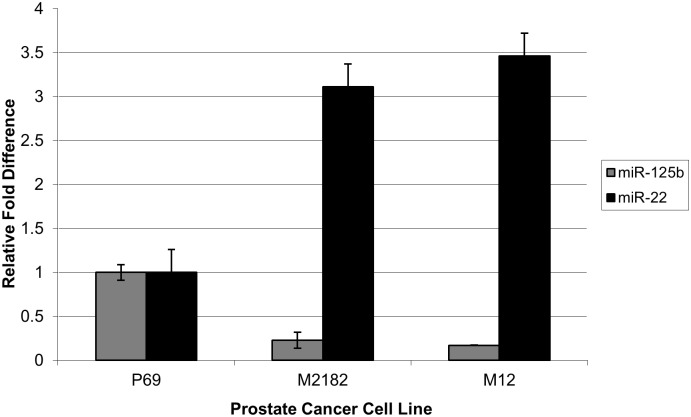
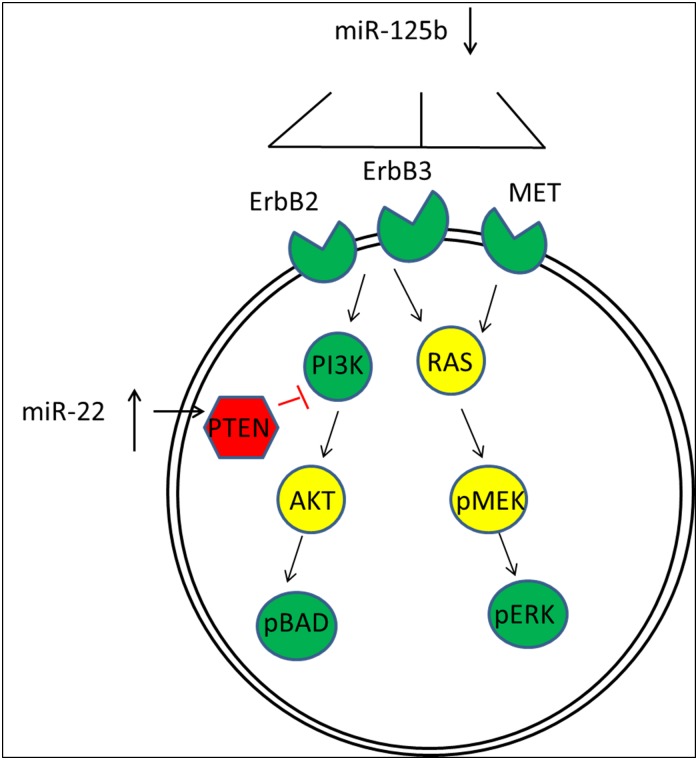
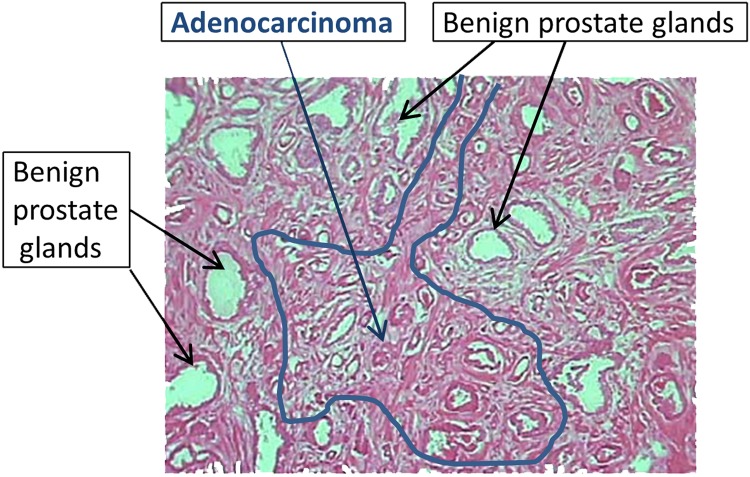
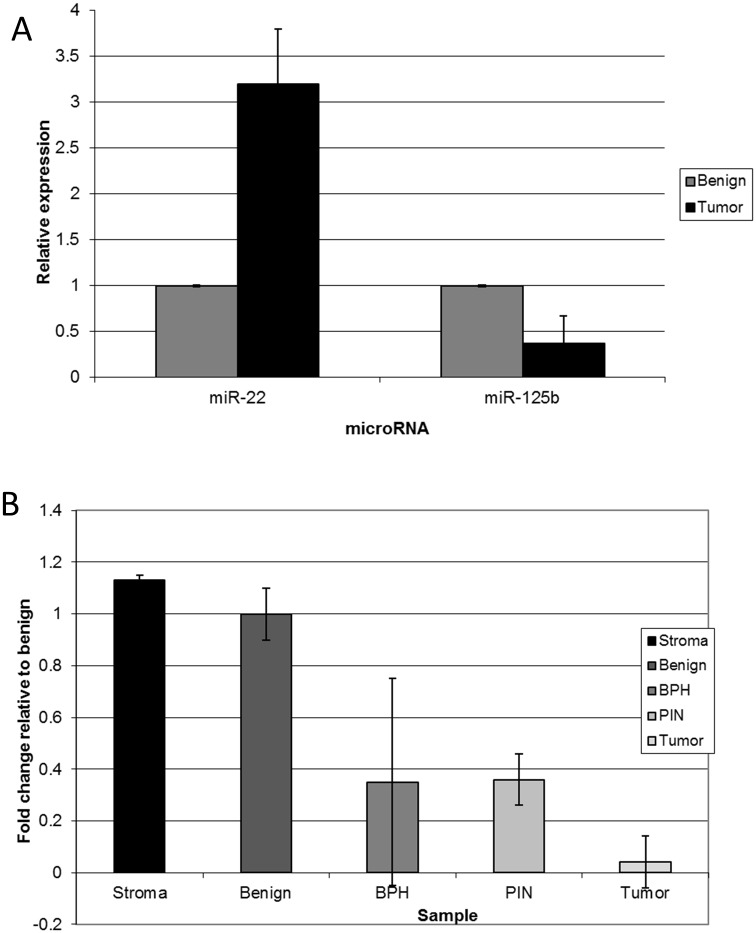
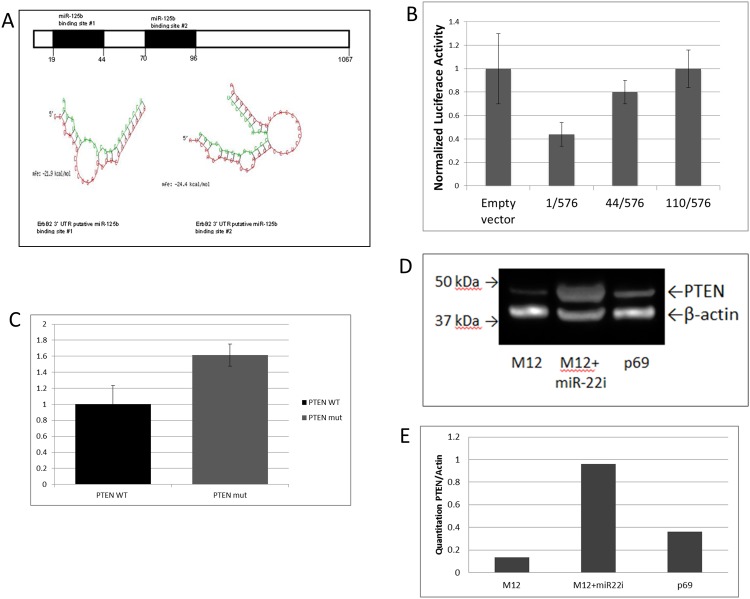
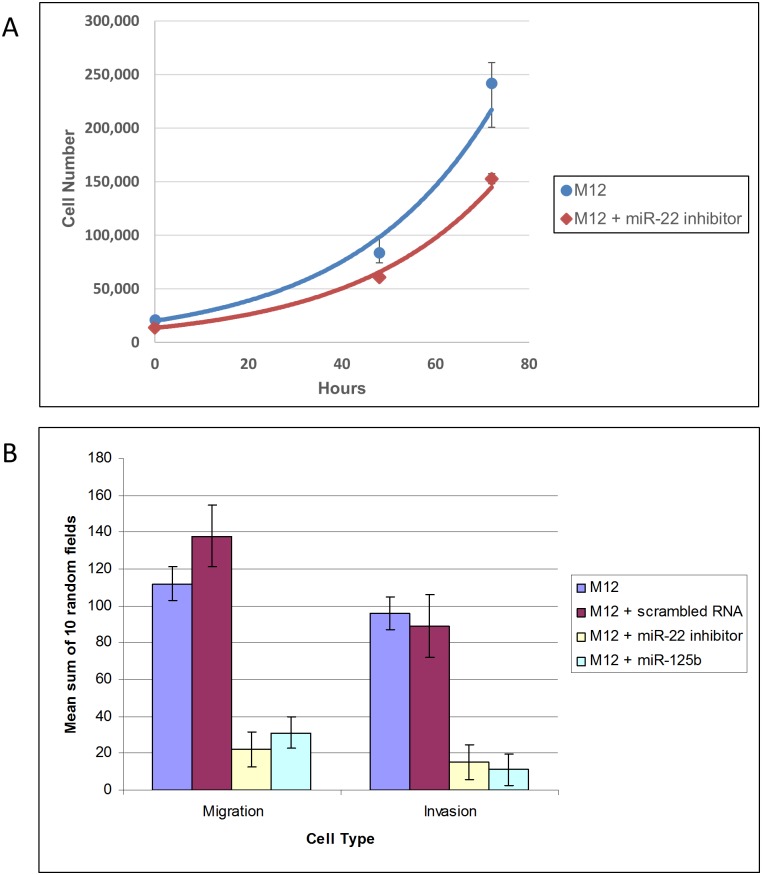
MicroRNAs (miRs) are a novel class of small RNA molecules, the dysregulation of which can contribute to cancer. A combinatorial approach was used to identify miRs that promote prostate cancer progression in a unique set of prostate cancer cell lines, which originate from the parental p69 cell line and extend to a highly tumorigenic/metastatic M12 subline. Together, these cell lines are thought to mimic prostate cancer progression in vivo. Previous network analysis and miR arrays suggested that the loss of hsa-miR-125b together with the overexpression of hsa-miR-22 could contribute to prostate tumorigenesis. The dysregulation of these two miRs was confirmed in human prostate tumor samples as compared to adjacent benign glandular epithelium collected through laser capture microdissection from radical prostatectomies. In fact, alterations in hsa-miR-125b expression appeared to be an early event in tumorigenesis. Reverse phase microarray proteomic analysis revealed ErbB2/3 and downstream members of the PI3K/AKT and MAPK/ERK pathways as well as PTEN to be protein targets differentially expressed in the M12 tumor cell compared to its parental p69 cell. Relevant luciferase+3'-UTR expression studies confirmed a direct interaction between hsa-miR-125b and ErbB2 and between hsa-miR-22 and PTEN. Restoration of hsa-miR-125b or inhibition of hsa-miR-22 expression via an antagomiR resulted in an alteration of M12 tumor cell behavior in vitro. Thus, the dual action of hsa-miR-125b as a tumor suppressor and hsa-miR-22 as an oncomiR contributed to prostate tumorigenesis by modulations in PI3K/AKT and MAPK/ERK signaling pathways, key pathways known to influence prostate cancer progression.
微小RNA(miRs)是一类新型的小RNA分子,其失调可导致癌症。采用组合方法在一组独特的前列腺癌细胞系中鉴定促进前列腺癌进展的miRs,这些细胞系源自亲本p69细胞系,并延伸至高度致瘤/转移性M12亚系。这些细胞系共同被认为可模拟体内前列腺癌的进展。先前的网络分析和miR阵列表明,hsa-miR-125b的缺失与hsa-miR-22的过表达可能促成前列腺肿瘤发生。与通过根治性前列腺切除术的激光捕获显微切割收集的相邻良性腺上皮相比,这两种miRs的失调在人前列腺肿瘤样本中得到证实。事实上,hsa-miR-125b表达的改变似乎是肿瘤发生的早期事件。反相微阵列蛋白质组学分析显示,与亲本p69细胞相比,ErbB2/3以及PI3K/AKT和MAPK/ERK途径的下游成员以及PTEN是在M12肿瘤细胞中差异表达的蛋白质靶点。相关的荧光素酶+3'-UTR表达研究证实了hsa-miR-125b与ErbB2之间以及hsa-miR-22与PTEN之间的直接相互作用。通过抗miR恢复hsa-miR-125b或抑制hsa-miR-22表达导致体外M12肿瘤细胞行为的改变。因此,hsa-miR-125b作为肿瘤抑制因子和hsa-miR-22作为癌miR的双重作用通过调节PI3K/AKT和MAPK/ERK信号通路促成前列腺肿瘤发生,这两条关键途径已知会影响前列腺癌进展。