Krüger Anne, Oldenburg Marina, Chebrolu Chiranjeevi, Beisser Daniela, Kolter Julia, Sigmund Anna M, Steinmann Jörg, Schäfer Simon, Hochrein Hubertus, Rahmann Sven, Wagner Hermann, Henneke Philipp, Hornung Veit, Buer Jan, Kirschning Carsten J
Institute of Medical Microbiology, University of Duisburg-Essen, Essen, Germany.
Genome Informatics, Institute of Human Genetics, University of Duisburg-Essen, Essen, Germany.
EMBO Rep. 2015 Dec;16(12):1656-63. doi: 10.15252/embr.201540861. Epub 2015 Nov 6.
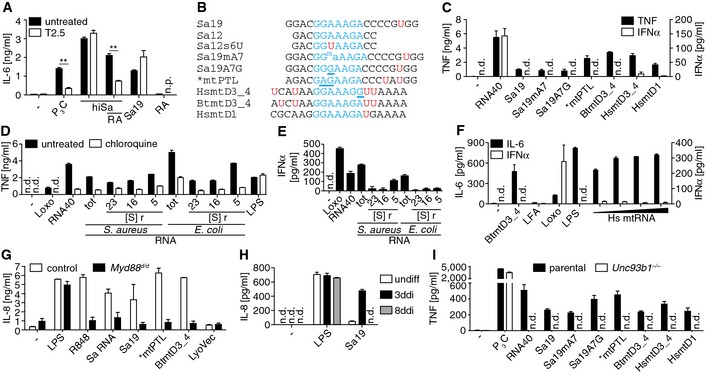
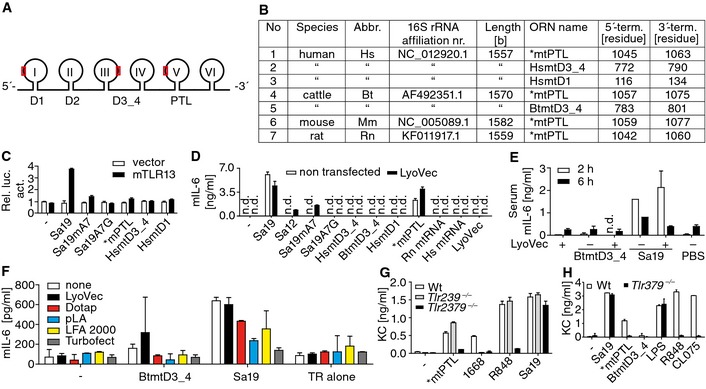
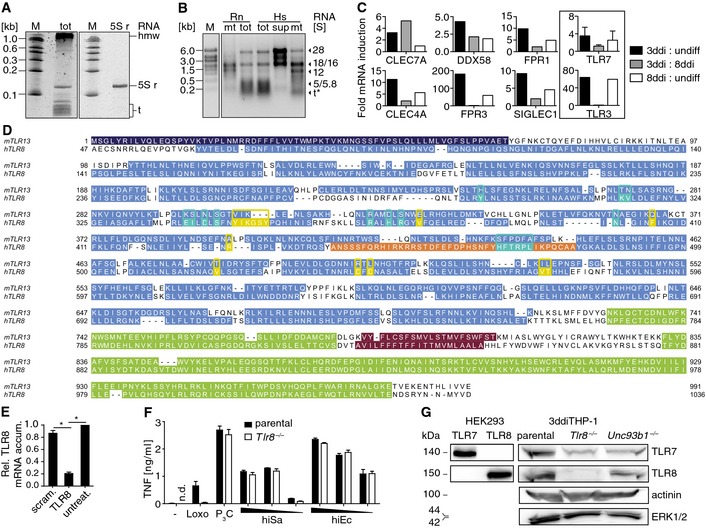
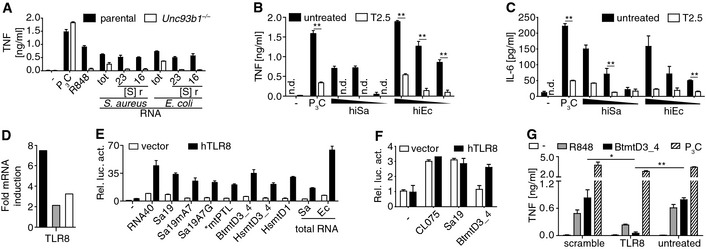
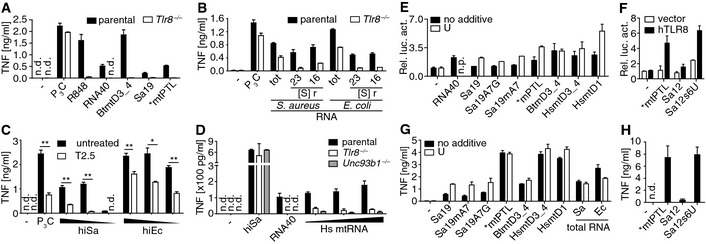
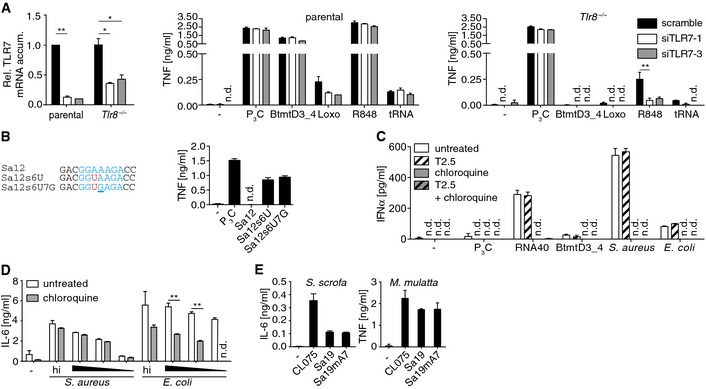
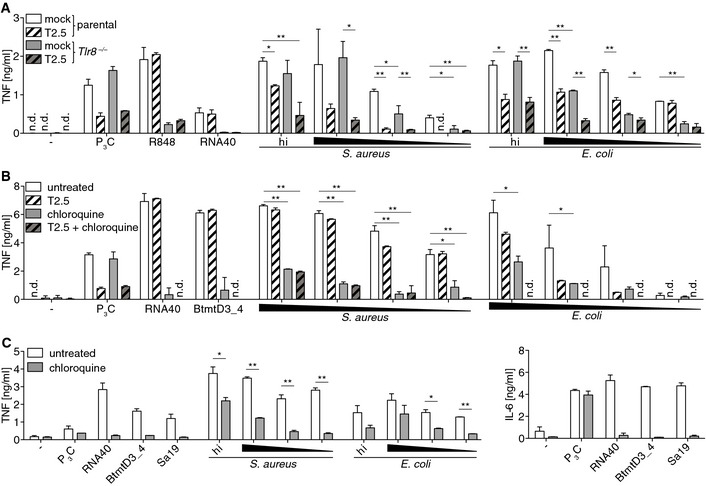
Toll-like receptor (TLR) 13 and TLR2 are the major sensors of Gram-positive bacteria in mice. TLR13 recognizes Sa19, a specific 23S ribosomal (r) RNA-derived fragment and bacterial modification of Sa19 ablates binding to TLR13, and to antibiotics such as erythromycin. Similarly, RNase A-treated Staphylococcus aureus activate human peripheral blood mononuclear cells (PBMCs) only via TLR2, implying single-stranded (ss) RNA as major stimulant. Here, we identify human TLR8 as functional TLR13 equivalent that promiscuously senses ssRNA. Accordingly, Sa19 and mitochondrial (mt) 16S rRNA sequence-derived oligoribonucleotides (ORNs) stimulate PBMCs in a MyD88-dependent manner. These ORNs, as well as S. aureus-, Escherichia coli-, and mt-RNA, also activate differentiated human monocytoid THP-1 cells, provided they express TLR8. Moreover, Unc93b1(-/-)- and Tlr8(-/-)-THP-1 cells are refractory, while endogenous and ectopically expressed TLR8 confers responsiveness in a UR/URR RNA ligand consensus motif-dependent manner. If TLR8 function is inhibited by suppression of lysosomal function, antibiotic treatment efficiently blocks bacteria-driven inflammatory responses in infected human whole blood cultures. Sepsis therapy might thus benefit from interfering with TLR8 function.
Toll样受体(TLR)13和TLR2是小鼠体内革兰氏阳性菌的主要感受器。TLR13识别Sa19,一种特定的23S核糖体(r)RNA衍生片段,而Sa19的细菌修饰会消除其与TLR13以及红霉素等抗生素的结合。同样,经核糖核酸酶A处理的金黄色葡萄球菌仅通过TLR2激活人外周血单核细胞(PBMC),这意味着单链(ss)RNA是主要刺激物。在此,我们确定人TLR8是功能性等同于TLR13的受体,可广泛感知ssRNA。因此,Sa19和线粒体(mt)16S rRNA序列衍生的寡核糖核苷酸(ORN)以依赖MyD88的方式刺激PBMC。这些ORN以及金黄色葡萄球菌、大肠杆菌和线粒体RNA,只要表达TLR8,也能激活分化的人单核细胞样THP-1细胞。此外,Unc93b1(-/-)和Tlr8(-/-)的THP-1细胞无反应,而内源性和异位表达的TLR8以依赖UR/URR RNA配体共有基序的方式赋予细胞反应性。如果通过抑制溶酶体功能来抑制TLR8功能,抗生素治疗可有效阻断感染的人全血培养物中细菌驱动的炎症反应。因此,脓毒症治疗可能受益于干扰TLR8功能。