Dept. of Infectious Diseases, Medical Microbiology and Hygiene, Medical Faculty, Heidelberg University, Heidelberg, Germany.
University Hospital Heidelberg, Heidelberg, Germany.
EMBO Rep. 2024 Nov;25(11):4674-4692. doi: 10.1038/s44319-024-00281-9. Epub 2024 Oct 3.
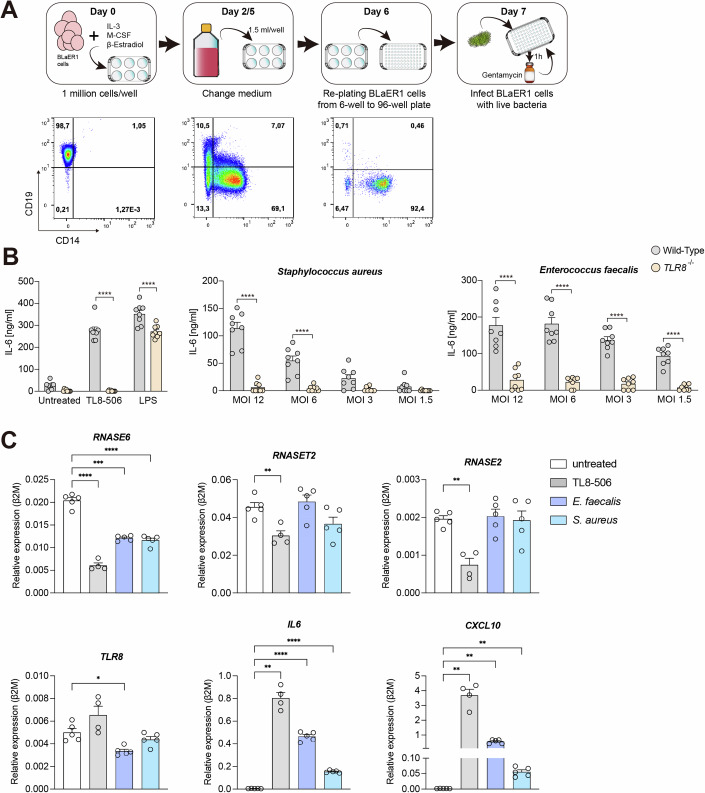
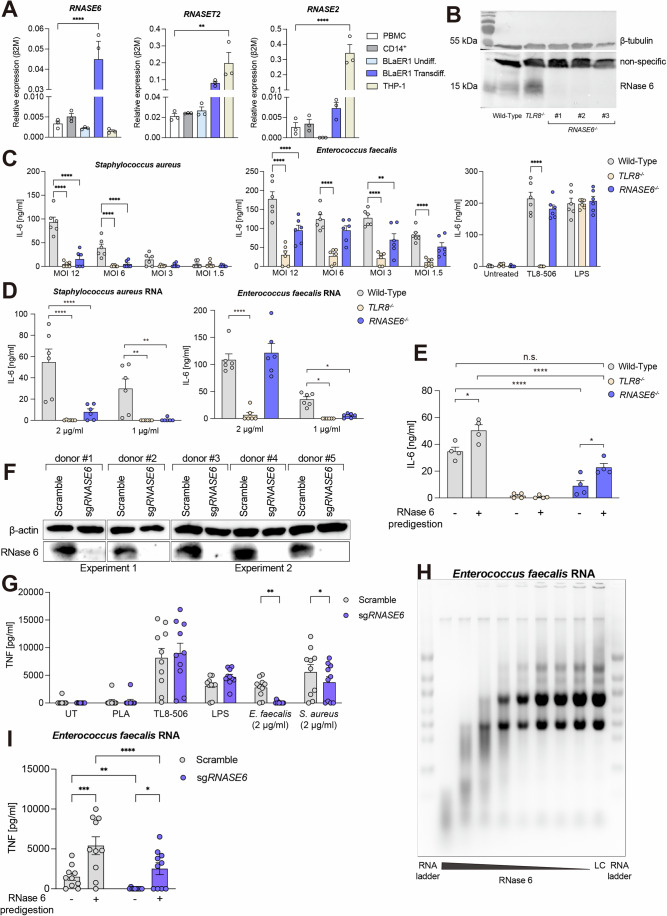
TLR8 senses single-stranded RNA (ssRNA) fragments, processed via cleavage by ribonuclease (RNase) T2 and RNase A family members. Processing by these RNases releases uridines and purine-terminated residues resulting in TLR8 activation. Monocytes show high expression of RNase 6, yet this RNase has not been analyzed for its physiological contribution to the recognition of bacterial RNA by TLR8. Here, we show a role for RNase 6 in TLR8 activation. BLaER1 cells, transdifferentiated into monocyte-like cells, as well as primary monocytes deficient for RNASE6 show a dampened TLR8-dependent response upon stimulation with isolated bacterial RNA (bRNA) and also upon infection with live bacteria. Pretreatment of bacterial RNA with recombinant RNase 6 generates fragments that induce TLR8 stimulation in RNase 6 knockout cells. 2'O-RNA methyl modification, when introduced at the first uridine in the UA dinucleotide, impairs processing by RNase 6 and dampens TLR8 stimulation. In summary, our data show that RNase 6 processes bacterial RNA and generates uridine-terminated breakdown products that activate TLR8.
TLR8 识别单链 RNA(ssRNA)片段,这些片段通过核糖核酸酶(RNase)T2 和 RNase A 家族成员的切割进行加工。这些 RNases 的切割会释放出尿嘧啶和嘌呤末端残基,从而激活 TLR8。单核细胞高表达 RNase 6,但尚未对其在 TLR8 识别细菌 RNA 中的生理作用进行分析。在这里,我们展示了 RNase 6 在 TLR8 激活中的作用。BLaER1 细胞,转分化为单核细胞样细胞,以及缺乏 RNASE6 的原代单核细胞,在受到分离的细菌 RNA(bRNA)刺激以及活细菌感染时,TLR8 依赖性反应减弱。用重组 RNase 6 预处理细菌 RNA 会产生片段,这些片段在 RNase 6 敲除细胞中诱导 TLR8 刺激。2'O-RNA 甲基化修饰,当引入 UA 二核苷酸中的第一个尿嘧啶时,会干扰 RNase 6 的切割,并抑制 TLR8 的刺激。总之,我们的数据表明,RNase 6 处理细菌 RNA 并产生尿嘧啶末端的降解产物,从而激活 TLR8。