Joseph Roody, Pan Xueliang, Cenkus Kathleen, Brown Lindsey, Ellis Thomas, Di Stasi Stephanie
Orthopedic Physical Therapy Residency Program, OSU Sports Medicine, The Ohio State University Wexner Medical Center, Columbus, Ohio, USA Outpatient Rehabilitation Center, Memorial Hospital Miramar, Miramar, Florida, USA.
Center for Biostatistics, The Ohio State University, Columbus, Ohio, USA.
Am J Sports Med. 2016 Jan;44(1):54-9. doi: 10.1177/0363546515610535. Epub 2015 Nov 6.
Femoroacetabular impingement (FAI) is a significant cause of disability in young adults. Hip arthroscopic surgery restores bony congruence and improves function in the majority of patients, but recent evidence indicates that women may experience worse pre- and postoperative function than men.
PURPOSE/HYPOTHESIS: The purpose of this study was to identify whether self-reported hip function differed between men and women with symptomatic FAI. The hypothesis was that mean self-reported hip function scores would improve after arthroscopic surgery but that women would report poorer function than men both before and up to 2 years after arthroscopic surgery.
Cohort study; Level of evidence, 2.
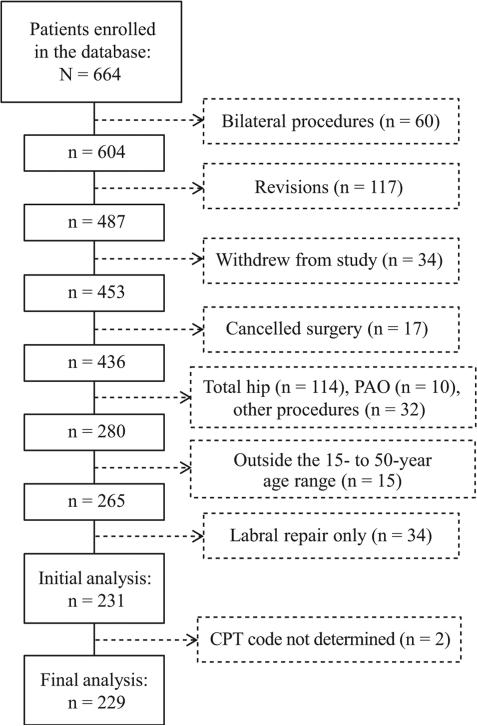
A total of 229 patients (68.4% women; mean [±SD] age, 31.6 ± 10.8 years; mean [±SD] body mass index, 26.8 ± 11.9 kg/m(2)) underwent hip arthroscopic surgery for unilateral symptomatic FAI. All eligible and consenting patients with radiologically and clinically confirmed FAI completed the International Hip Outcome Tool (iHOT-33) and the Hip Outcome Score activities of daily living subscale (HOS-ADL) before hip arthroscopic surgery and at 3, 6, 12, and 24 months after arthroscopic surgery. A linear mixed model for repeated measures was used to test for differences in self-reported hip function between men and women over the study period (P ≤ .05).
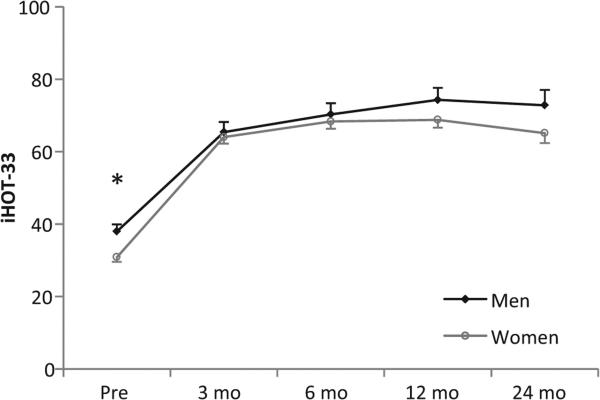
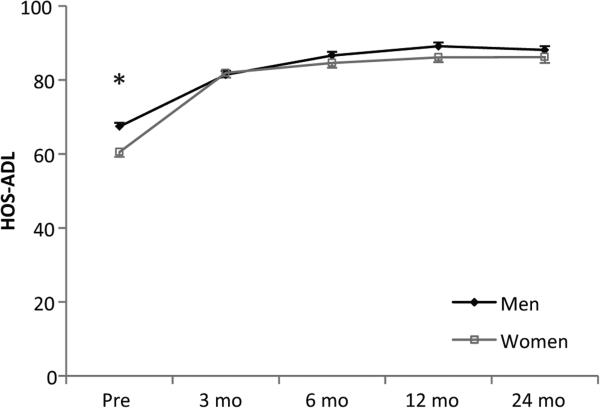
There were no significant time × sex interactions for either the HOS-ADL (P = .12) or iHOT-33 (P = .64), but both measures showed significant improvements between the preoperative time point and each of the 4 follow-up points (P < .0001); however, self-reported hip function did not improve between 6 and 24 months after arthroscopic surgery (P ≥ .11). Post hoc independent t tests indicated that women reported poorer hip function than did men before surgery (P ≤ .003) both on the HOS-ADL (mean ± standard error of the mean [SEM], 67.4 ± 1.9 [men] vs 60.5 ± 1.3 [women]) and iHOT-33 (mean ± SEM, 38.0 ± 1.9 [men] vs 30.9 ± 1.3 [women]); scores were not different between sexes at any other time point.
These findings indicate improvements in self-reported hip function in patients with FAI, regardless of sex, until 6 months after hip arthroscopic surgery. Although women reported poorer preoperative function than did men, the differences were not significant 2 years after surgery.
股骨髋臼撞击症(FAI)是导致年轻成年人残疾的一个重要原因。髋关节镜手术可恢复骨的一致性,并改善大多数患者的功能,但最近有证据表明,女性在术前和术后的功能可能比男性更差。
目的/假设:本研究的目的是确定有症状的FAI患者中,男性和女性自我报告的髋关节功能是否存在差异。假设是,关节镜手术后自我报告的髋关节功能平均得分会有所改善,但女性在关节镜手术前及术后2年内报告的功能比男性差。
队列研究;证据等级,2级。
共有229例患者(68.4%为女性;平均[±标准差]年龄为31.6±10.8岁;平均[±标准差]体重指数为26.8±11.9kg/m²)因单侧有症状的FAI接受了髋关节镜手术。所有符合条件并同意参与的经放射学和临床确诊为FAI的患者,在髋关节镜手术前以及术后3、6、12和24个月完成了国际髋关节结果工具(iHOT-33)和髋关节结果评分日常生活活动子量表(HOS-ADL)。使用重复测量的线性混合模型来检验研究期间男性和女性自我报告的髋关节功能差异(P≤0.05)。
HOS-ADL(P = 0.12)或iHOT-33(P = 0.64)均未出现显著的时间×性别交互作用,但这两项指标在术前时间点与4个随访点中的每一个之间均显示出显著改善(P < 0.0001);然而,关节镜手术后6至24个月自我报告的髋关节功能并未改善(P≥0.11)。事后独立t检验表明,在手术前,女性在HOS-ADL(平均±平均标准误[SEM],男性为67.4±1.9,女性为60.5±1.3)以及iHOT-33(平均±SEM,男性为38.0±1.9,女性为30.9±1.3)上报告的髋关节功能比男性差(P≤0.003);在其他任何时间点,两性得分均无差异。
这些发现表明,FAI患者自我报告的髋关节功能在髋关节镜手术后6个月内均有改善,无论性别如何。尽管女性术前报告的功能比男性差,但术后2年差异并不显著。