Cao Qifeng, Wang Ning, Qi Juan, Gu Zhengqin, Shen Haibo
Department of Urology, Xinhua Hospital, Shanghai Jiao Tong University School of Medicine, Shanghai 200092, P.R. China.
Mol Med Rep. 2016 Jan;13(1):27-34. doi: 10.3892/mmr.2015.4503. Epub 2015 Nov 5.
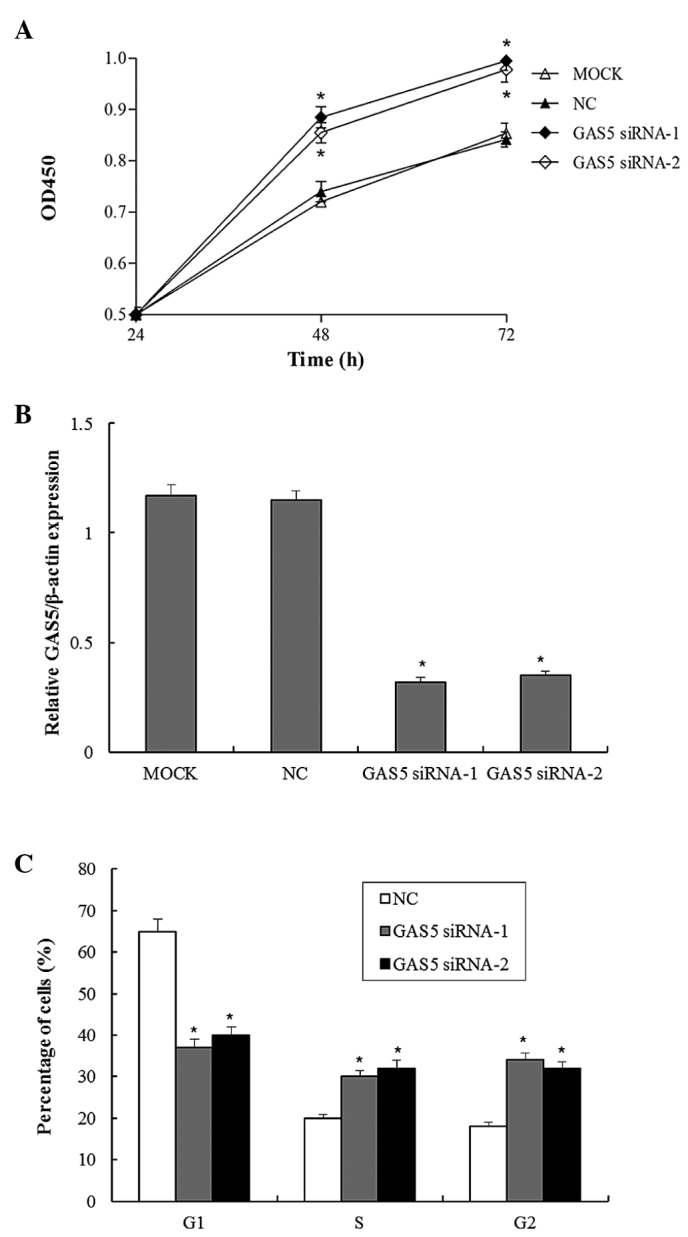
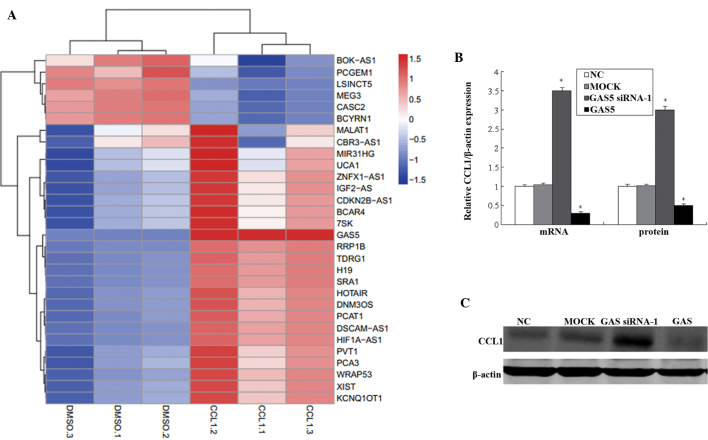
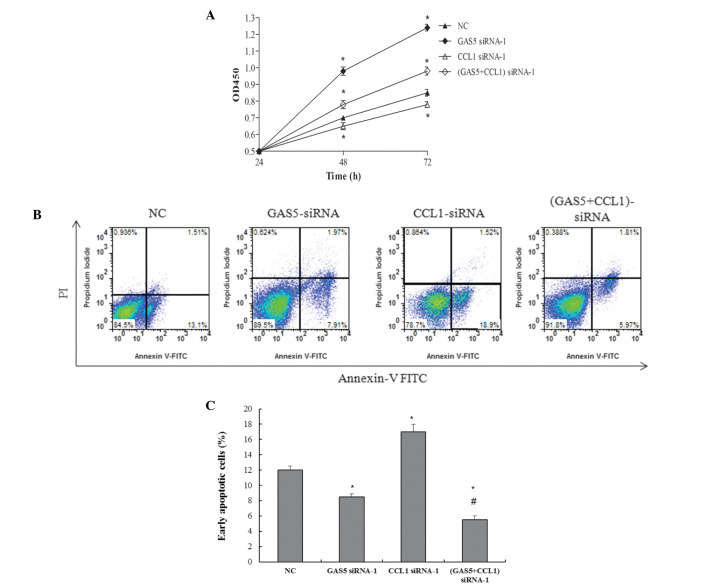
Long non‑coding RNAs (lncRNAs) have important roles in diverse biological processes, including transcriptional regulation, cell growth and tumorigenesis. The present study aimed to investigate whether lncRNA‑growth arrest‑specific (GAS)5 regulated bladder cancer progression via regulation of chemokine (C‑C) ligand (CCL)1 expression. The viability of BLX bladder cancer cells was detected using a Cell Counting kit‑8 assay, and cell apoptosis was assessed by annexin V‑propidium iodide double‑staining. The expression levels of specific genes and proteins were analyzed by reverse transcription‑quantitative polymerase chain reaction and western blotting, respectively. In addition, cells were transfected with small interfering (si)RNAs or recombinant GAS5 in order to silence or overexpress GAS5, respectively. The results of the present study demonstrated that knockdown of GAS5 expression promoted bladder cancer cell proliferation, whereas overexpression of GAS5 suppressed cell proliferation. Furthermore, knockdown of GAS5 resulted in an increased percentage of cells in S and G2 phase, and a decreased percentage of cells in G1 phase. In addition, the present study performed a hierarchical cluster analysis of differentially expressed lncRNAs in bladder cancer cells and detected that CCL1 overexpression resulted in an upregulation of GAS5, which may improve the ability of cells to regulate a stress response in vitro. Furthermore, knockdown of GAS5 expression increased the mRNA and protein expression of CCL1 in bladder cancer cells. Gain‑of‑function and loss‑of‑function studies demonstrated that GAS5 was able to inhibit bladder cancer cell proliferation, at least in part, by suppressing the expression of CCL1. The results of the present study demonstrated that GAS5 was able to suppress bladder cancer cell proliferation, at least partially, by suppressing the expression of CCL1. The results of the present study may provide a basis for developing novel effective treatment strategies against bladder cancer.
长链非编码RNA(lncRNAs)在多种生物学过程中发挥重要作用,包括转录调控、细胞生长和肿瘤发生。本研究旨在探讨lncRNA生长停滞特异性(GAS)5是否通过调节趋化因子(C-C)配体(CCL)1的表达来调控膀胱癌进展。使用细胞计数试剂盒-8检测BLX膀胱癌细胞的活力,并通过膜联蛋白V-碘化丙啶双染法评估细胞凋亡。分别通过逆转录-定量聚合酶链反应和蛋白质印迹法分析特定基因和蛋白质的表达水平。此外,为了分别沉默或过表达GAS5,用小干扰(si)RNA或重组GAS5转染细胞。本研究结果表明,敲低GAS5表达可促进膀胱癌细胞增殖,而过表达GAS5则抑制细胞增殖。此外,敲低GAS5导致S期和G2期细胞百分比增加,G1期细胞百分比降低。此外,本研究对膀胱癌细胞中差异表达的lncRNAs进行了层次聚类分析,并检测到CCL1过表达导致GAS5上调,这可能提高细胞在体外调节应激反应的能力。此外,敲低GAS5表达可增加膀胱癌细胞中CCL1的mRNA和蛋白质表达。功能获得和功能丧失研究表明,GAS5能够至少部分地通过抑制CCL1的表达来抑制膀胱癌细胞增殖。本研究结果表明,GAS5能够至少部分地通过抑制CCL1的表达来抑制膀胱癌细胞增殖。本研究结果可能为开发针对膀胱癌的新型有效治疗策略提供依据。