Karolinska Institutet, Stockholm, Sweden.
University of Louisville School of Dentistry, Louisville, Kentucky.
Arthritis Rheumatol. 2016 Mar;68(3):604-13. doi: 10.1002/art.39491.
To investigate the role of the periodontal pathogen Porphyromonas gingivalis in the etiology of rheumatoid arthritis (RA) by analyzing the antibody response to the P gingivalis virulence factor arginine gingipain type B (RgpB) in relation to anti-citrullinated protein antibodies (ACPAs), smoking, and HLA-DRB1 shared epitope (SE) alleles in patients with periodontitis, patients with RA, and controls.
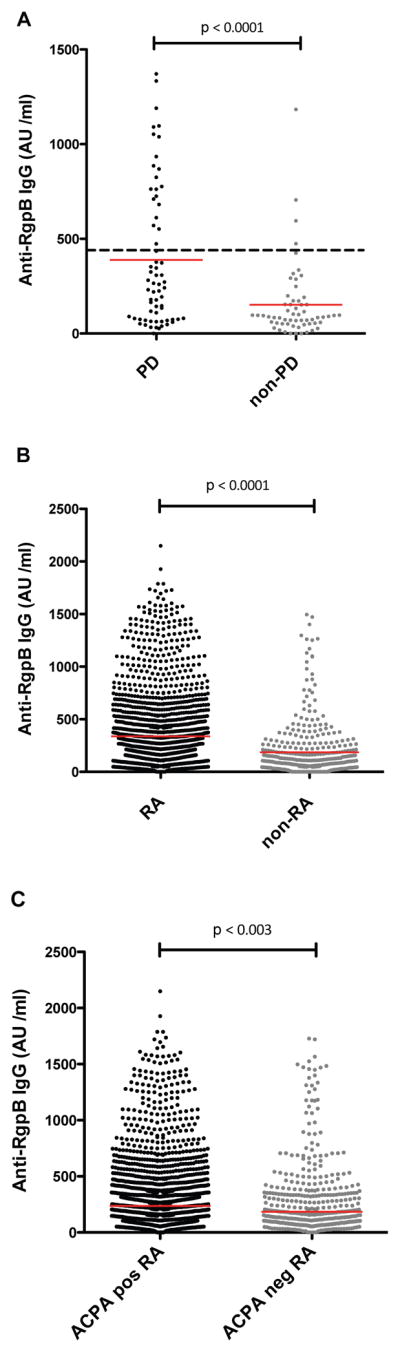
Anti-RgpB IgG was measured by enzyme-linked immunosorbent assay in 65 periodontitis patients and 59 controls without periodontitis, and in 1,974 RA patients and 377 controls without RA from the Swedish population-based case-control Epidemiological Investigation of Rheumatoid Arthritis (EIRA) study. Autoantibody status, smoking habits, and genetic data were retrieved from the EIRA database. Differences in antibody levels were examined using the Mann-Whitney U test. Unconditional logistic regression was used to calculate odds ratios (ORs) with 95% confidence intervals (95% CIs) for the association of anti-RgpB IgG with different subsets of RA patients.
Anti-RgpB antibody levels were significantly elevated in periodontitis patients compared to controls without periodontitis, in RA patients compared to controls without RA, and in ACPA-positive RA patients compared to ACPA-negative RA patients. There was a significant association between anti-RgpB IgG and RA (OR 2.96 [95% CI 2.00, 4.37]), which was even stronger than the association between smoking and RA (OR 1.37 [95% CI 1.07, 1.74]), and in ACPA-positive RA there were interactions between anti-RgpB antibodies and both smoking and the HLA-DRB1 SE.
Our study suggests that the previously reported link between periodontitis and RA could be accounted for by P gingivalis infection, and we conclude that P gingivalis is a credible candidate for triggering and/or driving autoimmunity and autoimmune disease in a subset of RA patients.
通过分析牙周病原体牙龈卟啉单胞菌(P. gingivalis)毒力因子精氨酸牙龈蛋白酶 B(RgpB)的抗体反应与抗瓜氨酸蛋白抗体(ACPAs)、吸烟和 HLA-DRB1 共享表位(SE)等位基因之间的关系,探讨牙周炎患者、类风湿关节炎(RA)患者和对照者中 P. gingivalis 在 RA 发病机制中的作用。
采用酶联免疫吸附试验(ELISA)检测 65 例牙周炎患者和 59 例无牙周炎对照者、1974 例 RA 患者和 377 例无 RA 的瑞典人群为基础的类风湿关节炎流行病学调查(EIRA)研究对照者的抗 RgpB IgG。从 EIRA 数据库中检索自身抗体状态、吸烟习惯和遗传数据。采用 Mann-Whitney U 检验比较抗体水平的差异。采用非条件逻辑回归计算抗 RgpB IgG 与不同亚组 RA 患者的关联的比值比(OR)及其 95%置信区间(95%CI)。
与无牙周炎对照者相比,牙周炎患者、RA 患者和 ACPA 阳性 RA 患者的抗 RgpB 抗体水平显著升高。抗 RgpB IgG 与 RA 显著相关(OR 2.96 [95%CI 2.00,4.37]),这与吸烟和 RA 的相关性(OR 1.37 [95%CI 1.07,1.74])甚至更强,在 ACPA 阳性 RA 中,抗 RgpB 抗体与吸烟和 HLA-DRB1 SE 之间存在交互作用。
我们的研究表明,先前报道的牙周炎与 RA 之间的联系可能归因于 P. gingivalis 感染,我们得出结论,P. gingivalis 是引发和/或驱动 RA 患者亚群自身免疫和自身免疫性疾病的一个可信候选者。