Kindstedt Elin, de Vries Charlotte, Wänman Magnus, Potempa Barbara Aleksandra, Potempa Jan, Lindquist Susanne, Esberg Anders, Lundberg Karin, Lundberg Pernilla
Department of Odontology, Section for Molecular Periodontology, Umeå University, Umeå, Sweden.
Wallenberg Centre for Molecular Medicine, Umeå University, Umeå, Sweden.
Front Immunol. 2025 Jan 14;15:1504975. doi: 10.3389/fimmu.2024.1504975. eCollection 2024.
Periodontitis is associated with rheumatoid arthritis (RA). One hypothesis posits that this connection arises from the formation of autoantibodies against citrullinated proteins (ACPA) in inflamed gums, possibly triggered by . We previously demonstrated an increased antibody response to arginine gingipains (anti-Rgp IgG), not only in individuals with severe periodontitis compared to controls, but in RA versus controls, with an association to ACPA. In the present study, we set out to further explore the relationship between anti-Rgp IgG, ACPA and periodontitis, including clinical periodontal parameters, in the large and well-characterized PerioGene North case-control study.
We measured serum levels of anti-Rgp and ACPA IgG by enzyme-linked immunosorbent assay (ELISA), in 478 patients with periodontitis and 509 periodontally healthy controls within PerioGene North. Subsequently, anti-Rgp IgG levels and ACPA status were analysed in relation to periodontitis and clinical periodontal parameters.
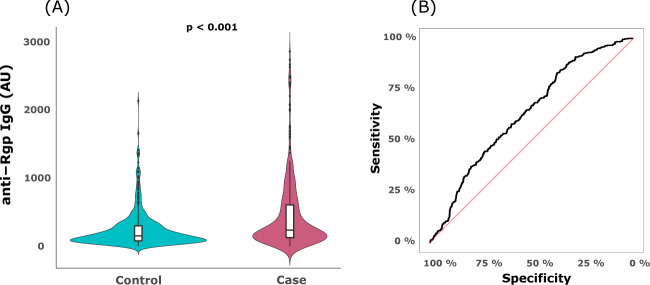
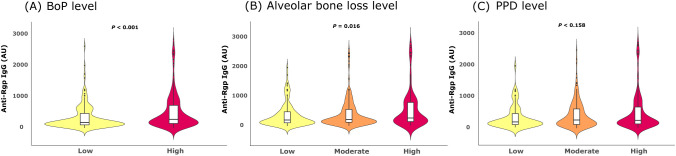
Serum anti-Rgp IgG levels were elevated in cases versus controls (p< 0.001). However, receiver operating characteristic (ROC) curve analysis revealed that anti-Rgp IgG could not efficiently discriminate cases from controls (AUC= 0.63; 95% CI: 0.60 - 0.66). Among cases, increased anti-Rgp IgG levels associated with high periodontal inflammation and advanced alveolar bone loss (p<0.001 for both). An ACPA response was detected in 15 (3.1%) cases and 6 (1.2%) controls (p=0.033), but no association to periodontitis was evident after adjustment for age and smoking and anti-Rgp IgG levels did not differ between ACPA-positive and ACPA-negative individuals.
We show that anti-Rgp IgG identifies a subgroup of periodontitis patients with high degree of periodontal inflammation and advanced alveolar bone loss, but we do not find support for a link between periodontitis or anti-Rgp IgG and ACPA status in PerioGene North. Given the association between anti-Rgp and alveolar bone loss, the mechanistic role of gingipains in bone resorption should be experimentally explored.
牙周炎与类风湿关节炎(RA)相关。一种假说认为,这种关联源于牙龈炎症中针对瓜氨酸化蛋白的自身抗体(ACPA)的形成,可能由……触发。我们之前证明,不仅与对照组相比,重度牙周炎患者对精氨酸牙龈蛋白酶的抗体反应(抗Rgp IgG)增加,而且RA患者与对照组相比也增加,且与ACPA相关。在本研究中,我们在规模大且特征明确的PerioGene North病例对照研究中,进一步探讨抗Rgp IgG、ACPA与牙周炎之间的关系,包括临床牙周参数。
我们通过酶联免疫吸附测定(ELISA)测量了PerioGene North中478例牙周炎患者和509例牙周健康对照者血清中抗Rgp和ACPA IgG的水平。随后,分析了抗Rgp IgG水平和ACPA状态与牙周炎及临床牙周参数的关系。
与对照组相比,病例组血清抗Rgp IgG水平升高(p<0.001)。然而,受试者工作特征(ROC)曲线分析显示,抗Rgp IgG不能有效区分病例组和对照组(曲线下面积[AUC]=0.63;95%置信区间:0.60 - 0.66)。在病例组中,抗Rgp IgG水平升高与高度牙周炎症和牙槽骨高度丧失相关(两者p均<0.001)。在15例(3.1%)病例和6例(1.2%)对照中检测到ACPA反应(p=0.033),但在调整年龄、吸烟因素后,未发现与牙周炎有明显关联,且ACPA阳性和阴性个体之间的抗Rgp IgG水平无差异。
我们表明,抗Rgp IgG可识别出一组牙周炎症程度高且牙槽骨高度丧失严重的牙周炎患者,但在PerioGene North研究中,我们未发现牙周炎或抗Rgp IgG与ACPA状态之间存在关联的证据。鉴于抗Rgp与牙槽骨丧失之间的关联,应通过实验探索牙龈蛋白酶在骨吸收中的机制作用。