Yen Ju-Chuan, Lin Hsiu-Li, Hsu Chia-An, Li Yu-Chuan Jack, Hsu Min-Huei
Graduate Institute of Biomedical Informatics, College of Medical Science and Technology, Taipei Medical University, Taipei, Taiwan ; Department of Ophthalmology, Taipei City Hospital, Zhongxiao Branch, Taipei 115, Taiwan.
Department of Neurology, Cathay General Hospital, Sijhih Branch, Taipei, Taiwan.
Biomed Res Int. 2015;2015:374616. doi: 10.1155/2015/374616. Epub 2015 Oct 19.
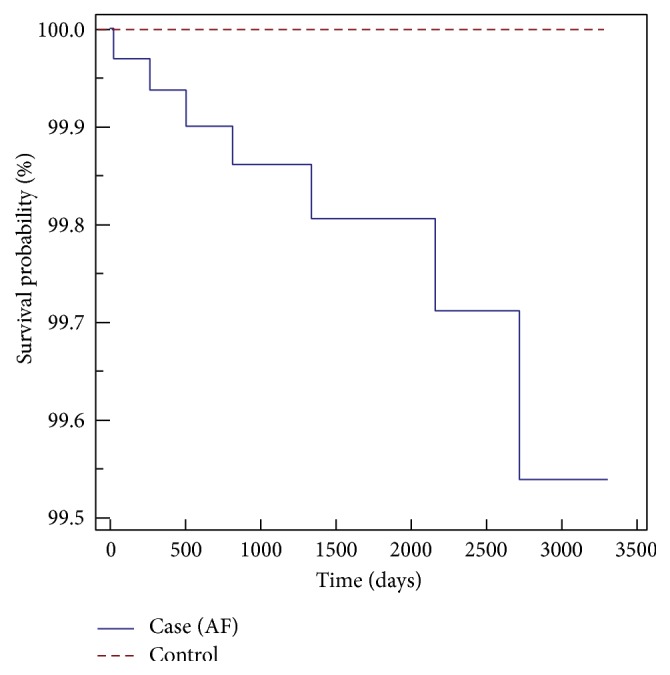
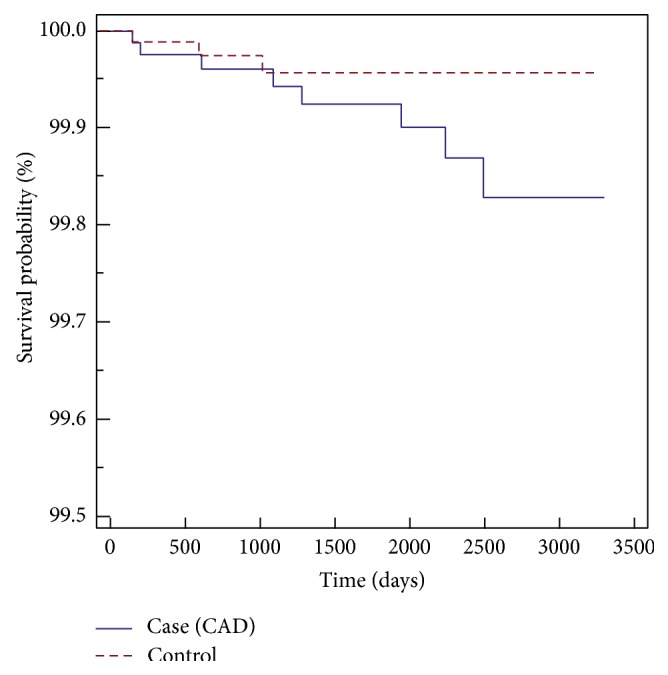
We use Taiwanese national health insurance research database (NHIRD) to investigate whether thrombolism (carotid artery disease (CAD) as a surrogate) or embolism (atrial fibrillation (AF) as a surrogate) plays roles in later retinal artery occlusion (RAO) development and examine their relative weights. The relative risks of RAO between AF and CAD patients and controls were compared by estimating the crude hazard ratio with logistic regression. Kaplan-Meier analysis was used to calculate the cumulative incidence rates of developing RAO, and a log-rank test was used to analyze the differences between the survival curves. Separate Cox proportional hazard regressions were done to compute the RAO-free rate after adjusting for possible confounding factors such as age and sex. The crude hazard ratios were 7.98 for the AF group and 5.27 for the CAD group, and the adjusted hazard ratios were 8.32 and 5.34 for the AF and CAD groups, respectively. The observation time with RAO-free was shorter for AF compared with CAD group (1490 versus 1819 days). AF and CAD were both risk factors for RAO with different hazard ratios. To tackle both AF and CAD is crucial for curbing RAO.
我们利用台湾全民健康保险研究数据库(NHIRD)来调查血栓形成(以颈动脉疾病(CAD)作为替代指标)或栓塞(以心房颤动(AF)作为替代指标)是否在随后的视网膜动脉阻塞(RAO)发展中起作用,并检验它们的相对权重。通过逻辑回归估计粗危险比,比较AF和CAD患者及对照组发生RAO的相对风险。采用Kaplan-Meier分析计算发生RAO的累积发病率,并用对数秩检验分析生存曲线之间的差异。进行单独的Cox比例风险回归,以计算在调整年龄和性别等可能的混杂因素后的无RAO发生率。AF组的粗危险比为7.98,CAD组为5.27,AF组和CAD组的调整后危险比分别为8.32和5.34。与CAD组相比,AF组无RAO的观察时间较短(1490天对1819天)。AF和CAD都是RAO的危险因素,危险比不同。同时应对AF和CAD对于控制RAO至关重要。