Christiansen Christine Benn, Torp-Pedersen Christian, Olesen Jonas Bjerring, Gislason Gunnar, Lamberts Morten, Carlson Nicholas, Buron Mathias, Juul Nikolai, Lip Gregory Y H
Aalborg University Hospital, Denmark, Søndre Skovvej 15, 9000, Aalborg, Denmark.
Department of Health Science and Technology, Aalborg University, Fredrik Bajers Vej 7D, 9220, Aalborg, Denmark.
BMC Cardiovasc Disord. 2018 May 10;18(1):91. doi: 10.1186/s12872-018-0825-1.
The inter-relationships of atrial fibrillation (AF) to retinal vascular occlusions (whether retinal artery occlusion (RAO) or retinal venous occlusion (RVO)) remain unclear. It is unknown if a presentation of retinal artery or venous occlusions may indicate a new onset cardiac arrhythmia. To shed light on this association, we investigated the risk of new onset AF in patients with known RAO and RVO.
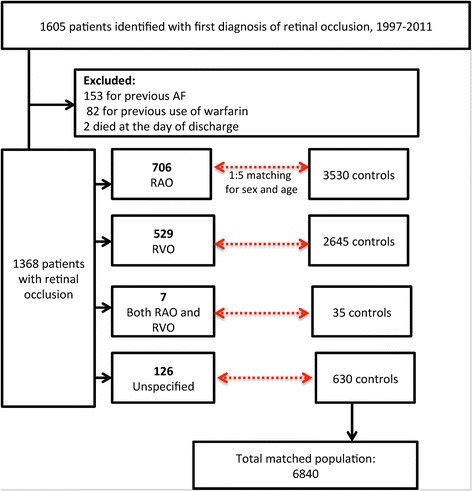
Patients with retinal occlusions from 1997 to 2011 were identified through Danish nationwide registries and matched 1:5 according to sex and age. Cumulative incidence and unadjusted rates of AF according to retinal vascular occlusions (i.e. RAO or RVO) were determined. Hazard ratios (HR) of AF according to retinal vascular occlusion were adjusted for hypertension, diabetes, vascular disease and prior stroke/systemic thromboembolism/transient ischemic attack.
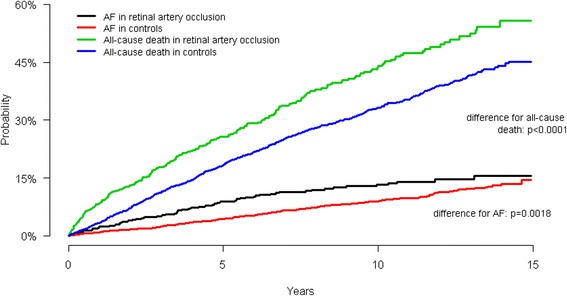
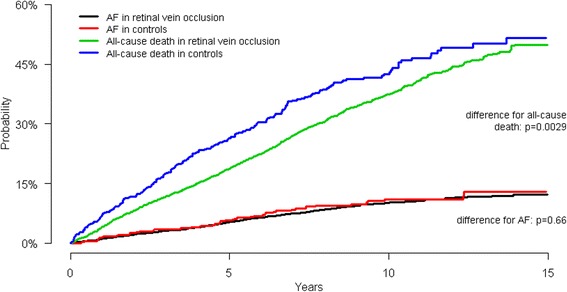
One thousand three hundred sixty-eight cases with retinal vascular occlusions were identified (median age 71.4 (inter quartile range (IQR); 61.2-79.8), 47.3% male). RAO constituted 706 cases (51.6%) and RVO 529 (38.7%). The rate of incident AF amongst all cases with retinal vascular occlusion was 1.74 per 100 person-years (95% confidence interval (CI), 1.47-2.06) compared to 1.22 (95% CI, 1.12-1.33) in the matched control group. The rate of AF in RAO was 2.01 (95% CI, 1.6-2.52) and 1.52 (1.15-2.01) in RVO. HRs of incident AF adjusted for cardiovascular comorbidities were 1.26 (95% CI; 1.04-1.53, p = 0.019) for any retinal vascular occlusion, 1.45 (95% CI; 1.10-1.89, p = 0.015) for RAO, and 1.02 (95% CI; 0.74-1.39, p = 0.920) for RVO.
A new diagnosis of retinal vascular occlusion in patients without prior AF was associated with increased risk of incident AF, particularly amongst patients with RAO. Awareness of AF in patients with retinal vascular occlusions is advised.
心房颤动(AF)与视网膜血管阻塞(无论是视网膜动脉阻塞(RAO)还是视网膜静脉阻塞(RVO))之间的相互关系仍不清楚。视网膜动脉或静脉阻塞的出现是否可能表明新发心律失常尚不清楚。为了阐明这种关联,我们调查了已知患有RAO和RVO的患者发生新发AF的风险。
通过丹麦全国性登记系统识别出1997年至2011年患有视网膜阻塞的患者,并根据性别和年龄以1:5的比例进行匹配。确定了根据视网膜血管阻塞(即RAO或RVO)的AF累积发病率和未调整率。根据视网膜血管阻塞情况调整了AF的风险比(HR),以考虑高血压、糖尿病、血管疾病和既往中风/全身性血栓栓塞/短暂性脑缺血发作。
共识别出1368例视网膜血管阻塞患者(中位年龄71.4岁(四分位间距(IQR);61.2 - 79.8),47.3%为男性)。RAO有706例(51.6%),RVO有529例(38.7%)。所有视网膜血管阻塞患者中AF的发病率为每100人年1.74例(95%置信区间(CI),1.47 - 2.06),而匹配对照组为1.22例(95%CI,1.12 - 1.33)。RAO中AF的发病率为2.01例(95%CI,1.6 - 2.52),RVO中为1.52例(1.15 - 2.01)。经心血管合并症调整后的新发AF的HR,任何视网膜血管阻塞为1.26(95%CI;1.04 - 1.53,p = 0.019),RAO为1.45(95%CI;1.10 - 1.89,p = 0.015),RVO为1.02(95%CI;0.74 - 1.39,p =