Gillick Bernadette, Menk Jeremiah, Mueller Bryon, Meekins Gregg, Krach Linda E, Feyma Timothy, Rudser Kyle
University of Minnesota, 420 Delaware Street SE, MMC 388, Minneapolis, MN, 55455, USA.
Biostatistical Design and Analysis Center, University of Minnesota, Minneapolis, MN, 55455, USA.
BMC Pediatr. 2015 Nov 12;15:178. doi: 10.1186/s12887-015-0498-1.
Perinatal stroke occurs in more than 1 in 2,500 live births and resultant congenital hemiparesis necessitates investigation into interventions which may improve long-term function and decreased burden of care beyond current therapies ( http://www.cdc.gov/ncbddd/cp/data.html ). Constraint-Induced Movement Therapy (CIMT) is recognized as an effective hemiparesis rehabilitation intervention. Transcranial direct current stimulation as an adjunct treatment to CIMT may potentiate neuroplastic responses and improve motor function. The methodology of a clinical trial in children designed as a placebo-controlled, serial -session, non-invasive brain stimulation trial incorporating CIMT is described here. The primary hypotheses are 1) that no serious adverse events will occur in children receiving non-invasive brain stimulation and 2) that children in the stimulation intervention group will show significant improvements in hand motor function compared to children in the placebo stimulation control group.
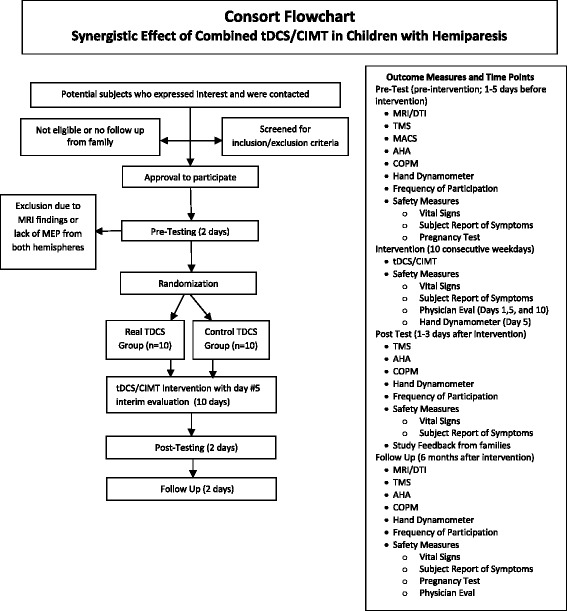
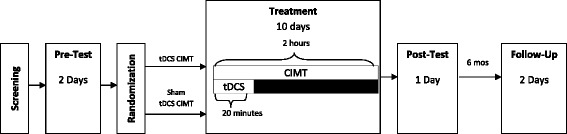
METHODS/DESIGN: A randomized, controlled, double-blinded clinical trial. Twenty children and/or young adults (ages 8-21) with congenital hemiparesis, will be enrolled. The intervention group will receive ten 2-hour sessions of transcranial direct current stimulation combined with constraint-induced movement therapy and the control group will receive sham stimulation with CIMT. The primary outcome measure is safety assessment of transcranial direct current stimulation by physician evaluation, vital sign monitoring and symptom reports. Additionally, hand function will be evaluated using the Assisting Hand Assessment, grip strength and assessment of goals using the Canadian Occupational Performance Measure. Neuroimaging will confirm diagnoses, corticospinal tract integrity and cortical activation. Motor cortical excitability will also be examined using transcranial magnetic stimulation techniques.
Combining non-invasive brain stimulation and CIMT interventions has the potential to improve motor function in children with congenital hemiparesis beyond each intervention independently. Such a combined intervention has the potential to benefit an individual throughout their lifetime.
Clinicaltrials.gov, NCT02250092 Registered 18 September 2014.
围产期卒中在每2500例活产中发生率超过1例,由此导致的先天性偏瘫需要对可能改善长期功能并减轻当前治疗之外护理负担的干预措施进行研究(http://www.cdc.gov/ncbddd/cp/data.html)。强制性运动疗法(CIMT)被认为是一种有效的偏瘫康复干预措施。经颅直流电刺激作为CIMT的辅助治疗可能增强神经可塑性反应并改善运动功能。本文描述了一项针对儿童的临床试验方法,该试验设计为纳入CIMT的安慰剂对照、多疗程、非侵入性脑刺激试验。主要假设为:1)接受非侵入性脑刺激的儿童不会发生严重不良事件;2)与安慰剂刺激对照组的儿童相比,刺激干预组的儿童手部运动功能将有显著改善。
方法/设计:一项随机、对照、双盲临床试验。将招募20名患有先天性偏瘫的儿童和/或年轻人(8 - 21岁)。干预组将接受十次每次2小时的经颅直流电刺激联合强制性运动疗法,对照组将接受CIMT假刺激。主要结局指标是通过医生评估、生命体征监测和症状报告对经颅直流电刺激进行安全性评估。此外,将使用辅助手评估、握力以及使用加拿大职业表现测量法评估目标来评估手部功能。神经影像学将确认诊断、皮质脊髓束完整性和皮质激活情况。还将使用经颅磁刺激技术检查运动皮质兴奋性。
将非侵入性脑刺激和CIMT干预相结合有可能独立于每种干预措施之外进一步改善先天性偏瘫儿童的运动功能。这种联合干预有可能使个体受益终生。
Clinicaltrials.gov,NCT02250092,于2014年9月18日注册。