University of Calgary, Calgary, AB, T2N 2T9, Canada.
Section of Neurology, Department of Pediatrics, Alberta Children's Hospital Research Institute, Calgary, AB, Canada.
J Neuroeng Rehabil. 2018 Aug 17;15(1):77. doi: 10.1186/s12984-018-0420-9.
Detailed kinematics of motor impairment of the contralesional ("affected") and ipsilesional ("unaffected") limbs in children with hemiparetic cerebral palsy are not well understood. We aimed to 1) quantify the kinematics of reaching in both arms of hemiparetic children with perinatal stroke using a robotic exoskeleton, and 2) assess the correlation of kinematic reaching parameters with clinical motor assessments.
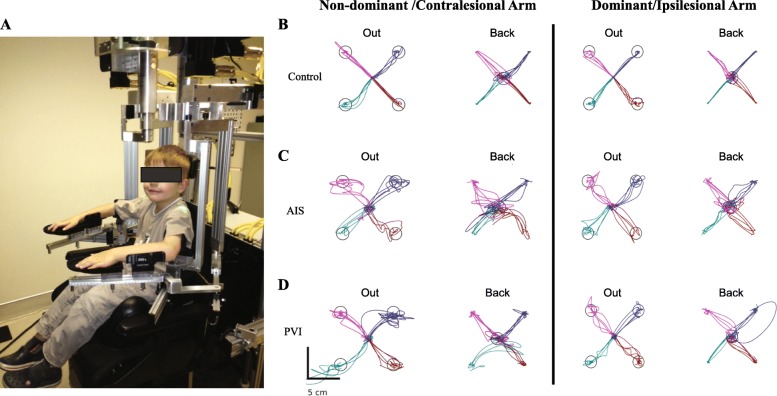
This prospective, case-control study involved the Alberta Perinatal Stroke Project, a population-based research cohort, and the Foothills Medical Center Stroke Robotics Laboratory in Calgary, Alberta over a four year period. Prospective cases were collected through the Calgary Stroke Program and included term-born children with magnetic resonance imaging confirmed perinatal ischemic stroke and upper extremity deficits. Control participants were recruited from the community. Participants completed a visually guided reaching task in the KINARM robot with each arm separately, with 10 parameters quantifying motor function. Kinematic measures were compared to clinical assessments and stroke type.
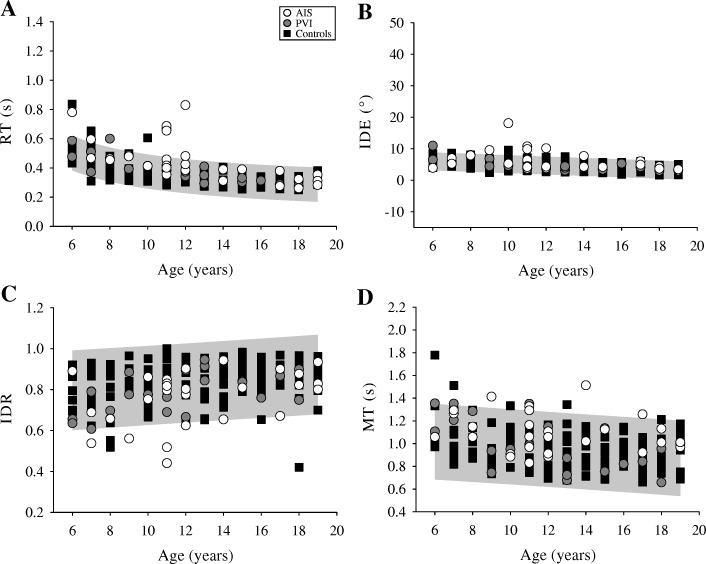
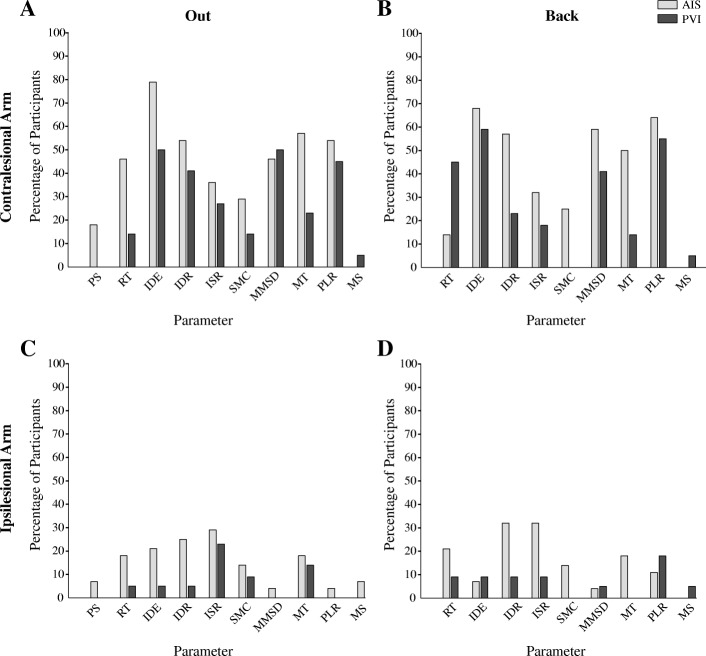
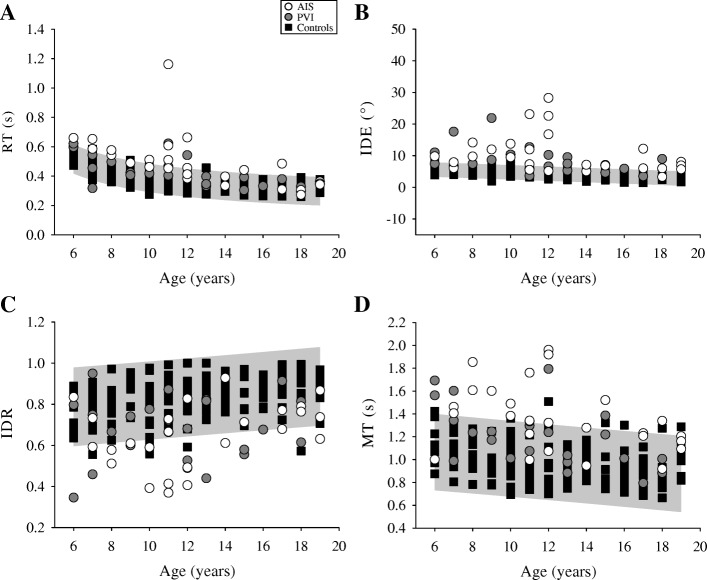
Fifty children with perinatal ischemic stroke (28 arterial, mean age: 12.5 ± 3.9 years; 22 venous, mean age: 11.5 ± 3.8 years) and upper extremity deficits were compared to healthy controls (n = 147, mean age: 12.7 ± 3.9 years). Perinatal stroke groups demonstrated contralesional motor impairments compared to controls when reaching out (arterial = 10/10, venous = 8/10), and back (arterial = 10/10, venous = 6/10) with largest errors in reaction time, initial direction error, movement length and time. Ipsilesional impairments were also found when reaching out (arterial = 7/10, venous = 1/10) and back (arterial = 6/10). The arterial group performed worse than venous on both contralesional and ipsilesional parameters. Contralesional reaching parameters showed modest correlations with clinical measures in the arterial group.
Robotic assessment of reaching behavior can quantify complex, upper limb dysfunction in children with perinatal ischemic stroke. The ipsilesional, "unaffected" limb is often abnormal and may be a target for therapeutic interventions in stroke-induced hemiparetic cerebral palsy.
患有偏瘫脑瘫的儿童对健侧(“受影响”)和患侧(“未受影响”)肢体运动障碍的详细运动学了解甚少。我们的目的是 1)使用机器人外骨骼量化围产期卒中偏瘫儿童双侧手臂的运动学,2)评估运动学伸展参数与临床运动评估的相关性。
本前瞻性病例对照研究涉及艾伯塔围产期卒中项目,这是一个基于人群的研究队列,以及艾伯塔卡尔加里的山麓医疗中心卒中机器人实验室,为期四年。前瞻性病例通过卡尔加里卒中计划收集,包括磁共振成像证实的围产期缺血性卒中且上肢有缺陷的足月出生的儿童。对照组参与者从社区招募。参与者在 KINARM 机器人中分别用每只手臂完成视觉引导的伸展任务,用 10 个参数来量化运动功能。运动学测量值与临床评估和卒中类型进行比较。
与健康对照组(n=147,平均年龄 12.7±3.9 岁)相比,50 名患有围产期缺血性卒中(28 例动脉性,平均年龄 12.5±3.9 岁;22 例静脉性,平均年龄 11.5±3.8 岁)和上肢缺陷的儿童表现出对侧运动障碍,当伸出手(动脉性=10/10,静脉性=8/10)和背部(动脉性=10/10,静脉性=6/10)时,反应时间、初始方向误差、运动长度和时间的最大误差。同侧手臂伸展时也发现了同侧运动障碍(动脉性=7/10,静脉性=1/10)和背部(动脉性=6/10)。动脉性组在对侧和同侧参数上的表现均不如静脉性组。对侧伸展参数与动脉性组的临床指标呈中度相关。
使用机器人评估伸手行为可以量化围产期缺血性卒中儿童复杂的上肢功能障碍。“未受影响”的同侧肢体通常是异常的,可能是卒中后偏瘫脑瘫的治疗靶点。