Smith Adrian D, Muhaari Allan D, Agwanda Carole, Kowuor Dickens, van der Elst Elise, Davies Alun, Graham Susan M, Jaffe Harold W, Sanders Eduard J
aNuffield Department of Population Health, University of Oxford, Oxford, UK bKenya Medical Research Institute-Wellcome Trust Research Programme, Kilifi, Kenya cDepartments of Medicine, Global Health and Epidemiology, University of Washington, Seattle, Washington, USA dCentre for Topical Medicine and Global Health, Nuffield Department of Medicine, University of Oxford, Oxford, UK eDepartment of Global Health, Academic Medical Centre, University of Amsterdam, Amsterdam, the Netherlands.
AIDS. 2015 Dec;29 Suppl 3(0 3):S201-10. doi: 10.1097/QAD.0000000000000889.
African men who have sex with men often sell sex to men, and MSM who sell sex (MSM-SW) often also have female partners. We compared sexual risk behaviour of MSM-SW who were sexually active with female partners (bisexual MSW) to MSM-SW with only male partners (exclusive MSW).
Descriptive behavioural study
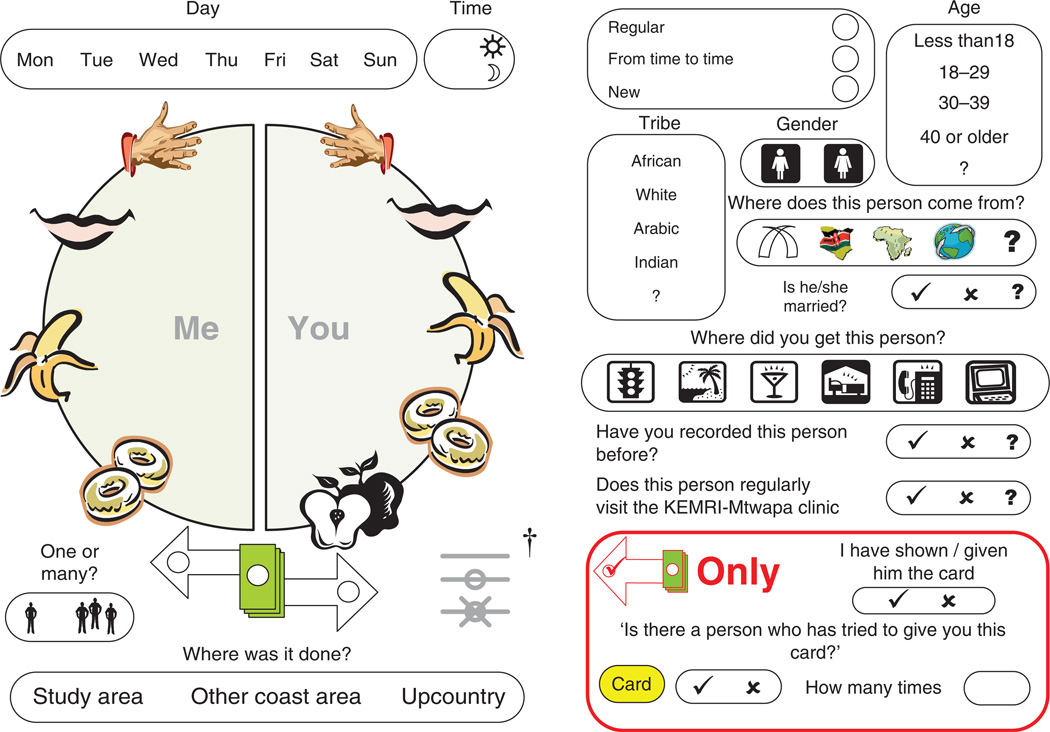
: A novel, validated daily event and partner diary self-completed by 82 MSM who sold sex over a follow-up period of 42 days with weekly review. Cumulative individual counts of sex and condomless sex were compiled by partner characteristics. The incidence of specific partnerships and sex acts were compared within and between bisexual and exclusive MSW.
Most (59%) MSM-SW reported female partners during follow-up. The majority of both male and female partners were cash-paying clients originating locally. Bisexual MSW reported a similar rate of condomless sex with male and female partners, but significantly fewer male partners than exclusive MSW. Bisexual MSW had lower HIV prevalence, were more likely to only report insertive anal sex roles, and reported lower frequencies of condomless receptive anal sex than exclusive MSW.
Bisexually active male sex workers in coastal Kenya create HIV and other sexually transmitted infection transmission pathways to partners and clients in both MSM and heterosexual networks, but differed from exclusive MSW in having lower HIV acquisition and transmission risks. Epidemiological projection methods are liable to overestimate bridging potential of MSM-SW and MSM populations without account for systematic differences in risk within these populations.
与男性发生性行为的非洲男性经常向男性卖淫,而从事性交易的男男性行为者(MSM-SW)通常也有女性伴侣。我们比较了与女性伴侣有性活动的MSM-SW(双性恋MSW)和只有男性伴侣的MSM-SW(排他性MSW)的性风险行为。
描述性行为研究
一项新颖的、经过验证的每日事件和伴侣日记,由82名从事性交易的男男性行为者在42天的随访期内自行填写,并每周进行回顾。按伴侣特征汇总性接触和无保护性行为的累计个体计数。比较双性恋MSW和排他性MSW内部及之间特定伴侣关系和性行为的发生率。
大多数(59%)MSM-SW在随访期间报告有女性伴侣。男性和女性伴侣大多是当地付费客户。双性恋MSW与男性和女性伴侣进行无保护性行为的比例相似,但男性伴侣数量明显少于排他性MSW。双性恋MSW的艾滋病毒感染率较低,更有可能只报告插入式肛交角色,且报告的无保护接受肛交频率低于排他性MSW。
肯尼亚沿海地区有双性性活动的男性性工作者在男男性行为者和异性恋网络中为伴侣和客户创造了艾滋病毒及其他性传播感染的传播途径,但与排他性MSW不同的是,他们感染和传播艾滋病毒的风险较低。流行病学预测方法在未考虑这些人群内部风险系统差异的情况下,容易高估MSM-SW和男男性行为者人群的桥梁潜力。