Lee Chang Hun, Lee Sun Hee, Lee Shinwon, Cho Heerim, Kim Kye-Hyung, Lee Jung Eun, Jung Eun Ju, Lee Su Jin, Kim Eun Jung, Kim Ki Hyung, Moon Eunsoo, Cho Hong Je
Department of Pathology, Pusan National University School of Medicine, Medical Research Institute, Pusan National University Hospital, Busan, Korea.
Department of Internal Medicine, Pusan National University School of Medicine, Medical Research Institute, Pusan National University Hospital, Busan, Korea.
PLoS One. 2016 Aug 22;11(8):e0161460. doi: 10.1371/journal.pone.0161460. eCollection 2016.
Little is known about the epidemiology on human papillomavirus (HPV) infection among HIV-infected men in Korea. The objective of this study was to determine the prevalence, genotype distribution and risk factors associated with anal HPV infection among HIV-infected men in Korea.
A single-center cross-sectional study was conducted with HIV-infected men in Korea. Participants completed a detailed sexual behavior risk factor questionnaire. Anal samples were collected for cytology and HPV genotyping. Factors associated with anal HPV infection were assessed using multivariable logistic regression, stratifying by sexual behaviour.
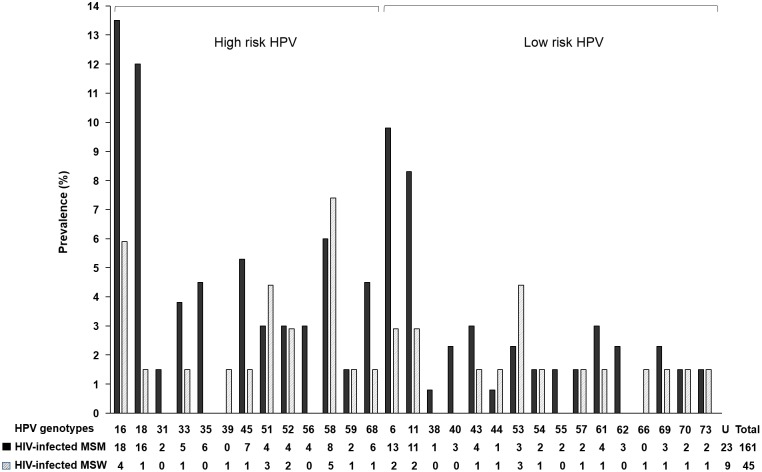
A total of 201 HIV-infected men were included in the study: 133 were from men who have sex with men (MSM) and 68 from men who have sex with women (MSW). Any anal HPV infection was detected in 82.7% of HIV-infected MSM and in 51.5% of HIV- infected MSW (P < 0.001). High-risk HPV (HR-HPV) prevalence was higher among MSM (47.4%) than MSW (25.0%; P = 0.002). The HR-HPV types identified most frequently were HPV 16 (11%), HPV 18 (9.9%), and HPV 58 (5%) in MSM, and HPV 58(11%) and HPV 16 (8.9%) in MSW. Prevalence of any HPV types in 9-valent vaccine types was higher among MSM than MSW (47.4% vs 22.1%. P = 0.001). Abnormal anal cytology was more commonly detected in MSM than MSW (42.9% vs.19.1%, P < 0.001). In HIV-infected MSM, higher number of lifetime male sex partners was significantly associated with any anal HPV infection, but age was a significant risk factor associated with anal HR-HPV infection.
Anal HPV infection was highly prevalent in HIV-infected MSM in Korea, and also commonly found in HIV-infected MSW. In HIV-infected MSM, the significant risk factor for being infected with any HPV infection was lifetime number of male sexual partners, and with anal oncogenic HPV infection was age.
韩国HIV感染男性中人类乳头瘤病毒(HPV)感染的流行病学情况鲜为人知。本研究的目的是确定韩国HIV感染男性中肛门HPV感染的患病率、基因型分布及相关危险因素。
在韩国对HIV感染男性进行了一项单中心横断面研究。参与者完成了一份详细的性行为危险因素调查问卷。采集肛门样本进行细胞学检查和HPV基因分型。采用多变量逻辑回归评估与肛门HPV感染相关的因素,并按性行为进行分层。
本研究共纳入201名HIV感染男性:133名来自男男性行为者(MSM),68名来自异性性行为男性(MSW)。82.7%的HIV感染MSM和51.5%的HIV感染MSW检测到任何肛门HPV感染(P<0.001)。MSM中高危HPV(HR-HPV)患病率(47.4%)高于MSW(25.0%;P=0.002)。在MSM中最常鉴定出的HR-HPV类型为HPV 16(11%)、HPV 18(9.9%)和HPV 58(5%),在MSW中为HPV 58(11%)和HPV 16(8.9%)。9价疫苗类型中任何HPV类型在MSM中的患病率高于MSW(47.4%对22.1%,P=0.001)。MSM中肛门细胞学异常的检出率高于MSW(42.9%对19.1%,P<0.001)。在HIV感染的MSM中,终身男性性伴侣数量较多与任何肛门HPV感染显著相关,但年龄是与肛门HR-HPV感染相关的显著危险因素。
韩国HIV感染的MSM中肛门HPV感染非常普遍,在HIV感染的MSW中也很常见。在HIV感染的MSM中,感染任何HPV感染的显著危险因素是终身男性性伴侣数量,而感染肛门致癌性HPV的显著危险因素是年龄。