Lagare Adamou, Maïnassara Halima Boubacar, Issaka Bassira, Sidiki Ali, Tempia Stefano
Centre de Recherche Médicale et Sanitaire (CERMES), 634 Bld de la Nation, BP:10887, YN034-, Niamey, Niger.
Influenza Division, Centers for Disease Control and Prevention, Georgia, Atlanta, USA.
BMC Infect Dis. 2015 Nov 14;15:515. doi: 10.1186/s12879-015-1251-y.
Globally, pneumonia is the leading cause of morbidity and mortality in children, with the highest burden experienced in sub-Saharan Africa and Asia. However, there is a dearth of information on the etiology of severe acute respiratory illness (SARI) in Africa, including Niger.
We implemented a retrospective study as part of national influenza sentinel surveillance in Niger. We randomly selected a sample of nasopharyngeal specimens collected from children <5 years of age hospitalized with SARI from January 2010 through December 2012 in Niger. The samples were selected from individuals that tested negative by real-time reverse transcription polymerase chain reaction (rRT-PCR) for influenza A and B virus. The samples were analyzed using the Fast Track Diagnostic Respiratory Pathogens 21plus Kit (BioMérieux, Luxemburg), which detects 23 respiratory pathogens including 18 viral and 5 bacterial agents.
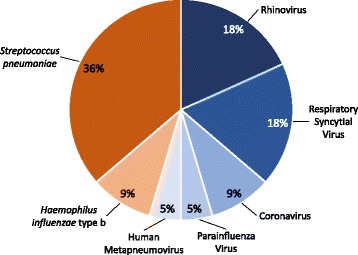
Among the 160 samples tested, 138 (86%) tested positive for at least one viral or bacterial pathogen; in 22 (16%) sample, only one pathogen was detected. We detected at least one respiratory virus in 126 (78%) samples and at least one bacterium in 102 (64%) samples. Respiratory syncytial virus (56/160; 35%), rhinovirus (47/160; 29%) and parainfluenza virus (39/160; 24%) were the most common viral pathogens detected. Among bacterial pathogens, Streptococcus pneumoniae (90/160; 56%) and Haemophilus influenzae type b (20/160; 12%) predominated.
The high prevalence of certain viral and bacterial pathogens among children <5 years of age with SARI highlights the need for continued and expanded surveillance in Niger.
在全球范围内,肺炎是儿童发病和死亡的主要原因,撒哈拉以南非洲和亚洲所承受的负担最为沉重。然而,关于非洲(包括尼日尔)严重急性呼吸道疾病(SARI)病因的信息匮乏。
作为尼日尔全国流感哨点监测的一部分,我们开展了一项回顾性研究。我们从2010年1月至2012年12月在尼日尔因SARI住院的5岁以下儿童中随机抽取了一份鼻咽标本样本。这些样本选自甲型和乙型流感病毒实时逆转录聚合酶链反应(rRT-PCR)检测呈阴性的个体。使用快速诊断呼吸道病原体21plus试剂盒(生物梅里埃公司,卢森堡)对样本进行分析,该试剂盒可检测23种呼吸道病原体,包括18种病毒和5种细菌病原体。
在检测的160份样本中,138份(86%)至少有一种病毒或细菌病原体检测呈阳性;在22份(16%)样本中,仅检测到一种病原体。我们在126份(78%)样本中检测到至少一种呼吸道病毒,在102份(64%)样本中检测到至少一种细菌。呼吸道合胞病毒(56/160;35%)、鼻病毒(47/160;29%)和副流感病毒(39/160;24%)是检测到的最常见病毒病原体。在细菌病原体中,肺炎链球菌(90/160;56%)和b型流感嗜血杆菌(20/160;12%)占主导地位。
5岁以下SARI儿童中某些病毒和细菌病原体的高流行率凸显了在尼日尔持续开展并扩大监测的必要性。