Weinblatt Michael E, Fleischmann Roy, van Vollenhoven Ronald F, Emery Paul, Huizinga Tom W J, Cutolo Maurizio, van der Heijde Désirée, Duncan Benjamin, Davies Owen, Luijtens Kristel, Dougados Maxime
Brigham and Women's Hospital, 75 Francis Street, Boston, MA, 02115, USA.
Department of Internal Medicine, University of Texas Southwestern Medical Center, 8144 Walnut Hill Lane, Dallas, TX, 75231, USA.
Arthritis Res Ther. 2015 Nov 15;17:325. doi: 10.1186/s13075-015-0841-9.
This 28-week, phase IIIb study assessed safety and maintenance of response to certolizumab pegol (CZP) in a diverse population of rheumatoid arthritis (RA) patients, stratified by prior anti-TNF exposure, concomitant methotrexate (MTX) use and disease duration. The ability to predict achievement of low disease activity (LDA) at week 28 from improvements in Disease Activity Score 28 (DAS28), erythrocyte sedimentation rate (ESR), swollen joint count (SJC) and Clinical Disease Activity Index (CDAI) up to week 12 was assessed.
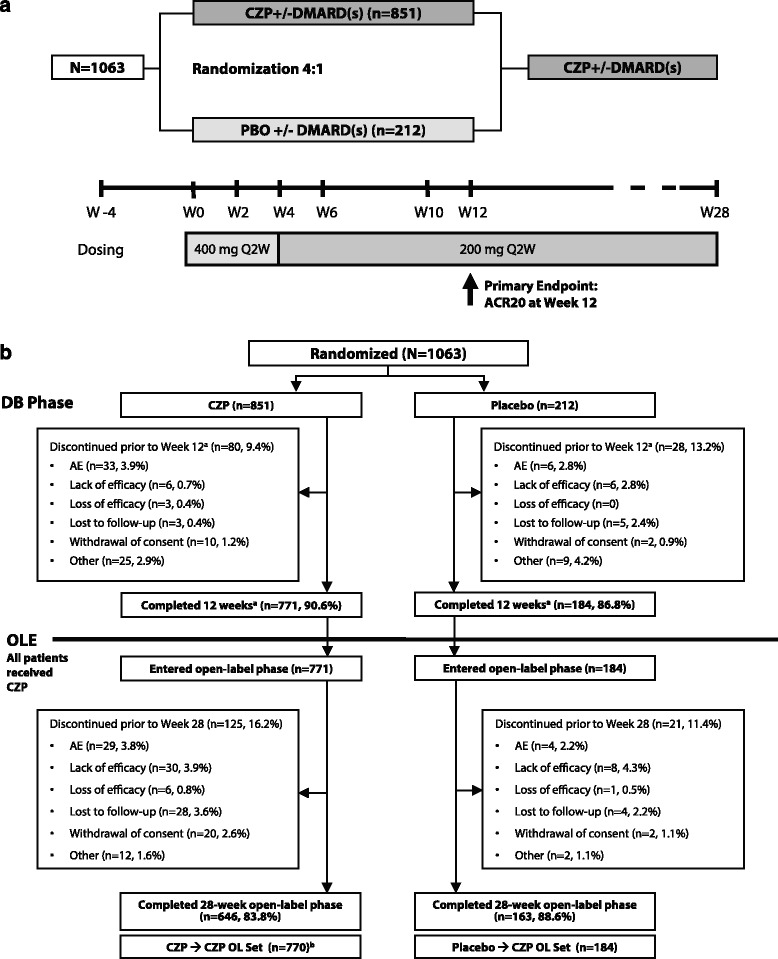
The 28-week study population included all patients who completed the double-blind (DB) phase and entered the open-label (OL) phase, receiving 200 mg CZP every 2 weeks (Q2W) ≥16 weeks. In the 12-week DB period, patients with active RA and an inadequate response to ≥1 disease-modifying antirheumatic drug (DMARD) were randomized 4:1 to CZP (400 mg at weeks 0, 2 and 4 then 200 mg Q2W) or placebo (Q2W), stratified by prior anti-TNF use, concomitant use of MTX and disease duration (<2 years vs. ≥2 years).
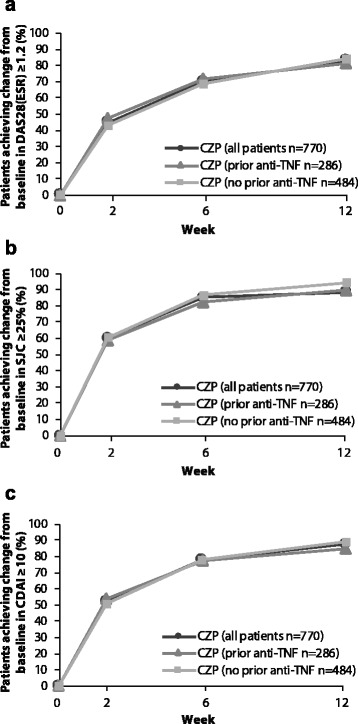
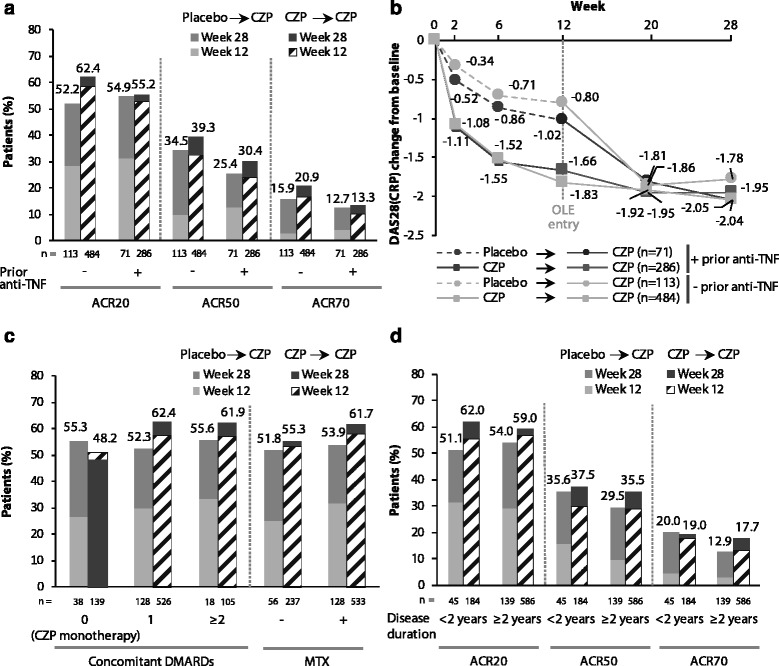
A total of 955 patients entered the OL phase. At week 28, similar clinical improvements were seen in those receiving CZP throughout (CZP → CZP; n = 771) and those receiving placebo during the DB phase and switching to CZP in the OL phase (placebo → CZP; n = 184) (ACR20 response rate = 59.7% vs. 53.3%; ACR50/ACR70 response rates were also similar). Effect of CZP treatment was similar regardless of prior anti-TNF use, disease duration and concomitant DMARDs, based on ACR20 response rates. The percentage of patients achieving DAS28(ESR) LDA at week 28 was calculated for DAS28(ESR), SJC or CDAI responders at earlier time points. Reductions from baseline (Δ) of DAS28(ESR) <1.2, ΔSJC <25% or ΔCDAI <10 by week 12 were associated with <9% chance of achieving LDA at week 28 regardless of prior anti-TNF exposure. Adverse event rates were similar for placebo → CZP and CZP → CZP patients, with no new safety signals identified.
A diverse population of RA patients with varying disease duration showed rapid and sustained clinical improvements on CZP treatment, regardless of prior anti-TNF or concomitant DMARD use. Failure to achieve improvements in DAS28(ESR), SJC or CDAI within the first 12 weeks of CZP therapy was associated with a low chance of achieving LDA at week 28. No new safety signals were observed.
ClinicalTrials.gov, NCT00717236 , 15 July 2008.
这项为期28周的IIIb期研究评估了在不同类风湿关节炎(RA)患者群体中,赛妥珠单抗聚乙二醇化制剂(CZP)的安全性以及反应的维持情况,这些患者根据既往抗TNF暴露情况、甲氨蝶呤(MTX)的联合使用情况以及病程进行分层。研究评估了从第1周到第12周疾病活动度评分28(DAS28)、红细胞沉降率(ESR)、肿胀关节计数(SJC)和临床疾病活动指数(CDAI)的改善情况来预测第28周达到低疾病活动度(LDA)的能力。
这项为期28周的研究人群包括所有完成双盲(DB)阶段并进入开放标签(OL)阶段的患者,每2周(Q2W)接受200mg CZP治疗≥16周。在为期12周的双盲期,患有活动性RA且对≥1种改善病情抗风湿药(DMARD)反应不足的患者按4:1随机分为CZP组(第0、2和4周给予400mg,然后Q2W给予200mg)或安慰剂组(Q2W),根据既往抗TNF使用情况、MTX的联合使用情况以及病程(<2年与≥2年)进行分层。
共有955名患者进入开放标签阶段。在第28周,全程接受CZP治疗的患者(CZP→CZP;n = 771)和在双盲阶段接受安慰剂治疗并在开放标签阶段转换为CZP治疗的患者(安慰剂→CZP;n = 184)出现了相似的临床改善(ACR20缓解率分别为59.7%和53.3%;ACR50/ACR70缓解率也相似)。基于ACR20缓解率,无论既往抗TNF使用情况、病程以及联合使用的DMARD如何,CZP治疗的效果相似。计算了在较早时间点DAS28(ESR)、SJC或CDAI缓解的患者在第28周达到DAS28(ESR)LDA的百分比。无论既往抗TNF暴露情况如何,到第12周时DAS28(ESR)较基线降低(Δ)<1.2、ΔSJC<25%或ΔCDAI<10与第28周达到LDA的可能性<9%相关。安慰剂→CZP组和CZP→CZP组患者的不良事件发生率相似,未发现新的安全信号。
无论既往抗TNF或联合使用DMARD情况如何,不同病程的RA患者群体在接受CZP治疗后均出现了快速且持续的临床改善。在CZP治疗的前12周内未实现DAS28(ESR)、SJC或CDAI的改善与第28周达到LDA的可能性较低相关。未观察到新的安全信号。
ClinicalTrials.gov,NCT00717236,2008年7月15日。