Shen Zu T, Zheng Shaokuan, Gounis Matthew J, Sigalov Alexander B
SignaBlok, Inc, Shrewsbury, Massachusetts, United States of America.
Department of Radiology, University of Massachusetts Medical School, Worcester, Massachusetts, United States of America.
PLoS One. 2015 Nov 16;10(11):e0143453. doi: 10.1371/journal.pone.0143453. eCollection 2015.
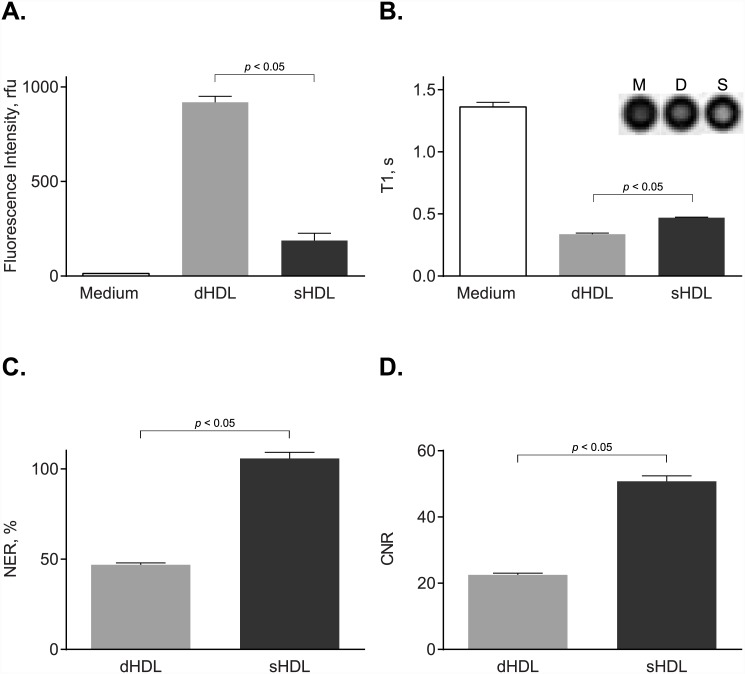
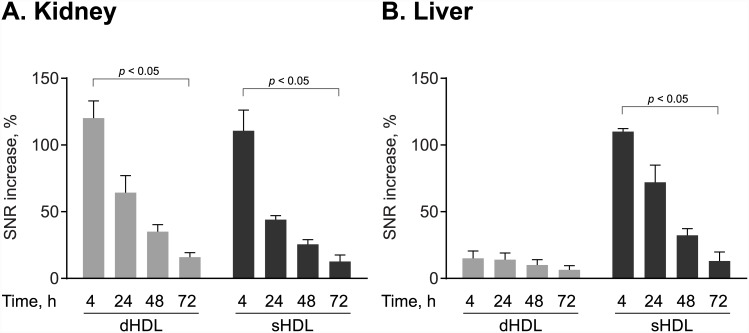
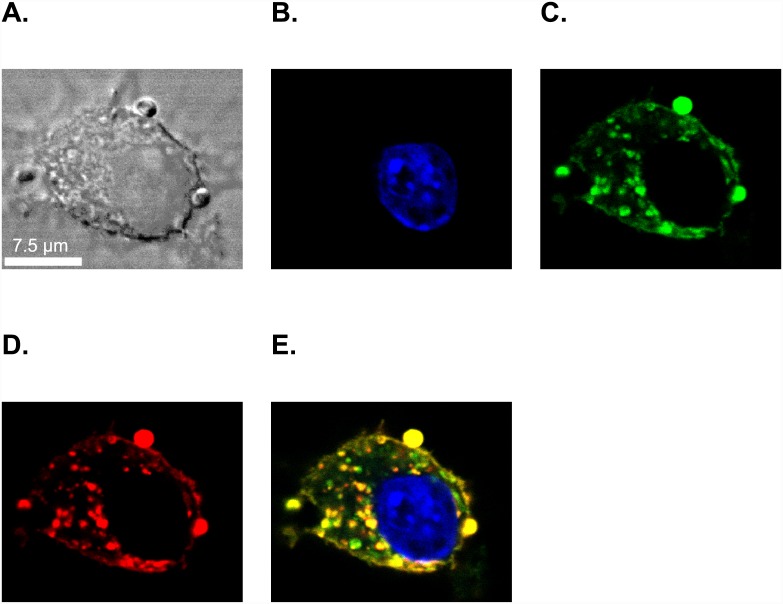
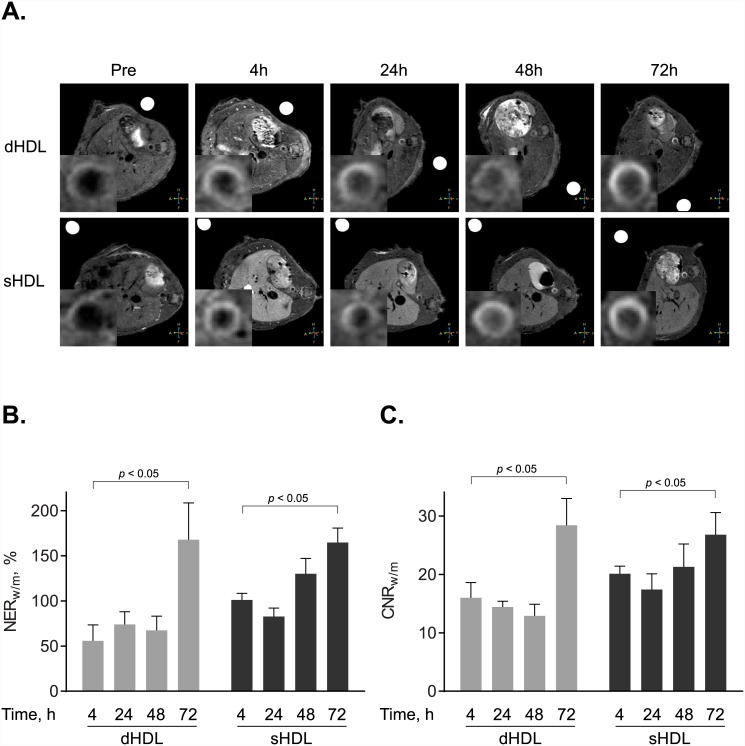
Cardiovascular disease is the leading cause of death in Western cultures. The vast majority of cardiovascular events, including stroke and myocardial infarction, result from the rupture of vulnerable atherosclerotic plaques, which are characterized by high and active macrophage content. Current imaging modalities including magnetic resonance imaging (MRI) aim to characterize anatomic and structural features of plaques rather than their content. Previously, we reported that macrophage-targeted delivery of gadolinium (Gd)-based contrast agent (GBCA-HDL) using high density lipoproteins (HDL)-like particles significantly enhances the detection of plaques in an apolipoprotein (apo) E knockout (KO) mouse model, with an atherosclerotic wall/muscle normalized enhancement ratio (NER) of 120% achieved. These particles are comprised of lipids and synthetic peptide fragments of the major protein of HDL, apo A-I, that contain a naturally occurring modification which targets the particles to macrophages. Targeted delivery minimizes the Gd dose and thus reduces the adverse effects of Gd. The aims of the current study were to test whether varying the GBCA-HDL particle shape and composition can further enhance atherosclerotic plaque MRI and control organ clearance of these agents. We show that the optimized GBCA-HDL particles are efficiently delivered intracellularly to and uptaken by both J774 macrophages in vitro and more importantly, by intraplaque macrophages in vivo, as evidenced by NER up to 160% and higher. This suggests high diagnostic power of our GBCA-HDL particles in the detection of vulnerable atherosclerotic plaques. Further, in contrast to discoidal, spherical GBCA-HDL exhibit hepatic clearance, which could further diminish adverse renal effects of Gd. Finally, activated macrophages are reliable indicators of any inflamed tissues and are implicated in other areas of unmet clinical need such as rheumatoid arthritis, sepsis and cancer, suggesting the expanded diagnostic and prognostic use of this method.
心血管疾病是西方文化中主要的死亡原因。绝大多数心血管事件,包括中风和心肌梗死,都是由易损动脉粥样硬化斑块破裂引起的,这些斑块的特征是巨噬细胞含量高且活跃。包括磁共振成像(MRI)在内的当前成像方式旨在表征斑块的解剖和结构特征,而非其内容物。此前,我们报道过,使用高密度脂蛋白(HDL)样颗粒进行钆(Gd)基造影剂(GBCA-HDL)的巨噬细胞靶向递送,可显著增强载脂蛋白(apo)E基因敲除(KO)小鼠模型中斑块的检测效果,实现动脉粥样硬化壁/肌肉归一化增强率(NER)达到120%。这些颗粒由HDL主要蛋白质apo A-I的脂质和合成肽片段组成,其中含有一种天然修饰,可将颗粒靶向至巨噬细胞。靶向递送可使Gd剂量最小化,从而降低Gd的不良反应。本研究的目的是测试改变GBCA-HDL颗粒的形状和组成是否能进一步增强动脉粥样硬化斑块的MRI成像,并控制这些药物在器官中的清除。我们发现,优化后的GBCA-HDL颗粒在体外可有效递送至J774巨噬细胞并被其摄取,更重要的是,在体内可被斑块内巨噬细胞摄取,NER高达160%及更高即证明了这一点。这表明我们的GBCA-HDL颗粒在检测易损动脉粥样硬化斑块方面具有很高的诊断能力。此外,与盘状颗粒不同,球形GBCA-HDL颗粒会被肝脏清除,这可能会进一步减少Gd对肾脏的不良影响。最后,活化的巨噬细胞是任何炎症组织的可靠指标,并且与类风湿性关节炎、败血症和癌症等其他未满足临床需求的领域有关,这表明该方法在诊断和预后方面的应用范围有所扩大。