van Hees Vincent T, Sabia Séverine, Anderson Kirstie N, Denton Sarah J, Oliver James, Catt Michael, Abell Jessica G, Kivimäki Mika, Trenell Michael I, Singh-Manoux Archana
MoveLab - Physical activity and exercise research, Institute of Cellular Medicine, Newcastle University, Newcastle upon Tyne, United Kingdom.
Netherlands eScience Center, Amsterdam, The Netherlands.
PLoS One. 2015 Nov 16;10(11):e0142533. doi: 10.1371/journal.pone.0142533. eCollection 2015.
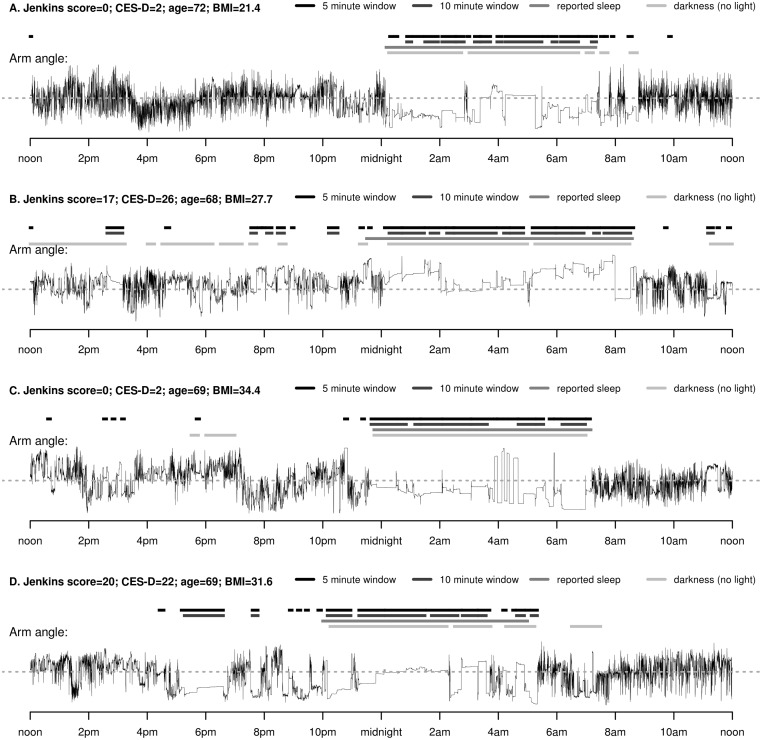
Wrist-worn accelerometers are increasingly being used for the assessment of physical activity in population studies, but little is known about their value for sleep assessment. We developed a novel method of assessing sleep duration using data from 4,094 Whitehall II Study (United Kingdom, 2012-2013) participants aged 60-83 who wore the accelerometer for 9 consecutive days, filled in a sleep log and reported sleep duration via questionnaire. Our sleep detection algorithm defined (nocturnal) sleep as a period of sustained inactivity, itself detected as the absence of change in arm angle greater than 5 degrees for 5 minutes or more, during a period recorded as sleep by the participant in their sleep log. The resulting estimate of sleep duration had a moderate (but similar to previous findings) agreement with questionnaire based measures for time in bed, defined as the difference between sleep onset and waking time (kappa = 0.32, 95%CI:0.29,0.34) and total sleep duration (kappa = 0.39, 0.36,0.42). This estimate was lower for time in bed for women, depressed participants, those reporting more insomnia symptoms, and on weekend days. No such group differences were found for total sleep duration. Our algorithm was validated against data from a polysomnography study on 28 persons which found a longer time window and lower angle threshold to have better sensitivity to wakefulness, while the reverse was true for sensitivity to sleep. The novelty of our method is the use of a generic algorithm that will allow comparison between studies rather than a "count" based, device specific method.
腕部佩戴式加速度计在人群研究中越来越多地用于身体活动评估,但对于其在睡眠评估中的价值却知之甚少。我们开发了一种新方法,利用来自4094名白厅II期研究(英国,2012 - 2013年)参与者的数据评估睡眠时间,这些参与者年龄在60 - 83岁之间,连续9天佩戴加速度计,填写睡眠日志并通过问卷报告睡眠时间。我们的睡眠检测算法将(夜间)睡眠定义为持续静止不动的时间段,其本身通过参与者在睡眠日志中记录为睡眠的时间段内,手臂角度变化小于5度持续5分钟或更长时间来检测。由此得出的睡眠时间估计值与基于问卷的卧床时间测量值(定义为入睡时间与醒来时间之差)具有中等程度的一致性(但与先前研究结果相似)(kappa = 0.32,95%CI:0.29,0.34)以及总睡眠时间(kappa = 0.39,0.36,0.42)。对于女性、抑郁的参与者、报告更多失眠症状的人以及周末的卧床时间,该估计值较低。在总睡眠时间方面未发现此类群体差异。我们的算法通过对28人的多导睡眠图研究数据进行验证,发现较长的时间窗口和较低的角度阈值对清醒状态具有更好的敏感性,而对睡眠的敏感性则相反。我们方法的新颖之处在于使用了一种通用算法,该算法将允许不同研究之间进行比较,而不是基于“计数”的、特定设备的方法。