Stanford University Center for Sleep Sciences and Medicine, Palo Alto, California, United States of America.
Department of Psychiatry and Behavioral Sciences, Stanford University, Stanford, California, United States of America.
PLoS One. 2020 Sep 17;15(9):e0238464. doi: 10.1371/journal.pone.0238464. eCollection 2020.
Actigraphs are wrist-worn devices that record tri-axial accelerometry data used clinically and in research studies. The expense of research-grade actigraphs, however, limit their widespread adoption, especially in clinical settings. Tri-axial accelerometer-based consumer wearable devices have gained worldwide popularity and hold potential for a cost-effective alternative. The lack of independent validation of minute-to-minute accelerometer data with polysomnographic data or even research-grade actigraphs, as well as access to raw data has hindered the utility and acceptance of consumer-grade actigraphs.
Sleep clinic patients wore a consumer-grade wearable (Huami Arc) on their non-dominant wrist while undergoing an overnight polysomnography (PSG) study. The sample was split into two, 20 in a training group and 21 in a testing group. In addition to the Arc, the testing group also wore a research-grade actigraph (Philips Actiwatch Spectrum). Sleep was scored for each 60-s epoch on both devices using the Cole-Kripke algorithm.
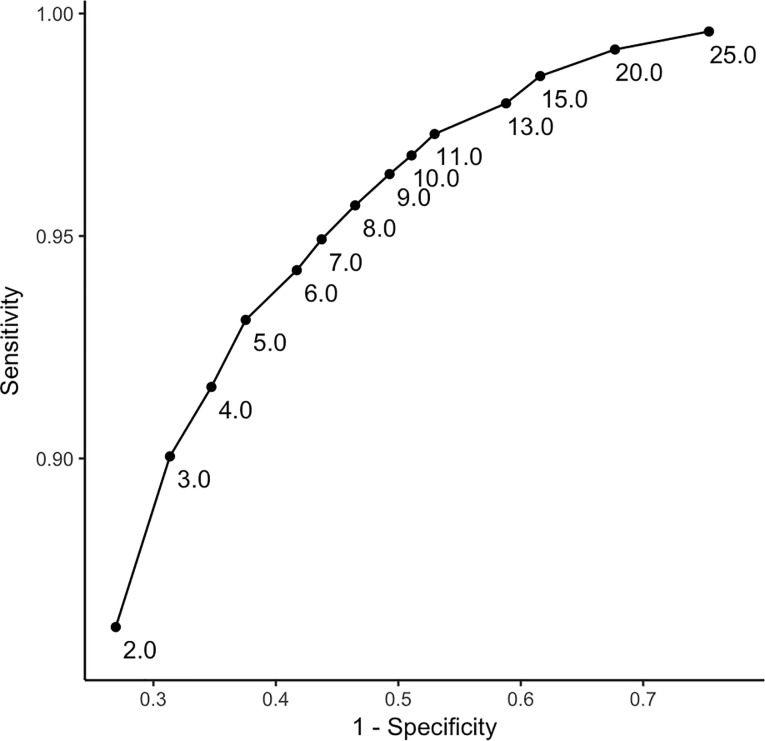
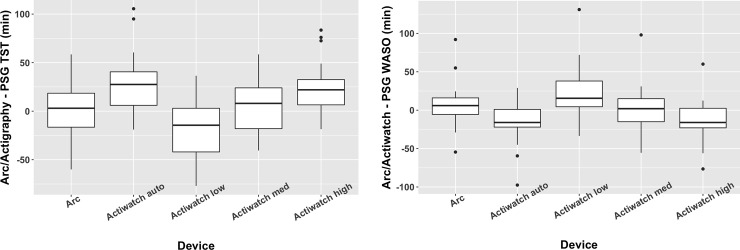
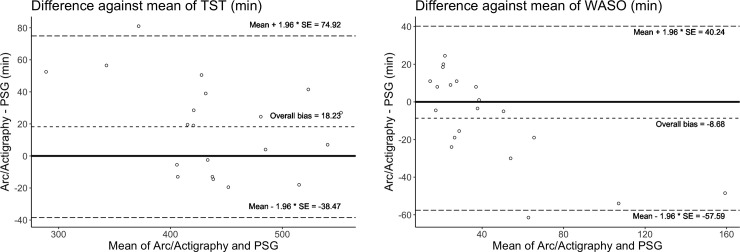
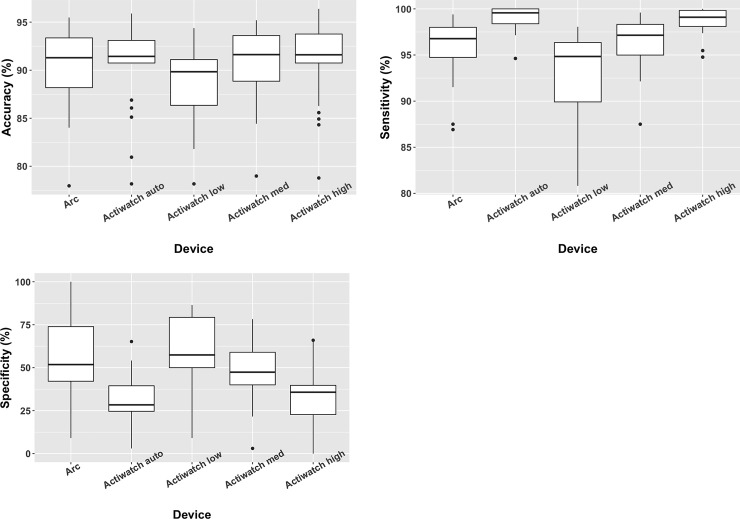
Based on analysis of our training group, Arc and PSG data were aligned best when a threshold of 10 units was used to examine the Arc data. Using this threshold value in our testing group, the Arc has an accuracy of 90.3%±4.3%, sleep sensitivity (or wake specificity) of 95.5%±3.5%, and sleep specificity (wake sensitivity) of 55.6%±22.7%. Compared to PSG, Actiwatch has an accuracy of 88.7%±4.5%, sleep sensitivity of 92.6%±5.2%, and sleep specificity of 60.5%±20.2%, comparable to that observed in the Arc.
An optimized sleep/wake threshold value was identified for a consumer-grade wearable Arc trained by PSG data. By applying this sleep/wake threshold value for Arc generated accelerometer data, when compared to PSG, sleep and wake estimates were adequate and comparable to those generated by a clinical-grade actigraph. As with other actigraphs, sleep specificity plateaus due to limitations in distinguishing wake without movement from sleep. Further studies are needed to evaluate the Arc's ability to differentiate between sleep and wake using other sources of data available from the Arc, such as high resolution accelerometry and photoplethysmography.
Actigraphs 是一种腕戴式设备,可记录三轴加速度计数据,临床上和研究中都有使用。然而,研究级别的 Actigraphs 价格昂贵,限制了其广泛应用,尤其是在临床环境中。基于三轴加速度计的消费级可穿戴设备在全球范围内越来越受欢迎,并且具有成本效益的替代方案的潜力。由于缺乏与多导睡眠图数据甚至研究级别的 Actigraphs 的分钟到分钟的加速度计数据的独立验证,以及对原始数据的访问,这阻碍了消费级别的 Actigraphs 的实用性和接受度。
睡眠诊所的患者在进行整夜多导睡眠图(PSG)研究时,将一只消费级可穿戴设备(Huami Arc)戴在非优势手腕上。该样本分为两组,20 人在训练组,21 人在测试组。除了 Arc 之外,测试组还佩戴了研究级别的 Actigraph(Philips Actiwatch Spectrum)。使用 Cole-Kripke 算法,在这两个设备上的每 60 秒的时间段内对睡眠进行评分。
基于对我们的训练组的分析,当使用 10 个单位的阈值来检查 Arc 数据时,Arc 和 PSG 数据的对齐效果最佳。在我们的测试组中使用这个阈值值,Arc 的准确率为 90.3%±4.3%,睡眠敏感性(或清醒特异性)为 95.5%±3.5%,睡眠特异性(清醒敏感性)为 55.6%±22.7%。与 PSG 相比,Actiwatch 的准确率为 88.7%±4.5%,睡眠敏感性为 92.6%±5.2%,睡眠特异性为 60.5%±20.2%,与 Arc 观察到的相似。
为经过 PSG 数据训练的消费级可穿戴设备 Arc 确定了一个优化的睡眠/唤醒阈值。通过将这个睡眠/唤醒阈值应用于 Arc 生成的加速度计数据,与 PSG 相比,睡眠和唤醒的估计值是足够的,并且与临床级别的 Actigraph 生成的估计值相当。与其他 Actigraphs 一样,由于难以区分无运动的清醒和睡眠,睡眠特异性趋于稳定。需要进一步的研究来评估 Arc 使用 Arc 提供的其他数据来源(例如高分辨率加速度计和光容积描记法)来区分睡眠和清醒的能力。