Schottdorf Manuel, Keil Wolfgang, Coppola David, White Leonard E, Wolf Fred
Max Planck Institute for Dynamics and Self-Organization, Göttingen, Germany.
Bernstein Center for Computational Neuroscience, Göttingen, Germany.
PLoS Comput Biol. 2015 Nov 17;11(11):e1004602. doi: 10.1371/journal.pcbi.1004602. eCollection 2015 Nov.
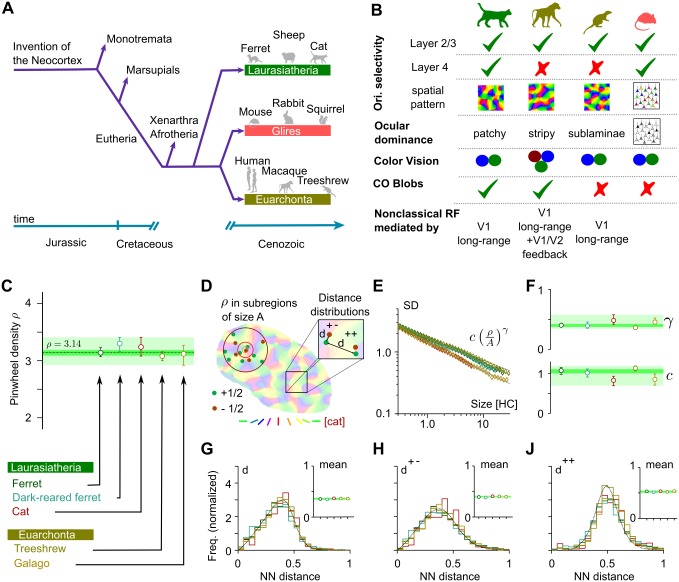
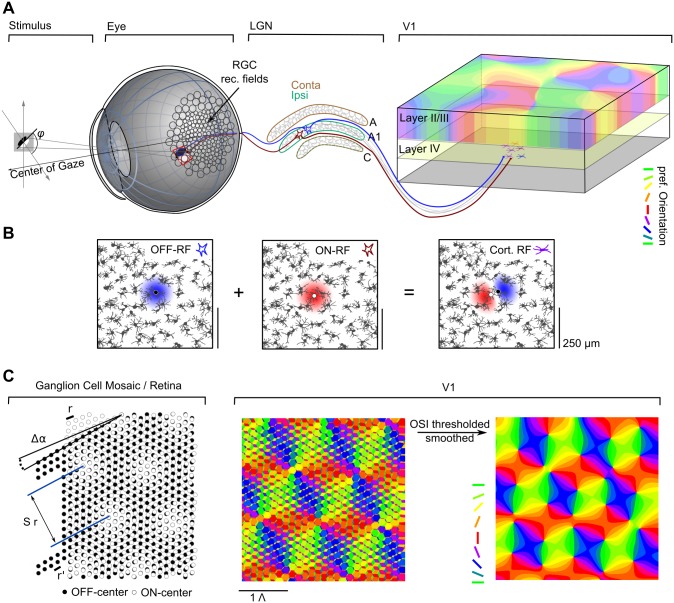
The architecture of iso-orientation domains in the primary visual cortex (V1) of placental carnivores and primates apparently follows species invariant quantitative laws. Dynamical optimization models assuming that neurons coordinate their stimulus preferences throughout cortical circuits linking millions of cells specifically predict these invariants. This might indicate that V1's intrinsic connectome and its functional architecture adhere to a single optimization principle with high precision and robustness. To validate this hypothesis, it is critical to closely examine the quantitative predictions of alternative candidate theories. Random feedforward wiring within the retino-cortical pathway represents a conceptually appealing alternative to dynamical circuit optimization because random dimension-expanding projections are believed to generically exhibit computationally favorable properties for stimulus representations. Here, we ask whether the quantitative invariants of V1 architecture can be explained as a generic emergent property of random wiring. We generalize and examine the stochastic wiring model proposed by Ringach and coworkers, in which iso-orientation domains in the visual cortex arise through random feedforward connections between semi-regular mosaics of retinal ganglion cells (RGCs) and visual cortical neurons. We derive closed-form expressions for cortical receptive fields and domain layouts predicted by the model for perfectly hexagonal RGC mosaics. Including spatial disorder in the RGC positions considerably changes the domain layout properties as a function of disorder parameters such as position scatter and its correlations across the retina. However, independent of parameter choice, we find that the model predictions substantially deviate from the layout laws of iso-orientation domains observed experimentally. Considering random wiring with the currently most realistic model of RGC mosaic layouts, a pairwise interacting point process, the predicted layouts remain distinct from experimental observations and resemble Gaussian random fields. We conclude that V1 layout invariants are specific quantitative signatures of visual cortical optimization, which cannot be explained by generic random feedforward-wiring models.
胎盘食肉动物和灵长类动物初级视觉皮层(V1)中同向性域的结构显然遵循物种不变的定量规律。动力学优化模型假设神经元在连接数百万个细胞的整个皮层回路中协调其刺激偏好,具体预测了这些不变性。这可能表明V1的内在连接组及其功能结构高精度且稳健地遵循单一优化原则。为了验证这一假设,密切检验替代候选理论的定量预测至关重要。视网膜-皮层通路内的随机前馈布线是动力学电路优化在概念上有吸引力的替代方案,因为随机维度扩展投影被认为通常对刺激表征具有计算上有利的特性。在这里,我们询问V1结构的定量不变性是否可以解释为随机布线的一般涌现特性。我们推广并检验了Ringach及其同事提出的随机布线模型,其中视觉皮层中的同向性域通过视网膜神经节细胞(RGC)的半规则镶嵌与视觉皮层神经元之间的随机前馈连接产生。我们推导了该模型对完美六边形RGC镶嵌预测的皮层感受野和域布局的闭式表达式。在RGC位置引入空间无序会根据无序参数(如位置散射及其在视网膜上的相关性)显著改变域布局特性。然而,无论参数如何选择,我们发现模型预测与实验观察到的同向性域布局规律有很大偏差。考虑使用目前最现实的RGC镶嵌布局模型(成对相互作用点过程)进行随机布线,预测的布局仍然与实验观察结果不同,并且类似于高斯随机场。我们得出结论,V1布局不变性是视觉皮层优化的特定定量特征,不能用一般的随机前馈布线模型来解释。