Loupakis Fotios, Moretto Roberto, Aprile Giuseppe, Muntoni Marta, Cremolini Chiara, Iacono Donatella, Casagrande Mariaelena, Ferrari Laura, Salvatore Lisa, Schirripa Marta, Rossini Daniele, De Maglio Giovanna, Fasola Gianpiero, Calvetti Lorenzo, Pilotto Sara, Carbognin Luisa, Fontanini Gabriella, Tortora Giampaolo, Falcone Alfredo, Sperduti Isabella, Bria Emilio
Oncologia Medica 2 Universitaria, Dipartimento di Ricerca Traslazionale e delle Nuove Tecnologie in Medicina e Chirurgia, Azienda Ospedaliero-Universitaria Pisana, Via Roma 67, 56126 Pisa, Italy.
Dipartimento di Oncologia, Azienda Ospedaliero-Universitaria 'Santa Maria della Misericordia', Piazzale Santa Maria della Misericordia 15, 33100 Udine, Italy.
Br J Cancer. 2016 Jan 12;114(1):30-6. doi: 10.1038/bjc.2015.399. Epub 2015 Nov 17.
In metastatic colorectal cancer (mCRC), BRAFV600E mutation has been variously associated to specific clinico-pathological features.
Two large retrospective series of mCRC patients from two Italian Institutions were used as training-set (TS) and validation-set (VS) for developing a nomogram predictive of BRAFV600E status. The model was internally and externally validated.
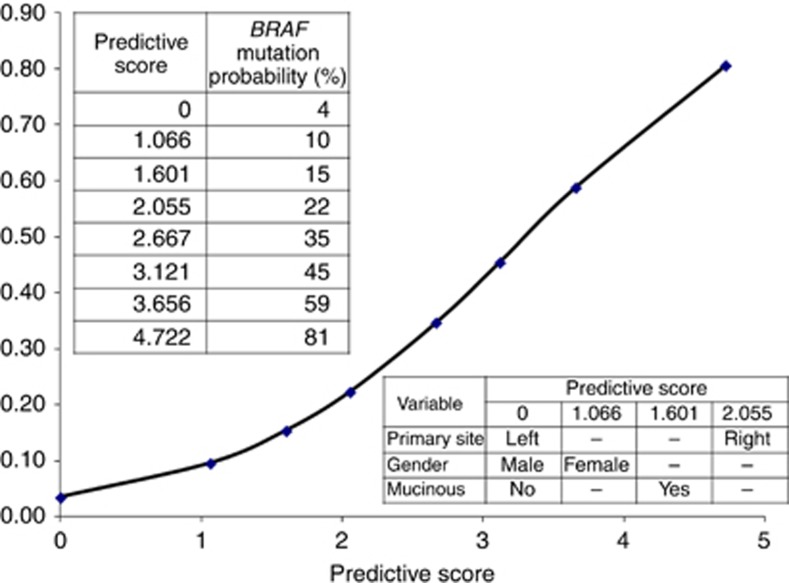
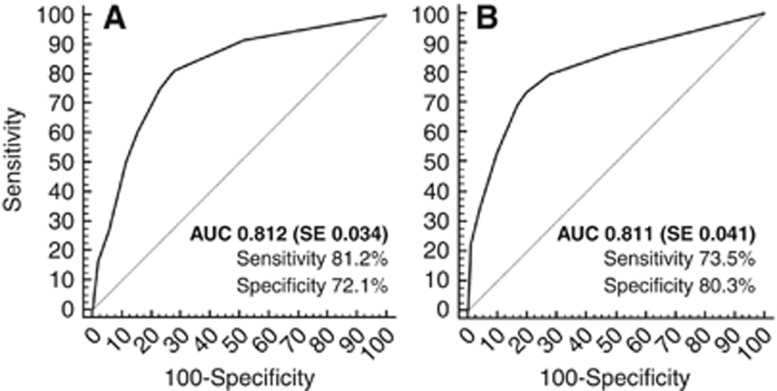
In the TS, data from 596 mCRC patients were gathered (RAS wild-type (wt) 281 (47.1%); BRAFV600E mutated 54 (9.1%)); RAS and BRAFV600E mutations were mutually exclusive. In the RAS-wt population, right-sided primary (odds ratio (OR): 7.80, 95% confidence interval (CI) 3.05-19.92), female gender (OR: 2.90, 95% CI 1.14-7.37) and mucinous histology (OR: 4.95, 95% CI 1.90-12.90) were independent predictors of BRAFV600E mutation, with high replication at internal validation (100%, 93% and 98%, respectively). A predictive nomogram was calculated: patients with the highest score (right-sided primary, female and mucinous) had a 81% chance to bear a BRAFV600E-mutant tumour; accuracy measures: AUC=0.812, SE:0.034, sensitivity:81.2%; specificity:72.1%. In the VS (508 pts, RAS wt: 262 (51.6%), BRAFV600E mutated: 49 (9.6%)), right-sided primary, female gender and mucinous histology were confirmed as independent predictors of BRAFV600E mutation with high accuracy.
Three simple and easy-to-collect characteristics define a useful nomogram for predicting BRAF status in mCRC with high specificity and sensitivity.
在转移性结直肠癌(mCRC)中,BRAFV600E突变与特定的临床病理特征存在多种关联。
来自两个意大利机构的两个大型mCRC患者回顾性系列被用作训练集(TS)和验证集(VS),以建立预测BRAFV600E状态的列线图。该模型进行了内部和外部验证。
在训练集中,收集了596例mCRC患者的数据(RAS野生型(wt)281例(47.1%);BRAFV600E突变54例(9.1%));RAS和BRAFV600E突变相互排斥。在RAS野生型人群中,右侧原发性肿瘤(比值比(OR):7.80,95%置信区间(CI)3.05 - 19.92)、女性性别(OR:2.90,95%CI 1.14 - 7.37)和黏液组织学(OR:4.95,95%CI 1.90 - 12.90)是BRAFV600E突变的独立预测因素,在内部验证中有高重复性(分别为100%、93%和98%)。计算了一个预测列线图:得分最高的患者(右侧原发性肿瘤、女性和黏液性)携带BRAFV600E突变肿瘤的几率为81%;准确性指标:AUC = 0.812,SE:0.034,敏感性:81.2%;特异性:72.1%。在验证集中(508例患者,RAS野生型:262例(51.6%),BRAFV600E突变:49例(9.6%)),右侧原发性肿瘤、女性性别和黏液组织学被确认为BRAFV600E突变的独立预测因素,准确性高。
三个简单且易于收集的特征定义了一个有用的列线图,用于预测mCRC中的BRAF状态,具有高特异性和敏感性。