Manzi Joao, Hoff Camilla O, Ferreira Raphaella, Pimentel Agustin, Datta Jashodeep, Livingstone Alan S, Vianna Rodrigo, Abreu Phillipe
Miami Transplant Institute, Jackson Memorial Hospital, University of Miami, Miami, FL 33136, USA.
Sylvester Comprehensive Cancer Center, University of Miami, Miami, FL 33136, USA.
Cancers (Basel). 2023 Jun 1;15(11):3023. doi: 10.3390/cancers15113023.
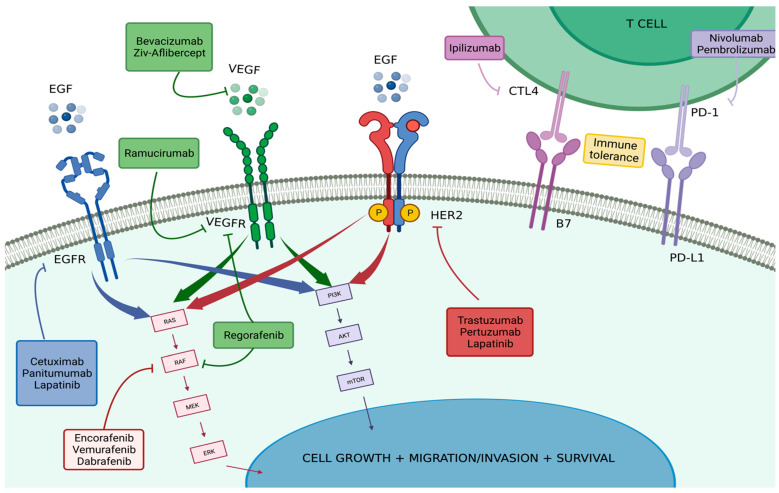
In 2022, approximately 600,000 cancer deaths were expected; more than 50,000 of those deaths would be from colorectal cancer (CRC). The CRC mortality rate in the US has decreased in recent decades, with a 51% drop between 1976 and 2014. This drop is attributed, in part, to the tremendous therapeutic improvements, especially after the 2000s, in addition to increased social awareness regarding risk factors and diagnostic improvement. Five-fluorouracil, irinotecan, capecitabine, and later oxaliplatin were the mainstays of mCRC treatment from the 1960s to 2002. Since then, more than a dozen drugs have been approved for the disease, betting on a new chapter in medicine, precision oncology, which uses patient and tumor characteristics to guide the therapeutic choice. Thus, this review will summarize the current literature on targeted therapies, highlighting the molecular biomarkers involved and their pathways.
2022年,预计约有60万例癌症死亡;其中超过5万例将死于结直肠癌(CRC)。近几十年来,美国的结直肠癌死亡率有所下降,1976年至2014年间下降了51%。这一下降部分归因于巨大的治疗进步,特别是在21世纪之后,此外还归因于社会对风险因素的认识提高和诊断的改善。从20世纪60年代到2002年,5-氟尿嘧啶、伊立替康、卡培他滨以及后来的奥沙利铂一直是转移性结直肠癌(mCRC)治疗的主要药物。从那时起,已有十多种药物被批准用于该疾病,开启了医学的新篇章——精准肿瘤学,即利用患者和肿瘤特征来指导治疗选择。因此,本综述将总结当前关于靶向治疗的文献,重点介绍所涉及的分子生物标志物及其途径。