O'Sullivan Daniel J, Fallico Vincenzo, O'Sullivan Orla, McSweeney Paul L H, Sheehan Jeremiah J, Cotter Paul D, Giblin Linda
Teagasc Food Research Centre, Moorepark, Fermoy, Cork, Ireland.
School of Food and Nutritional Sciences, University College Cork, Cork, Ireland.
BMC Microbiol. 2015 Nov 17;15:266. doi: 10.1186/s12866-015-0596-0.
The aim of this study was to employ high-throughput DNA sequencing to assess the incidence of bacteria with biogenic amine (BA; histamine and tyramine) producing potential from among 10 different cheeses varieties. To facilitate this, a diagnostic approach using degenerate PCR primer pairs that were previously designed to amplify segments of the histidine (hdc) and tyrosine (tdc) decarboxylase gene clusters were employed. In contrast to previous studies in which the decarboxylase genes of specific isolates were studied, in this instance amplifications were performed using total metagenomic DNA extracts.
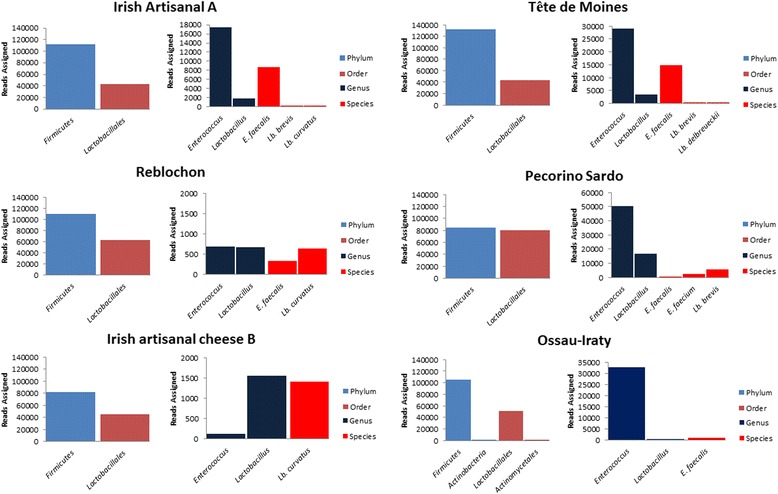
Amplicons were initially cloned to facilitate Sanger sequencing of individual gene fragments to ensure that a variety of hdc and tdc genes were present. Once this was established, high throughput DNA sequencing of these amplicons was performed to provide a more in-depth analysis of the histamine- and tyramine-producing bacteria present in the cheeses. High-throughput sequencing resulted in generation of a total of 1,563,764 sequencing reads and revealed that Lactobacillus curvatus, Enterococcus faecium and E. faecalis were the dominant species with tyramine producing potential, while Lb. buchneri was found to be the dominant species harbouring histaminogenic potential. Commonly used cheese starter bacteria, including Streptococcus thermophilus and Lb. delbreueckii, were also identified as having biogenic amine producing potential in the cheese studied. Molecular analysis of bacterial communities was then further complemented with HPLC quantification of histamine and tyramine in the sampled cheeses.
In this study, high-throughput DNA sequencing successfully identified populations capable of amine production in a variety of cheeses. This approach also gave an insight into the broader hdc and tdc complement within the various cheeses. This approach can be used to detect amine producing communities not only in food matrices but also in the production environment itself.
本研究的目的是利用高通量DNA测序技术评估10种不同奶酪品种中具有产生生物胺(BA;组胺和酪胺)潜力的细菌的发生率。为此,采用了一种诊断方法,即使用先前设计的简并PCR引物对来扩增组氨酸(hdc)和酪氨酸(tdc)脱羧酶基因簇的片段。与以往研究特定分离株的脱羧酶基因不同,本研究使用总宏基因组DNA提取物进行扩增。
最初将扩增子克隆以促进单个基因片段的桑格测序,以确保存在多种hdc和tdc基因。一旦确定了这一点,就对这些扩增子进行高通量DNA测序,以更深入地分析奶酪中存在的产生组胺和酪胺的细菌。高通量测序共产生了1,563,764个测序读数,结果显示弯曲乳杆菌、粪肠球菌和屎肠球菌是具有产生酪胺潜力的优势菌种,而布氏乳杆菌是具有产生组胺潜力的优势菌种。常用的奶酪发酵剂细菌,包括嗜热链球菌和德氏乳杆菌,在本研究的奶酪中也被鉴定为具有产生生物胺的潜力。然后,通过对采样奶酪中组胺和酪胺的HPLC定量分析,进一步补充了细菌群落的分子分析。
在本研究中,高通量DNA测序成功鉴定了多种奶酪中能够产生胺的菌群。这种方法还深入了解了各种奶酪中更广泛的hdc和tdc互补情况。这种方法不仅可用于检测食品基质中产生胺的群落,还可用于检测生产环境本身中的此类群落。