Monti Flavio, Duriez Olivier, Arnal Véronique, Dominici Jean-Marie, Sforzi Andrea, Fusani Leonida, Grémillet David, Montgelard Claudine
CEFE UMR 5175, CNRS - Université de Montpellier - Université Paul-Valéry Montpellier - EPHE, 1919 Route de Mende, 34293, Montpellier cedex 5, France.
Department of Life Sciences and Biotechnology, University of Ferrara, via Borsari 46, I-44121, Ferrara, Italy.
BMC Evol Biol. 2015 Nov 17;15:255. doi: 10.1186/s12862-015-0535-6.
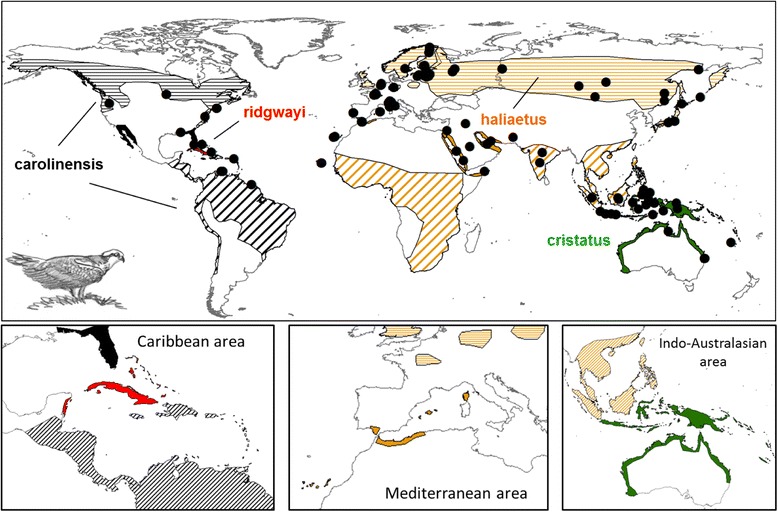
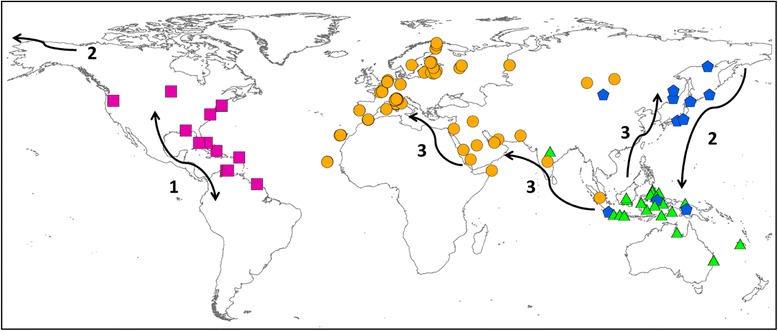
The Osprey (Pandion haliaetus) is one of only six bird species with an almost world-wide distribution. We aimed at clarifying its phylogeographic structure and elucidating its taxonomic status (as it is currently separated into four subspecies). We tested six biogeographical scenarios to explain how the species' distribution and differentiation took place in the past and how such a specialized raptor was able to colonize most of the globe.
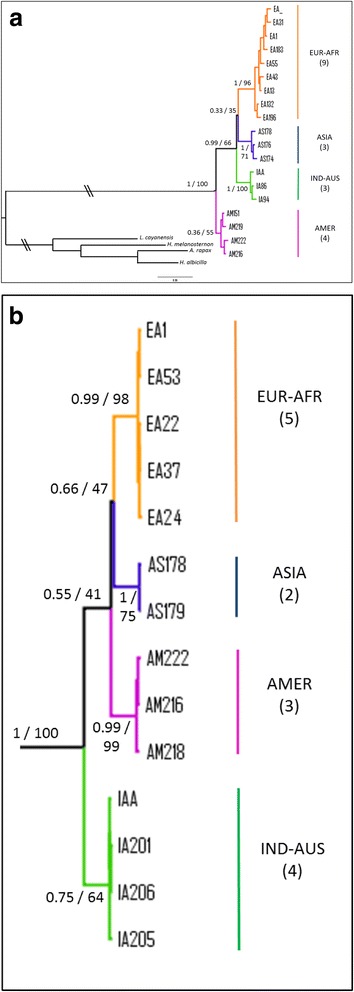
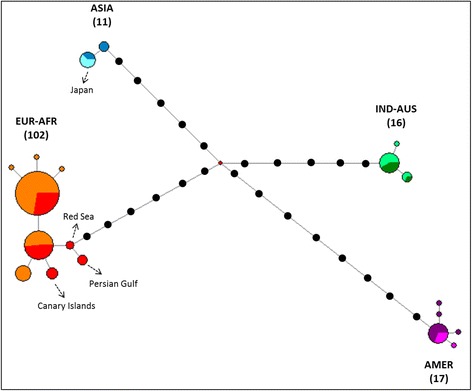
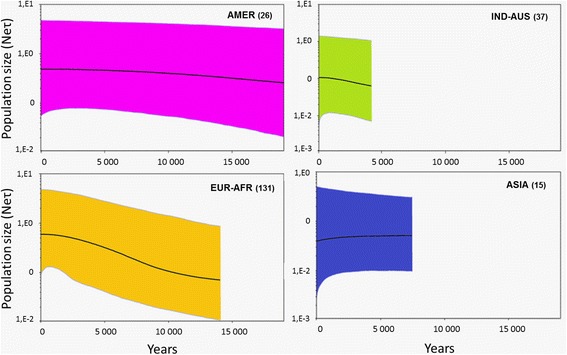
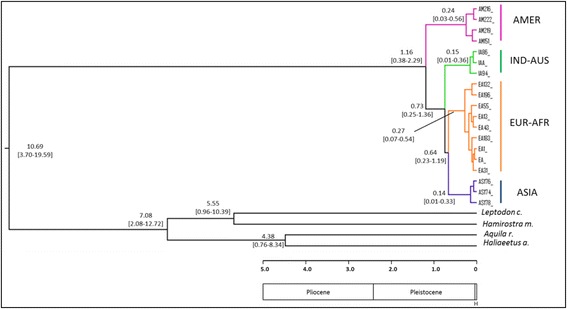
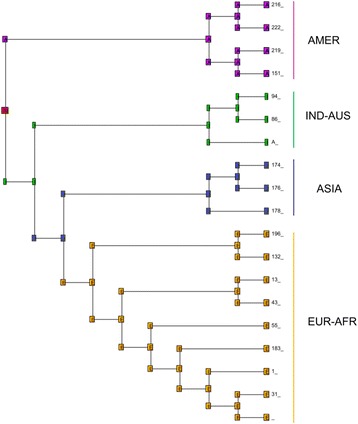
Using two mitochondrial genes (cyt b and ND2), the Osprey appeared structured into four genetic groups representing quasi non-overlapping geographical regions. The group Indo-Australasia corresponds to the cristatus ssp, as well as the group Europe-Africa to the haliaetus ssp. In the Americas, we found a single lineage for both carolinensis and ridgwayi ssp, whereas in north-east Asia (Siberia and Japan), we discovered a fourth new lineage. The four lineages are well differentiated, contrasting with the low genetic variability observed within each clade. Historical demographic reconstructions suggested that three of the four lineages experienced stable trends or slight demographic increases. Molecular dating estimates the initial split between lineages at about 1.16 Ma ago, in the Early Pleistocene.
Our biogeographical inference suggests a pattern of colonization from the American continent towards the Old World. Populations of the Palearctic would represent the last outcomes of this colonization. At a global scale the Osprey complex may be composed of four different Evolutionary Significant Units, which should be treated as specific management units. Our study brought essential genetic clarifications, which have implications for conservation strategies in identifying distinct lineages across which birds should not be artificially moved through exchange/reintroduction schemes.
鹗(Pandion haliaetus)是仅有的六种分布几乎遍及全球的鸟类之一。我们旨在阐明其系统地理结构,并阐明其分类地位(目前它被分为四个亚种)。我们测试了六种生物地理情景,以解释该物种过去的分布和分化情况,以及这样一种特化的猛禽是如何能够在全球大部分地区定居的。
利用两个线粒体基因(细胞色素b和ND2),鹗似乎被分为四个遗传组,代表了几乎不重叠的地理区域。印度 - 澳大拉西亚组对应于 cristatus 亚种,欧洲 - 非洲组对应于 haliaetus 亚种。在美洲,我们发现卡罗琳鹗(carolinensis)和里氏鹗(ridgwayi)亚种只有一个谱系,而在亚洲东北部(西伯利亚和日本),我们发现了第四个新谱系。这四个谱系差异明显,与每个分支内观察到的低遗传变异性形成对比。历史种群动态重建表明,四个谱系中的三个经历了稳定趋势或轻微的种群增长。分子钟估计谱系之间的初始分歧发生在约116万年前的更新世早期。
我们的生物地理推断表明了一种从美洲大陆向旧世界的殖民模式。古北区的种群将代表这种殖民的最后结果。在全球范围内,鹗复合体可能由四个不同的进化显著单元组成,应将其视为特定的管理单元。我们的研究带来了重要的遗传学阐释,这对保护策略具有重要意义,即在识别不同谱系时,不应通过交换/重新引入计划人为地移动鸟类。