Laboratory of Genetics, Biodiversity and Enhancement of Bioresources (LR11ES41), University of Monastir, Higher Institute of Biotechnology of Monastir, Av. Tahar Hadded, B.P. 74, 5000, Monastir, Tunisia.
Middle East Technical University, Institute of Marine Sciences, P.O.Box 28, 33731, Erdemli-Mersin, Turkey.
BMC Evol Biol. 2018 Apr 11;18(1):53. doi: 10.1186/s12862-018-1167-4.
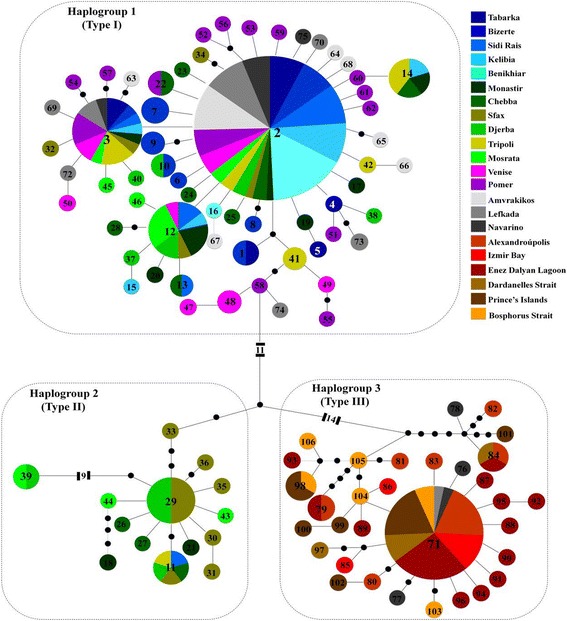
Recently, population genetic studies of Mediterranean marine species highlighted patterns of genetic divergence and phylogeographic breaks, due to the interplay between impacts of Pleistocene climate shifts and contemporary hydrographical barriers. These factors markedly shaped the distribution of marine organisms and their genetic makeup. The present study is part of an ongoing effort to understand the phylogeography and evolutionary history of the highly dispersive Mediterranean green crab, Carcinus aestuarii (Nardo, 1847), across the Mediterranean Sea. Recently, marked divergence between two highly separated haplogroups (genetic types I and II) of C. aestuarii was discerned across the Siculo-Tunisian Strait, suggesting an Early Pleistocene vicariant event. In order to better identify phylogeographic patterns in this species, a total of 263 individuals from 22 Mediterranean locations were analysed by comparing a 587 basepair region of the mitochondrial gene Cox1 (cytochrome oxidase subunit 1). The examined dataset is composed of both newly generated sequences (76) and previously investigated ones (187).
Our results unveiled the occurrence of a highly divergent haplogroup (genetic type III) in the most north-eastern part of the Mediterranean Sea. Divergence between the most distinct type III and the common ancestor of both types I and II corresponds to the Early Pleistocene and coincides with the historical episode of separation between types I and II. Our results also revealed strong genetic divergence among adjacent regions (separating the Aegean and Marmara seas from the remaining distribution zone) and confirmed a sharp phylogeographic break across the Eastern Mediterranean. The recorded parapatric genetic divergence, with the potential existence of a contact zone between both groups in the Ionian Sea and notable differences in the demographic history, suggest the likely impact of paleoclimatic events, as well as past and contemporary oceanographic processes, in shaping genetic variability of this species.
Our findings not only provide further evidence for the complex evolutionary history of the green crab in the Mediterranean Sea, but also stress the importance of investigating peripheral areas in the species' distribution zone in order to fully understand the distribution of genetic diversity and unravel hidden genetic units and local patterns of endemism.
最近,对地中海海洋物种的群体遗传学研究强调了遗传分化和地理分化模式,这是由于更新世气候变化和当代水文障碍的相互作用所致。这些因素显著塑造了海洋生物的分布及其遗传构成。本研究是理解高度分散的地中海绿蟹(Carcinus aestuarii)(Nardo,1847)在整个地中海的系统地理学和进化历史的一部分。最近,在西西里-突尼斯海峡发现了两个高度分离的单倍群(遗传类型 I 和 II)之间的明显分歧,表明这是一次早更新世的地理隔离事件。为了更好地识别该物种的系统地理学模式,对来自地中海 22 个地点的 263 个个体进行了分析,比较了线粒体基因 Cox1(细胞色素氧化酶亚基 1)的 587 个碱基对区域。所检查的数据集由新生成的序列(76)和先前研究的序列(187)组成。
我们的研究结果揭示了地中海最东北部分存在一个高度分化的单倍群(遗传类型 III)。最明显的类型 III 与类型 I 和 II 的共同祖先之间的分化对应于早更新世,与类型 I 和 II 分离的历史事件相吻合。我们的研究结果还揭示了相邻区域之间的强烈遗传分化(将爱琴海和马尔马拉海与剩余分布区隔开),并证实了东地中海的明显地理分化。记录的邻域遗传分化,以及两个群体之间在爱奥尼亚海可能存在的接触区以及在人口历史上的显著差异,表明古气候事件以及过去和当代的海洋过程可能对该物种的遗传变异性产生影响。
我们的研究结果不仅为地中海绿蟹的复杂进化历史提供了进一步的证据,而且还强调了在物种分布区调查边缘地区的重要性,以便充分了解遗传多样性的分布并揭示隐藏的遗传单元和地方特有模式。