Nicolardi Simone, Bogdanov Bogdan, Deelder André M, Palmblad Magnus, van der Burgt Yuri E M
Center for Proteomics and Metabolomics, Leiden University Medical Center (LUMC), PO Box 9600, 2300 RC Leiden, The Netherlands.
Perkin Elmer, San Jose Technology Center, San Jose, CA 95134, USA.
Int J Mol Sci. 2015 Nov 13;16(11):27133-44. doi: 10.3390/ijms161126012.
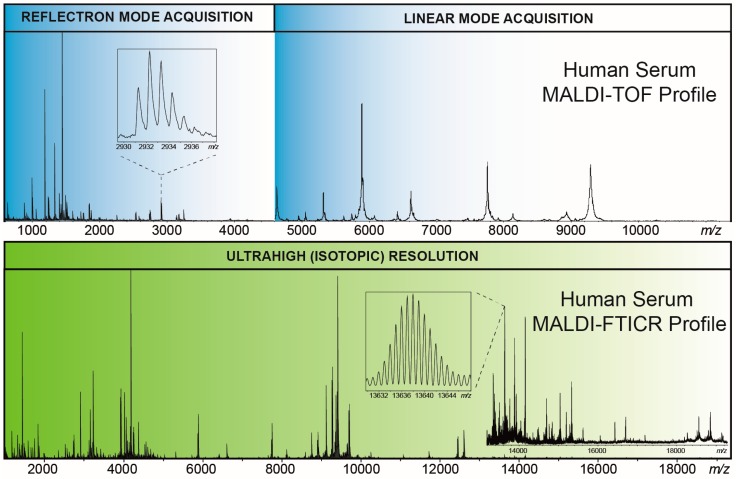
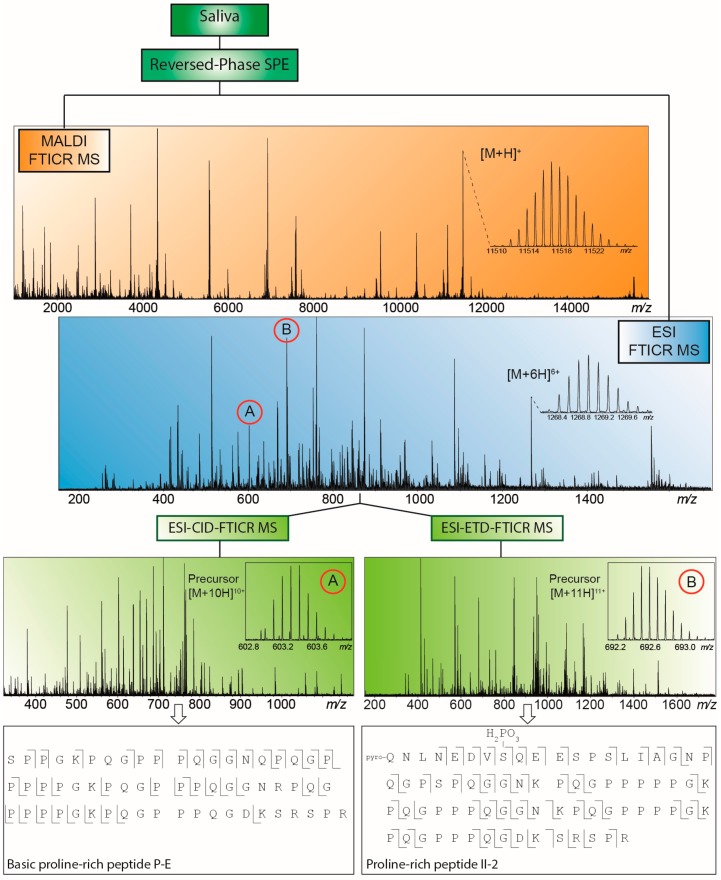
Fourier transform mass spectrometry (FTMS) is the method of choice for measurements that require ultra-high resolution. The establishment of Fourier transform ion cyclotron resonance (FTICR) MS, the availability of biomolecular ionization techniques and the introduction of the Orbitrap™ mass spectrometer have widened the number of FTMS-applications enormously. One recent example involves clinical proteomics using FTICR-MS to discover and validate protein biomarker signatures in body fluids such as serum or plasma. These biological samples are highly complex in terms of the type and number of components, their concentration range, and the structural identity of each species, and thus require extensive sample cleanup and chromatographic separation procedures. Clearly, such an elaborate and multi-step sample preparation process hampers high-throughput analysis of large clinical cohorts. A final MS read-out at ultra-high resolution enables the analysis of a more complex sample and can thus simplify upfront fractionations. To this end, FTICR-MS offers superior ultra-high resolving power with accurate and precise mass-to-charge ratio (m/z) measurement of a high number of peptides and small proteins (up to 20 kDa) at isotopic resolution over a wide mass range, and furthermore includes a wide variety of fragmentation strategies to characterize protein sequence and structure, including post-translational modifications (PTMs). In our laboratory, we have successfully applied FTICR "next-generation" peptide profiles with the purpose of cancer disease classifications. Here we will review a number of developments and innovations in FTICR-MS that have resulted in robust and routine procedures aiming for ultra-high resolution signatures of clinical samples, exemplified with state-of-the-art examples for serum and saliva.
傅里叶变换质谱(FTMS)是需要超高分辨率测量的首选方法。傅里叶变换离子回旋共振(FTICR)质谱的建立、生物分子电离技术的可用性以及轨道阱™质谱仪的引入极大地拓宽了FTMS的应用范围。最近的一个例子是临床蛋白质组学,使用FTICR-MS在血清或血浆等体液中发现和验证蛋白质生物标志物特征。这些生物样品在成分的类型和数量、浓度范围以及每种物质的结构特性方面都高度复杂,因此需要广泛的样品净化和色谱分离程序。显然,这样一个精心设计的多步骤样品制备过程阻碍了对大型临床队列的高通量分析。超高分辨率的最终质谱读出能够分析更复杂的样品,从而可以简化前期分级分离。为此,FTICR-MS具有卓越的超高分辨能力,能够在宽质量范围内以同位素分辨率对大量肽和小蛋白质(高达20 kDa)进行精确的质荷比(m/z)测量,此外还包括多种碎裂策略来表征蛋白质序列和结构,包括翻译后修饰(PTM)。在我们实验室,我们已成功应用FTICR“下一代”肽谱进行癌症疾病分类。在此,我们将回顾FTICR-MS的一些发展和创新,这些发展和创新已形成旨在获得临床样品超高分辨率特征的稳健且常规的程序,并以血清和唾液的最新实例进行说明。