Department of Bio-Organic Synthesis, Leiden Institute of Chemistry, Leiden University , Leiden, 2333 CC, The Netherlands.
ACS Nano. 2017 Aug 22;11(8):8257-8264. doi: 10.1021/acsnano.7b03402. Epub 2017 Jul 12.
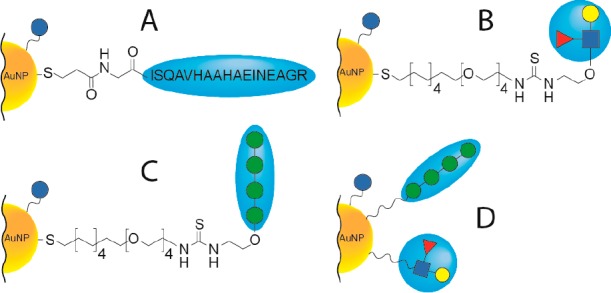
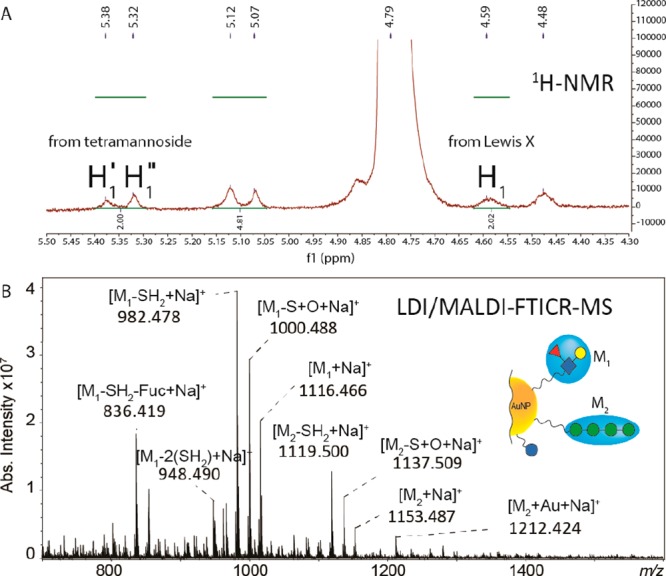
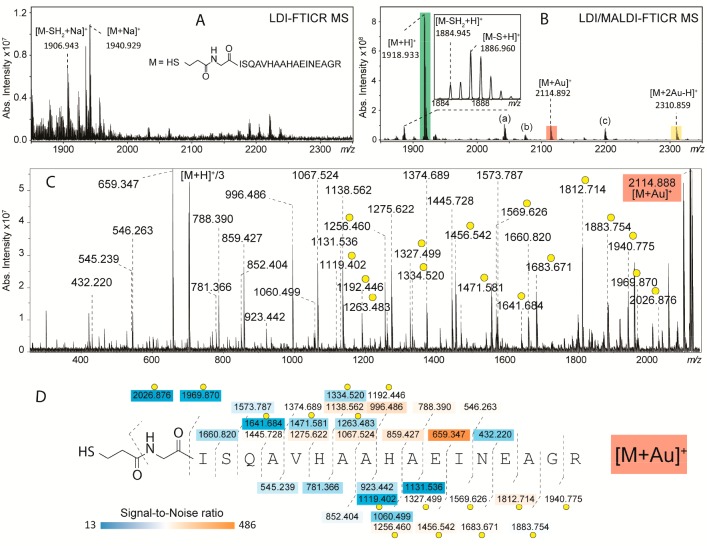
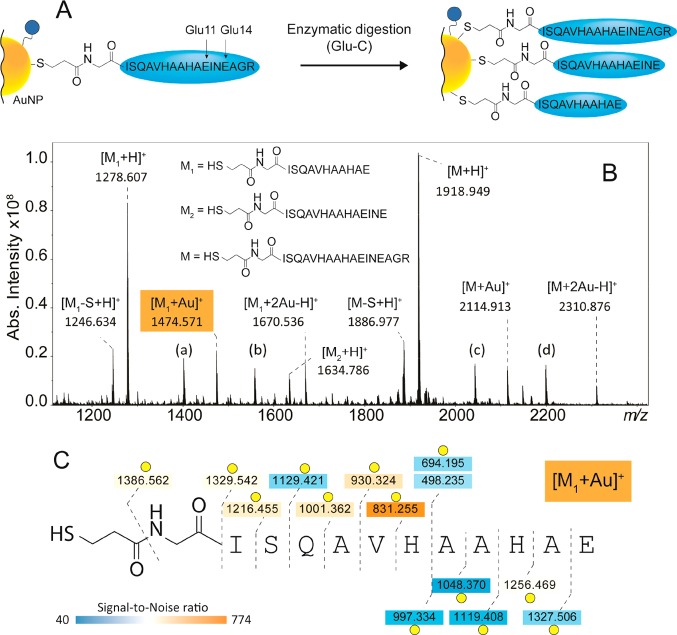
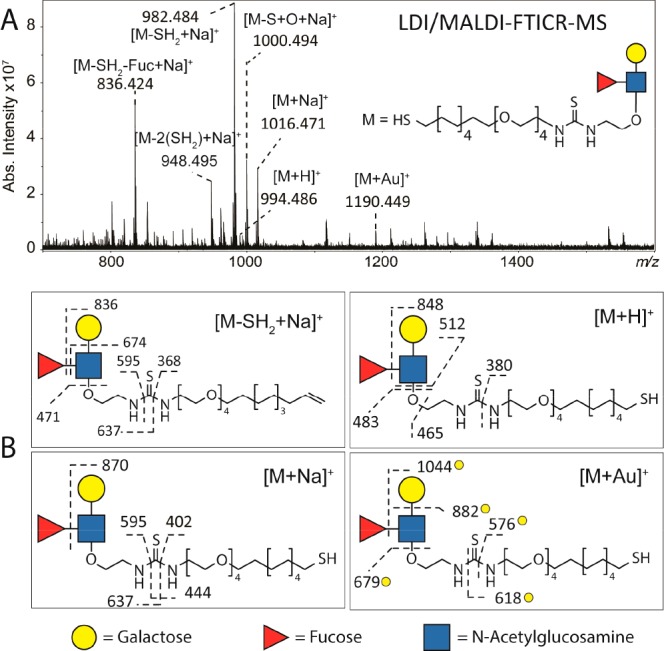
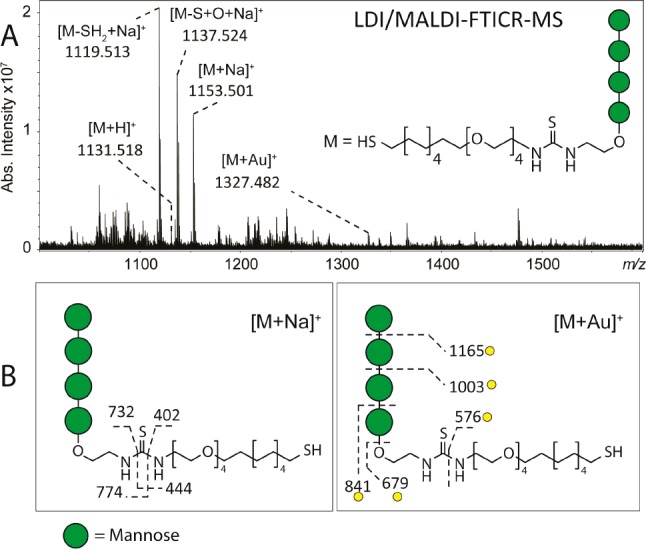
Biofunctionalized gold nanoparticles (AuNPs) enable innovative translational research and development in biomedicine. Biomolecules such as peptides, proteins, lipids, and carbohydrates can be assembled onto AuNPs to yield nanomaterials with unique properties for applications in imaging, photothermal therapy, vaccination strategies, and drug delivery. The characterization of functionalized AuNPs still remains an analytical challenge that normally requires the combination of multiple techniques. Laser desorption/ionization (LDI) and matrix-assisted LDI (MALDI) have been applied successfully in combination with time-of-flight (TOF) mass spectrometry (MS) for the analysis of the surface chemistry of AuNPs functionalized with synthetic ligands, however only for ligands with a molecular mass limited to 1000 Da. TOF-MS-based approaches in addition exhibit limited performance in terms of mass resolution and MS/MS possibilities. To overcome these limitations, we designed an approach for the analysis of AuNPs based on ultrahigh resolution Fourier transform ion cyclotron resonance (FTICR) MS and a combination of LDI and MALDI. To illustrate the performance of the method, we present a comprehensive characterization of the surface chemistry of AuNPs conjugated via a thiol-ending linker to either the ovalbumin peptide (OVA 323-339), the Lewis X antigen (Galβ1-4[Fucα1-3]GlcNAcβ1) trisaccharide, the tetramannoside Manα1-2Manα1-2Manα1-3Manα1, or a mixture of both carbohydrates. Collision-induced dissociation (CID) was used to characterize the structure of pseudomolecular ions generated by LDI/MALDI in-depth. These included [M + H] and [M + Na], and importantly also [M + Au] and [M + 2Au-H] ions. This first observation of gold-containing pseudomolecular ions provides direct evidence for the Au-conjugation of ligands. In addition, we show the applicability of the method to monitor proteolytic cleavage of peptides that are conjugated to the AuNP surface. The presented LDI/MALDI-FTICR-MS and MS/MS approach will be applicable to the characterization of a wide range of functionalized AuNPs.
生物功能化金纳米粒子 (AuNPs) 使医学领域的创新转化研究和开发成为可能。生物分子,如肽、蛋白质、脂质和碳水化合物,可以组装到 AuNPs 上,得到具有独特性能的纳米材料,可应用于成像、光热治疗、疫苗策略和药物输送。功能化 AuNPs 的表征仍然是一个分析挑战,通常需要多种技术的结合。激光解吸/电离 (LDI) 和基质辅助激光解吸/电离 (MALDI) 已成功应用于与飞行时间 (TOF) 质谱 (MS) 结合,用于分析用合成配体功能化的 AuNPs 的表面化学,然而,仅适用于分子量限制在 1000 Da 的配体。基于 TOF-MS 的方法在质量分辨率和 MS/MS 方面的性能也有限。为了克服这些限制,我们设计了一种基于超高分辩率傅里叶变换离子回旋共振 (FTICR) MS 以及 LDI 和 MALDI 结合的 AuNP 分析方法。为了说明该方法的性能,我们对通过硫醇末端接头与卵清蛋白肽 (OVA 323-339)、路易斯 X 抗原 (Galβ1-4[Fucα1-3]GlcNAcβ1) 三糖、四甘露糖苷 Manα1-2Manα1-2Manα1-3Manα1 或两者的混合物连接的 AuNP 的表面化学进行了全面表征。碰撞诱导解离 (CID) 用于深入表征 LDI/MALDI 生成的准分子离子的结构。这些包括 [M + H]+和 [M + Na]+,重要的是还有 [M + Au]+和 [M + 2Au-H] 离子。这些含金准分子离子的首次观察为配体的 Au 键合提供了直接证据。此外,我们还展示了该方法在监测与 AuNP 表面连接的肽的蛋白水解切割方面的适用性。所提出的 LDI/MALDI-FTICR-MS 和 MS/MS 方法将适用于广泛功能化 AuNP 的表征。