Department of Ecology and Evolutionary Biology , Cornell University , Ithaca, NY 14853, USA.
Department of Ecology and Evolutionary Biology , Cornell University , Ithaca, NY 14853, USA ; Department of Biology , University of Central Florida , Orlando, FL 32816, USA.
R Soc Open Sci. 2015 Jul 15;2(7):140377. doi: 10.1098/rsos.140377. eCollection 2015 Jul.
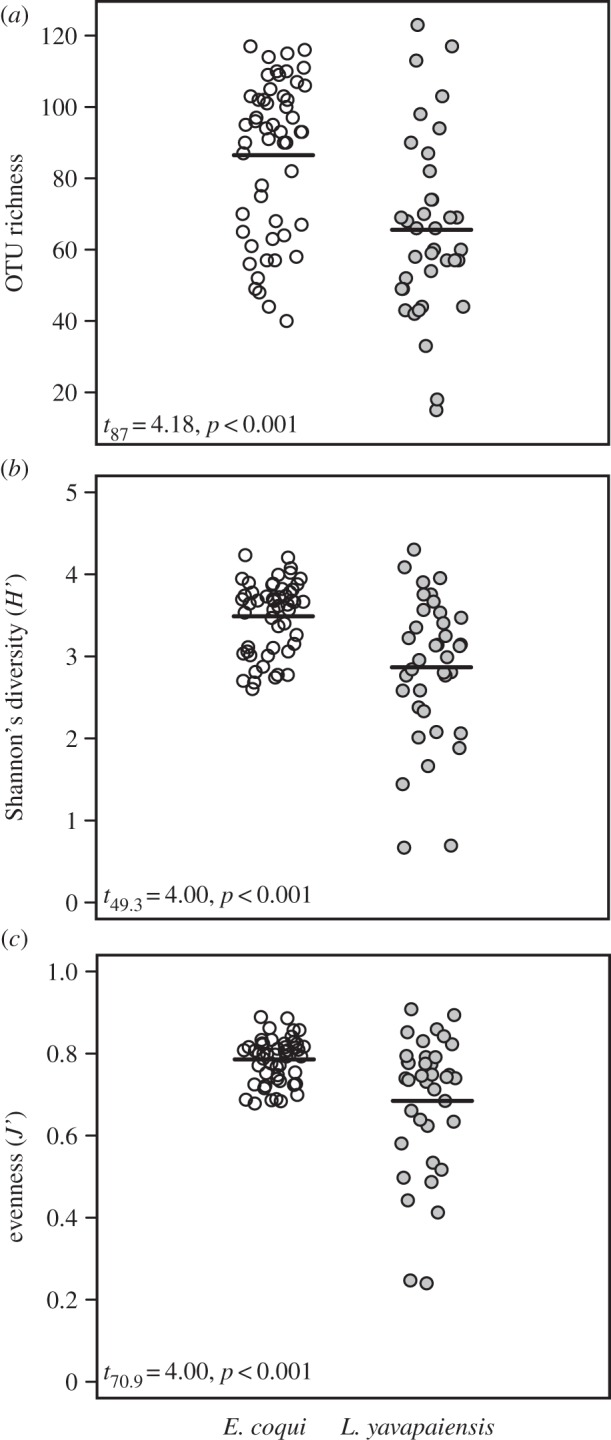
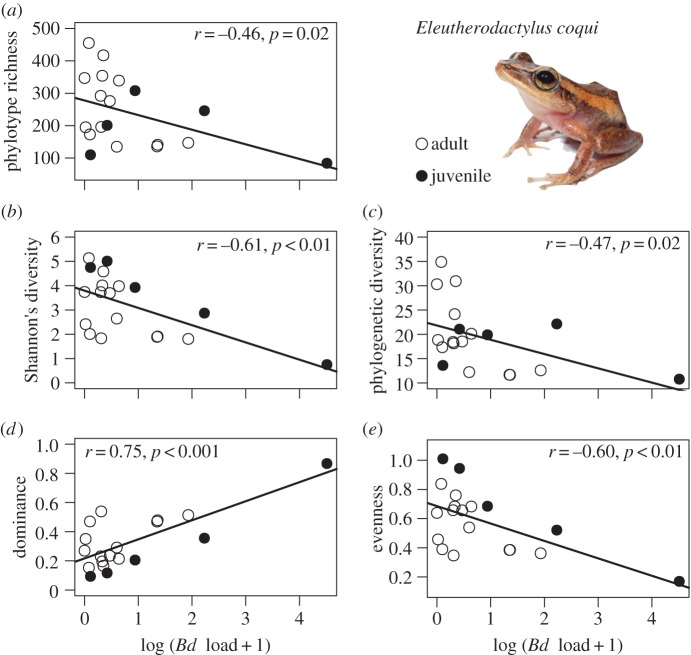
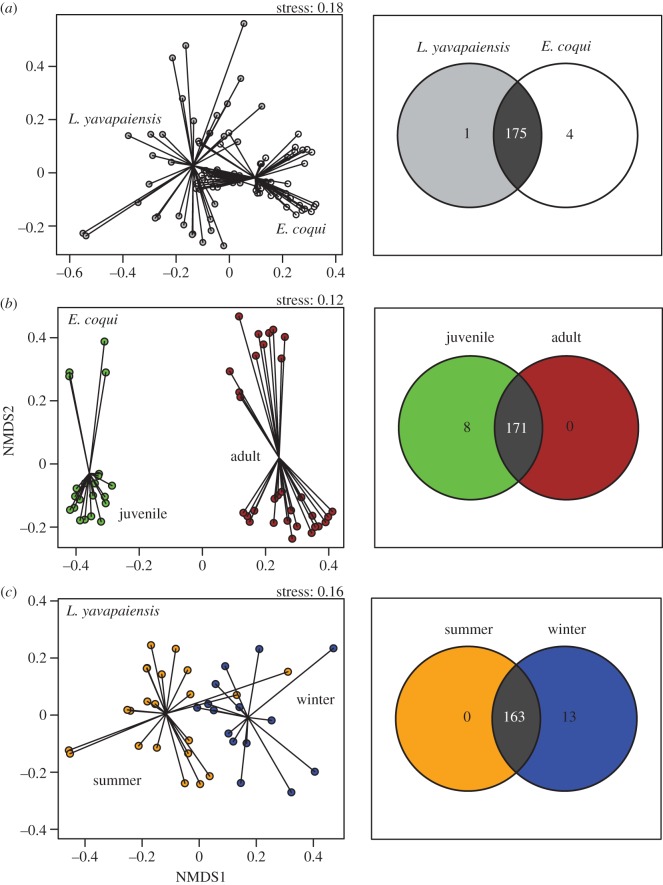
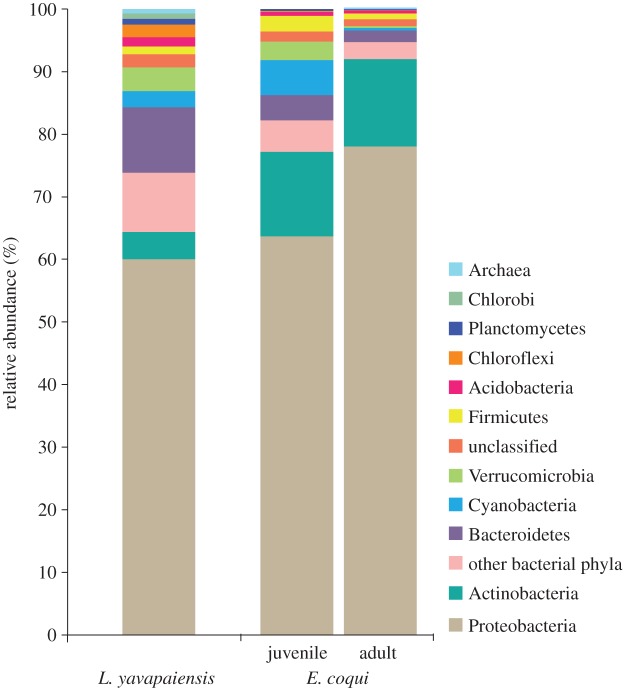
Recently, microbiologists have focused on characterizing the probiotic role of skin bacteria for amphibians threatened by the fungal disease chytridiomycosis. However, the specific characteristics of microbial diversity required to maintain health or trigger disease are still not well understood in natural populations. We hypothesized that seasonal and developmental transitions affecting susceptibility to chytridiomycosis could also alter the stability of microbial assemblages. To test our hypothesis, we examined patterns of skin bacterial diversity in two species of declining amphibians (Lithobates yavapaiensis and Eleutherodactylus coqui) affected by the pathogenic fungus Batrachochytrium dendrobatidis (Bd). We focused on two important transitions that affect Bd susceptibility: ontogenetic (from juvenile to adult) shifts in E. coqui and seasonal (from summer to winter) shifts in L. yavapaiensis. We used a combination of community-fingerprinting analyses and 16S rRNA amplicon sequencing to quantify changes in bacterial diversity and assemblage composition between seasons and developmental stages, and to investigate the relationship between bacterial diversity and pathogen load. We found that winter-sampled frogs and juveniles, two states associated with increased Bd susceptibility, exhibited higher diversity compared with summer-sampled frogs and adult individuals. Our findings also revealed that hosts harbouring higher bacterial diversity carried lower Bd infections, providing support for the protective role of bacterial communities. Ongoing work to understand skin microbiome resilience after pathogen disturbance has the potential to identify key taxa involved in disease resistance.
最近,微生物学家专注于描述皮肤细菌对受真菌疾病壶菌病威胁的两栖动物的益生菌作用。然而,在自然种群中,维持健康或引发疾病所需的微生物多样性的具体特征仍未得到很好的理解。我们假设,影响对壶菌病易感性的季节性和发育性转变也可能改变微生物组合的稳定性。为了验证我们的假设,我们研究了受致病真菌 Batrachochytrium dendrobatidis (Bd)影响的两种数量下降的两栖动物(Lithobates yavapaiensis 和 Eleutherodactylus coqui)的皮肤细菌多样性模式。我们关注了两个影响 Bd 易感性的重要转变:E. coqui 的个体发育(从幼年到成年)转变和 L. yavapaiensis 的季节性(从夏季到冬季)转变。我们使用群落指纹分析和 16S rRNA 扩增子测序的组合来量化季节和发育阶段之间细菌多样性和组合组成的变化,并研究细菌多样性与病原体负荷之间的关系。我们发现,与夏季采样的青蛙和成年个体相比,冬季采样的青蛙和幼蛙表现出更高的多样性,这两个状态与 Bd 易感性增加有关。我们的研究结果还表明,携带更高细菌多样性的宿主携带的 Bd 感染较低,这为细菌群落的保护作用提供了支持。正在进行的研究旨在了解病原体干扰后皮肤微生物组的恢复能力,有潜力确定参与疾病抵抗的关键分类群。