Brotherton Lindsay, Welton Michael, Robb Sara W
Department of Epidemiology and Biostatistics, College of Public Health, University of Georgia, Athens, Georgia.
Cancer Med. 2016 Jan;5(1):100-10. doi: 10.1002/cam4.552. Epub 2015 Nov 21.
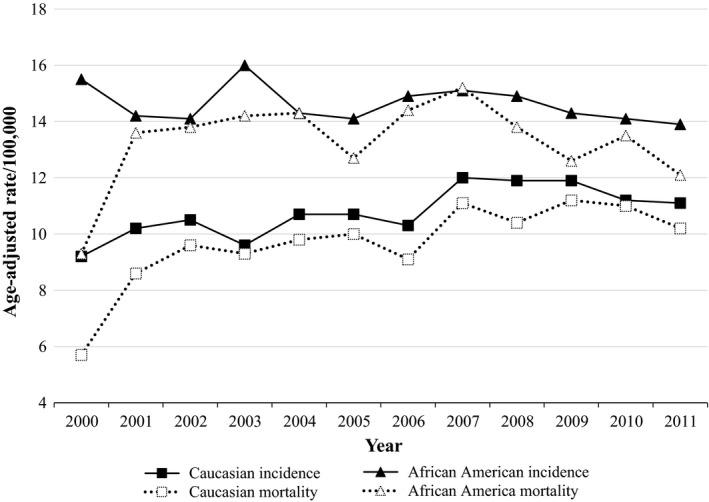
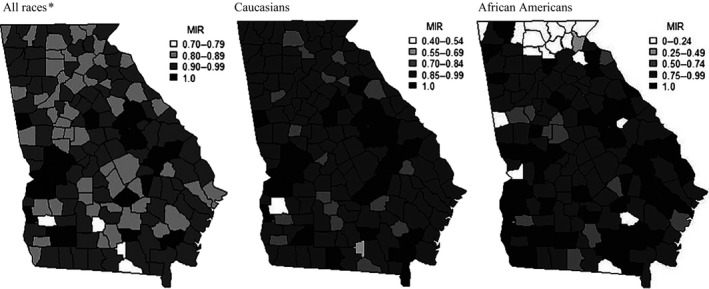
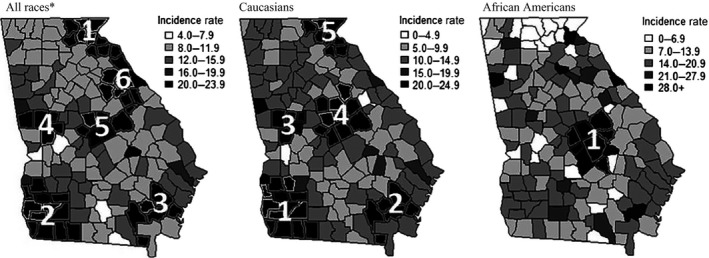
Understanding the geographic distribution of pancreatic cancer is important in assessing disease burden and identifying high-risk populations. This study examined the geographic trends of pancreatic cancer incidence, mortality, and mortality-to-incidence ratios (MIRs) in Georgia, with a special focus on racial disparities of disease. Directly age-adjusted pancreatic cancer incidence and mortality rates for Georgia counties (N = 159) were obtained for 2000-2011. Maps of county age-adjusted disease rates and MIRs were generated separately for African Americans and Caucasians. Cluster analyses were conducted to identify unusual geographic aggregations of cancer cases or deaths. Pearson correlation coefficients were calculated to examine associations between county health factors (e.g., health behaviors, clinical care, and physical environment) and pancreatic cancer incidence or mortality rates. African Americans displayed a significantly higher age-adjusted incidence (14.6/100,000) and mortality rate (13.3/100,000), compared to Caucasians. Cluster analyses identified five significant incidence clusters and four significant mortality clusters among Caucasians; one significant incidence cluster and two significant mortality clusters were identified among African Americans. Weak but significant correlations were noted between physical environment and pancreatic cancer incidence (ρ = 0.16, P = 0.04) and mortality (ρ = 0.18, P = 0.02) among African Americans. A disproportion burden of pancreatic cancer incidence and mortality was exhibited among African Americans in Georgia. Disease intervention efforts should be implemented in high-risk areas, such as the southwest and central region of the state. Future studies should assess health behaviors and physical environment in relationship with the spatial distribution of pancreatic cancer.
了解胰腺癌的地理分布对于评估疾病负担和识别高危人群至关重要。本研究调查了佐治亚州胰腺癌发病率、死亡率及死亡率与发病率之比(MIR)的地理趋势,特别关注了疾病的种族差异。获取了佐治亚州各县(N = 159)2000 - 2011年直接年龄调整后的胰腺癌发病率和死亡率。分别为非裔美国人和白人绘制了各县年龄调整后的疾病率和MIR地图。进行聚类分析以识别癌症病例或死亡的异常地理聚集情况。计算皮尔逊相关系数以检验县健康因素(如健康行为、临床护理和物理环境)与胰腺癌发病率或死亡率之间的关联。与白人相比,非裔美国人的年龄调整后发病率(14.6/10万)和死亡率(13.3/10万)显著更高。聚类分析在白人中识别出五个显著的发病簇和四个显著的死亡簇;在非裔美国人中识别出一个显著的发病簇和两个显著的死亡簇。在非裔美国人中,注意到物理环境与胰腺癌发病率(ρ = 0.16,P = 0.04)和死亡率(ρ = 0.18,P = 0.02)之间存在微弱但显著的相关性。佐治亚州非裔美国人的胰腺癌发病率和死亡率负担不均衡。应在该州西南部和中部等高危地区开展疾病干预工作。未来的研究应评估健康行为和物理环境与胰腺癌空间分布的关系。