Department of Cancer Epidemiology, Moffitt Cancer Center, Tampa, Florida.
Department of Gastrointestinal Oncology, Moffitt Cancer Center, Tampa, Florida.
Cancer Med. 2019 Jun;8(6):3314-3324. doi: 10.1002/cam4.2180. Epub 2019 May 9.
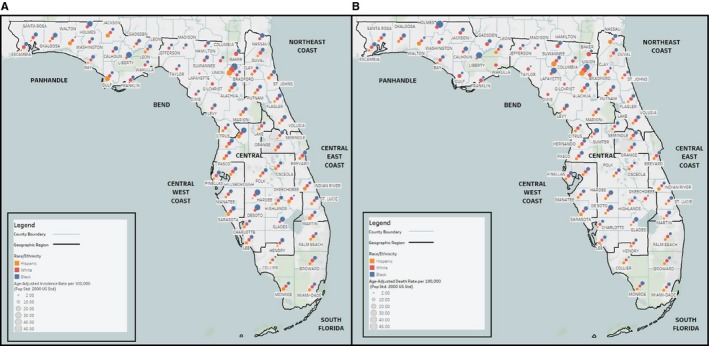
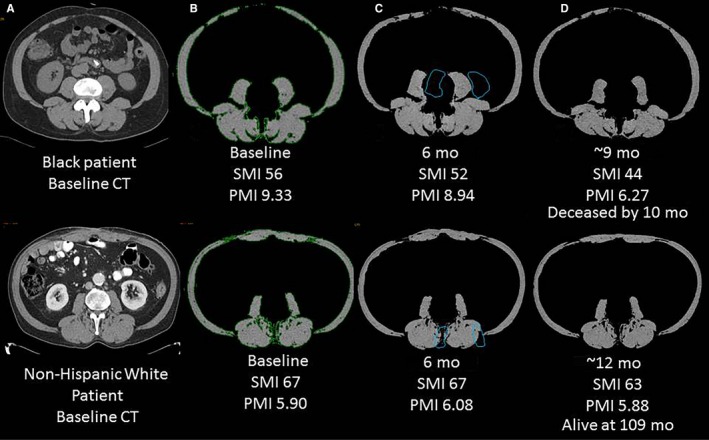
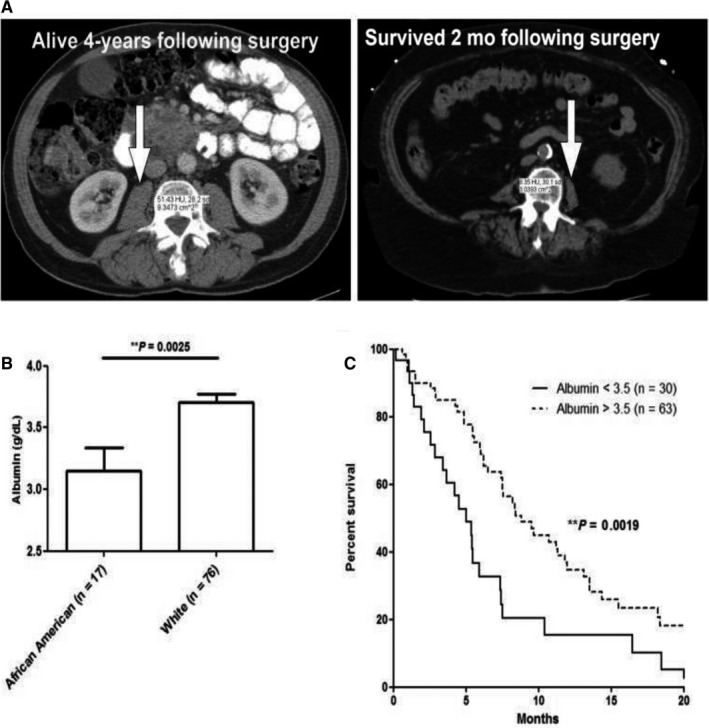
Pancreatic cancer (PC) is characterized by racial/ethnic disparities and the debilitating muscle-wasting condition, cancer cachexia. Florida ranks second in the number of PC deaths and has a large and understudied minority population. We examined the primary hypothesis that PC incidence and mortality rates may be highest among Black Floridians and the secondary hypothesis that biological correlates of cancer cachexia may underlie disparities. PC incidence and mortality rates were estimated by race/ethnicity, gender, and county using publicly available state-wide cancer registry data that included approximately 2700 Black, 25 200 Non-Hispanic White (NHW), and 3300 Hispanic/Latino (H/L) Floridians diagnosed between 2004 and 2014. Blacks within Florida experienced a significantly (P < 0.05) higher incidence (12.5/100 000) and mortality (10.97/100 000) compared to NHW (incidence = 11.2/100 000; mortality = 10.3/100 000) and H/L (incidence = 9.6/100 000; mortality = 8.7/100 000), especially in rural counties. To investigate radiologic and blood-based correlates of cachexia, we leveraged data from a subset of patients evaluated at two geographically distinct Florida Cancer Centers. In Blacks compared to NHW matched on stage, markers of PC-induced cachexia were more frequent and included greater decreases in core musculature compared to corresponding healthy control patients (25.0% vs 10.1% lower), greater decreases in psoas musculature over time (10.5% vs 4.8% loss), lower baseline serum albumin levels (3.8 vs 4.0 gm/dL), and higher platelet counts (332.8 vs 268.7 k/UL). Together, these findings suggest for the first time that PC and cachexia may affect Blacks disproportionately. Given its nearly universal contribution to illness and PC-related deaths, the early diagnosis and treatment of cachexia may represent an avenue to improve health equity, quality of life, and survival.
胰腺癌(PC)的特征是存在种族/民族差异和使人衰弱的肌肉消耗状况,即癌症恶病质。佛罗里达州的 PC 死亡人数排名第二,且拥有庞大且研究不足的少数民族人口。我们检验了两个主要假设,即 PC 的发病率和死亡率可能在佛罗里达州黑人中最高,以及癌症恶病质的生物学相关因素可能是造成差异的基础。使用公共的全州癌症登记处数据,通过种族/民族、性别和县来估计 PC 的发病率和死亡率,这些数据包括 2004 年至 2014 年间诊断出的约 2700 名黑人、25200 名非西班牙裔白人(NHW)和 3300 名西班牙裔/拉丁裔(H/L)佛罗里达人。佛罗里达州的黑人经历的发病率(12.5/100000)和死亡率(10.97/100000)明显高于 NHW(发病率=11.2/100000;死亡率=10.3/100000)和 H/L(发病率=9.6/100000;死亡率=8.7/100000),尤其是在农村县。为了研究恶病质的影像学和血液相关指标,我们利用了在两个地理位置不同的佛罗里达癌症中心评估的一部分患者的数据。与 NHW 相比,在匹配分期的情况下,黑人患者中与 PC 相关的恶病质的标志物更为常见,包括核心肌肉群的减少幅度更大(低 25.0%,而低 10.1%),与相应的健康对照患者相比,腰大肌肌肉群随时间的减少幅度更大(10.5% vs 4.8%损失),基线血清白蛋白水平更低(3.8 与 4.0gm/dL),血小板计数更高(332.8 与 268.7k/UL)。综上所述,这些发现首次表明,PC 和恶病质可能不成比例地影响黑人。鉴于其对疾病和 PC 相关死亡的几乎普遍贡献,恶病质的早期诊断和治疗可能是改善健康公平、生活质量和生存的途径。