Baratchart Etienne, Benzekry Sébastien, Bikfalvi Andreas, Colin Thierry, Cooley Lindsay S, Pineau Raphäel, Ribot Emeline J, Saut Olivier, Souleyreau Wilfried
INRIA Bordeaux-Sud-Ouest team MONC; University of Bordeaux, IMB, UMR 5251; CNRS, IMB, UMR 5251; Bordeaux INP, IMB, UMR 5251,Talence, France.
LAMC, INSERM U1029, University of Bordeaux, Pessac, France.
PLoS Comput Biol. 2015 Nov 23;11(11):e1004626. doi: 10.1371/journal.pcbi.1004626. eCollection 2015 Nov.
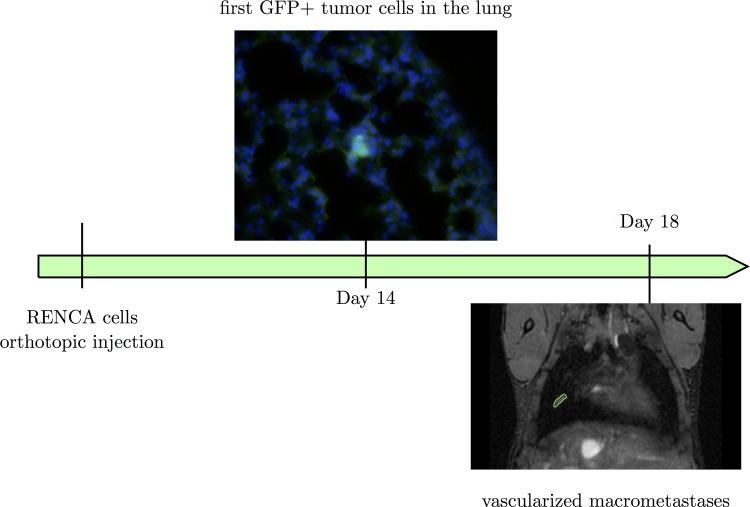
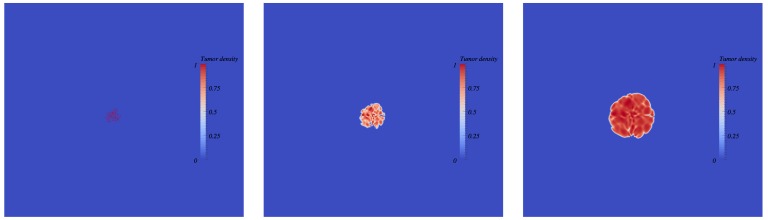
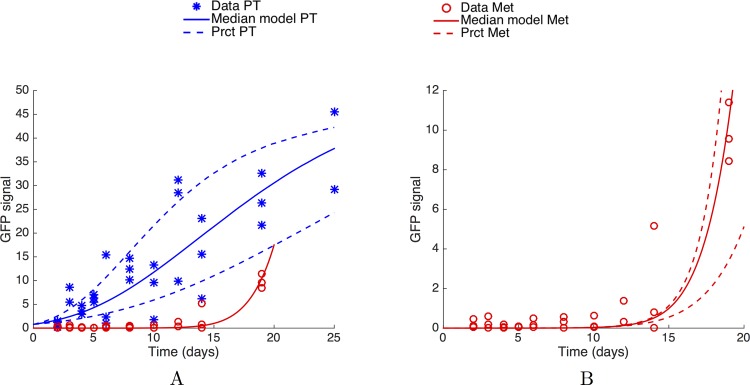
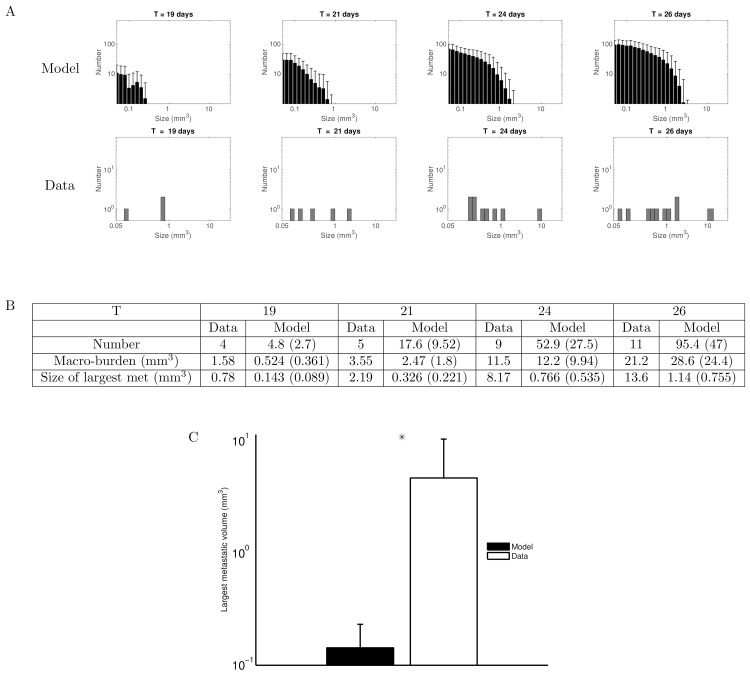
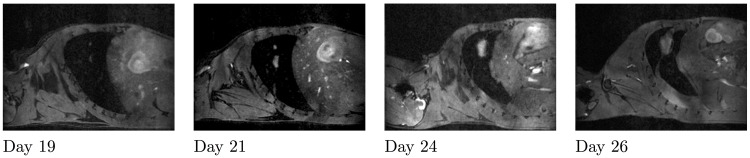
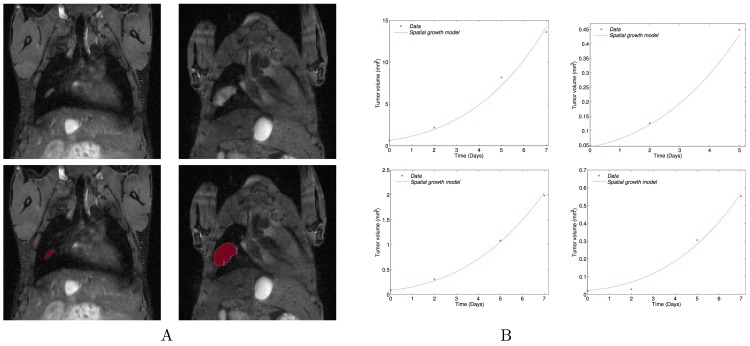
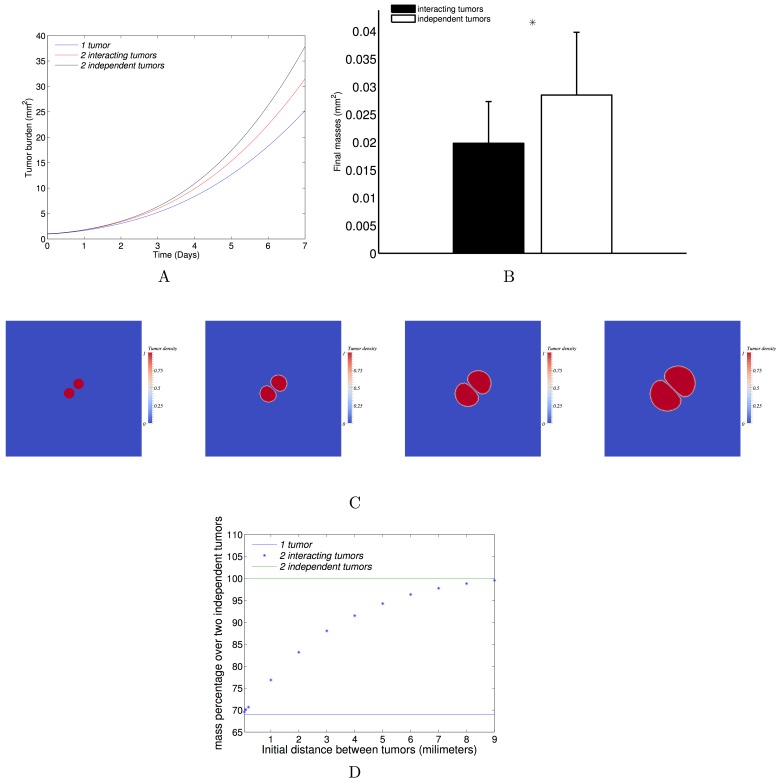
The biology of the metastatic colonization process remains a poorly understood phenomenon. To improve our knowledge of its dynamics, we conducted a modelling study based on multi-modal data from an orthotopic murine experimental system of metastatic renal cell carcinoma. The standard theory of metastatic colonization usually assumes that secondary tumours, once established at a distant site, grow independently from each other and from the primary tumour. Using a mathematical model that translates this assumption into equations, we challenged this theory against our data that included: 1) dynamics of primary tumour cells in the kidney and metastatic cells in the lungs, retrieved by green fluorescent protein tracking, and 2) magnetic resonance images (MRI) informing on the number and size of macroscopic lesions. Critically, when calibrated on the growth of the primary tumour and total metastatic burden, the predicted theoretical size distributions were not in agreement with the MRI observations. Moreover, tumour expansion only based on proliferation was not able to explain the volume increase of the metastatic lesions. These findings strongly suggested rejection of the standard theory, demonstrating that the time development of the size distribution of metastases could not be explained by independent growth of metastatic foci. This led us to investigate the effect of spatial interactions between merging metastatic tumours on the dynamics of the global metastatic burden. We derived a mathematical model of spatial tumour growth, confronted it with experimental data of single metastatic tumour growth, and used it to provide insights on the dynamics of multiple tumours growing in close vicinity. Together, our results have implications for theories of the metastatic process and suggest that global dynamics of metastasis development is dependent on spatial interactions between metastatic lesions.
转移定植过程的生物学机制仍是一个了解甚少的现象。为了增进我们对其动态变化的认识,我们基于转移性肾细胞癌原位小鼠实验系统的多模态数据进行了一项建模研究。转移性定植的标准理论通常假定,继发性肿瘤一旦在远处部位形成,就会彼此独立生长,并且与原发性肿瘤独立生长。我们使用一个将这一假设转化为方程的数学模型,依据我们的数据对该理论提出了质疑,这些数据包括:1)通过绿色荧光蛋白追踪获得的肾脏原发性肿瘤细胞和肺部转移细胞的动态变化,以及2)提供宏观病变数量和大小信息的磁共振成像(MRI)。至关重要的是,当根据原发性肿瘤的生长和总的转移负担进行校准时,预测的理论大小分布与MRI观察结果不一致。此外,仅基于增殖的肿瘤扩展无法解释转移病灶的体积增加。这些发现强烈表明应摒弃标准理论,证明转移灶大小分布的时间演变无法通过转移灶的独立生长来解释。这促使我们研究合并的转移性肿瘤之间的空间相互作用对整体转移负担动态变化的影响。我们推导了一个空间肿瘤生长的数学模型,将其与单个转移性肿瘤生长的实验数据进行对比,并利用它来深入了解在附近生长的多个肿瘤的动态变化。总之,我们的结果对转移过程的理论具有启示意义,并表明转移发展的整体动态变化取决于转移病灶之间的空间相互作用。