Baylis James R, Yeon Ju Hun, Thomson Max H, Kazerooni Amir, Wang Xu, St John Alex E, Lim Esther B, Chien Diana, Lee Anna, Zhang Jesse Q, Piret James M, Machan Lindsay S, Burke Thomas F, White Nathan J, Kastrup Christian J
Michael Smith Laboratories, University of British Columbia, Vancouver, British Columbia V6T 1Z4, Canada. ; Biomedical Engineering Program, University of British Columbia, Vancouver, British Columbia V6T 1Z4, Canada.
Michael Smith Laboratories, University of British Columbia, Vancouver, British Columbia V6T 1Z4, Canada. ; Department of Biochemistry and Molecular Biology, University of British Columbia, Vancouver, British Columbia V6T 1Z4, Canada.
Sci Adv. 2015 Oct 2;1(9):e1500379. doi: 10.1126/sciadv.1500379. eCollection 2015 Oct.
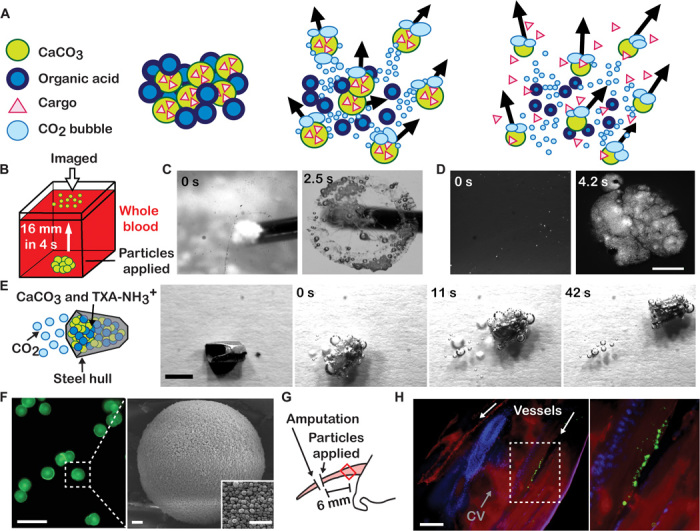
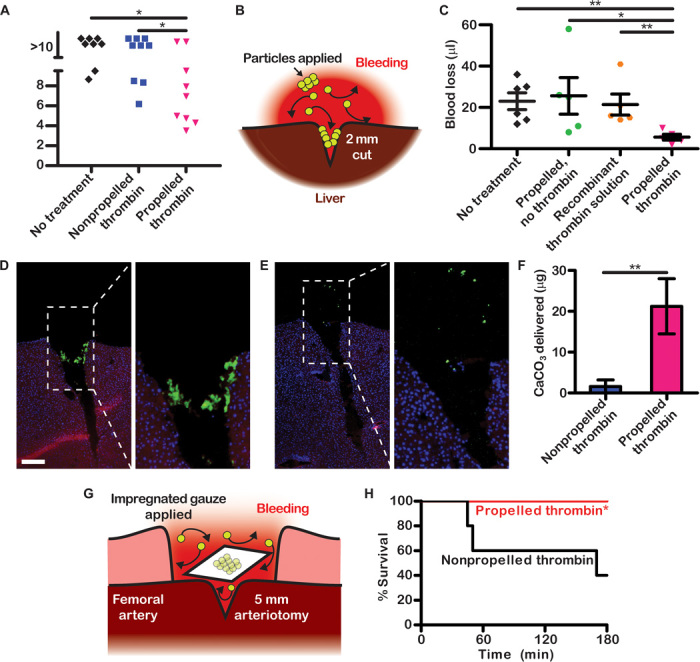
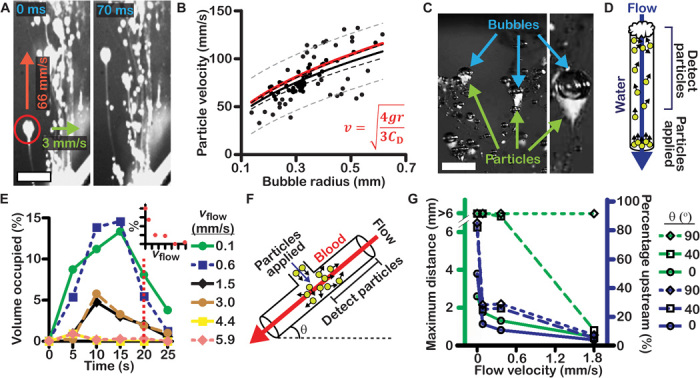
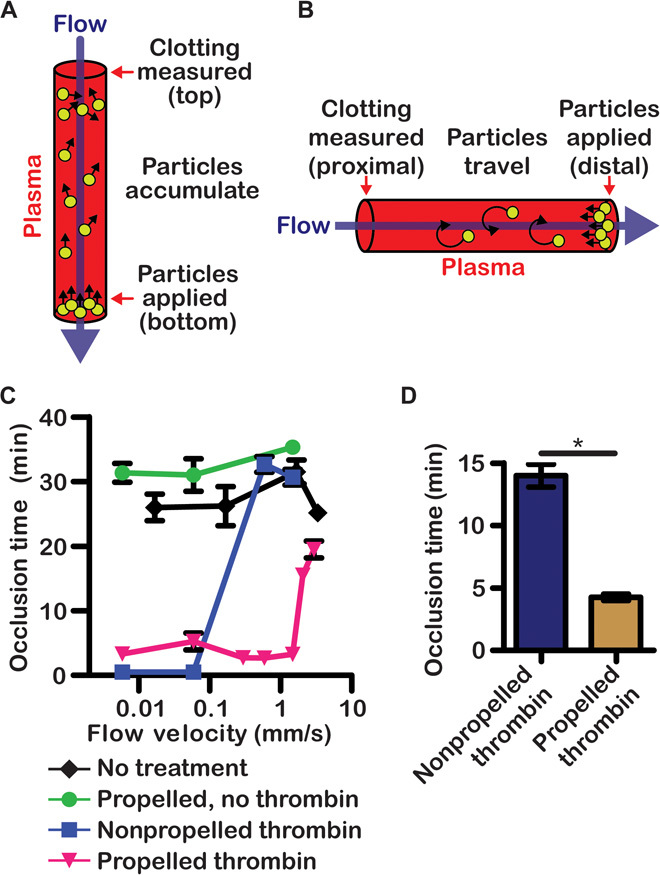
Delivering therapeutics deep into damaged tissue during bleeding is challenging because of the outward flow of blood. When coagulants cannot reach and clot blood at its source, uncontrolled bleeding can occur and increase surgical complications and fatalities. Self-propelling particles have been proposed as a strategy for transporting agents upstream through blood. Many nanoparticle and microparticle systems exhibiting autonomous or collective movement have been developed, but propulsion has not been used successfully in blood or used in vivo to transport therapeutics. We show that simple gas-generating microparticles consisting of carbonate and tranexamic acid traveled through aqueous solutions at velocities of up to 1.5 cm/s and delivered therapeutics millimeters into the vasculature of wounds. The particles transported themselves through a combination of lateral propulsion, buoyant rise, and convection. When loaded with active thrombin, these particles worked effectively as a hemostatic agent and halted severe hemorrhage in multiple animal models of intraoperative and traumatic bleeding. Many medical applications have been suggested for self-propelling particles, and the findings of this study show that the active self-fueled transport of particles can function in vivo to enhance drug delivery.
在出血期间将治疗药物深入递送至受损组织具有挑战性,因为血液会向外流动。当凝血剂无法到达出血源头并使血液凝结时,就会发生不受控制的出血,并增加手术并发症和死亡率。自推进颗粒已被提议作为一种使药物通过血液向上游运输的策略。已经开发出许多具有自主或集体运动的纳米颗粒和微粒系统,但推进技术尚未在血液中成功应用,也未在体内用于运输治疗药物。我们发现,由碳酸盐和氨甲环酸组成的简单产气微粒能够以高达1.5厘米/秒的速度在水溶液中移动,并将治疗药物输送到伤口血管系统的毫米深处。这些微粒通过侧向推进、浮力上升和对流的组合实现自我运输。当装载有活性凝血酶时,这些微粒作为止血剂发挥了有效作用,并在多种术中及创伤性出血的动物模型中止住了严重出血。自推进颗粒已被提出用于许多医学应用,本研究结果表明,颗粒的主动自供能运输在体内能够发挥作用以增强药物递送。