Degerud E, Hoff R, Nygård O, Strand E, Nilsen D W, Nordrehaug J E, Midttun Ø, Ueland P M, de Vogel S, Dierkes J
Department of Clinical Medicine, University of Bergen, Bergen, Norway.
The Institute of Basic Medical Sciences, University of Oslo, Oslo, Norway.
Eur J Clin Nutr. 2016 Apr;70(4):517-22. doi: 10.1038/ejcn.2015.200. Epub 2015 Nov 25.
BACKGROUND/OBJECTIVES: Seasonal variation may reduce the validity of 25-hydroxyvitamin D (25OHD) as a biomarker of vitamin D status. Here we aimed to identify potential determinants of seasonal variation in 25OHD concentrations and to evaluate cosinor modelling as a method to adjust single 25OHD measurements for seasonal variation.
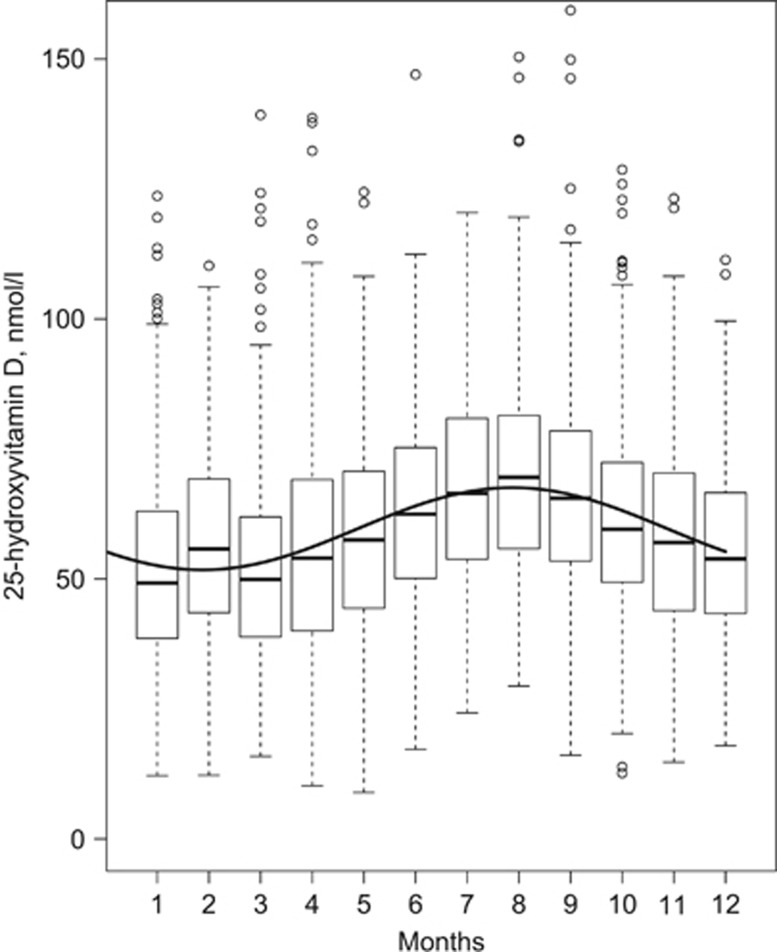
SUBJECTS/METHODS: In Caucasian cardiovascular patients (1999-2004), we measured 25OHD by liquid chromatography tandem mass spectrometry in 4116 baseline and 528 follow-up samples. To baseline values, we fitted a cosinor model for monthly concentrations of 25OHD. Using the model, we estimated each patient's adjusted annual 25OHD value. Further, we studied how covariates affected the annual mean 25OHD concentration and seasonal variation of the study cohort. To evaluate the model, we predicted follow-up measurements with and without covariates and compared accuracy with carrying forward baseline values and linear regression adjusting for season, common approaches in research and clinical practice, respectively.
The annual mean (59.6 nmol/l) was associated with participants' age, gender, smoking status, body mass, physical activity level, diabetes diagnosis, vitamin D supplement use and study site (adjusted models, P<0.05). Seasonal 25OHD variation was 15.8 nmol/l, and older age (>62 years) was associated with less variation (adjusted model, P=0.025). Prediction of follow-up measurements was more accurate with the cosinor model compared with the other approaches (P<0.05). Adding covariates to cosinor models did not improve prediction (P>0.05).
We find cosinor models suitable and flexible for analysing and adjusting for seasonal variation in 25OHD concentrations, which is influenced by age.
背景/目的:季节变化可能会降低25-羟维生素D(25OHD)作为维生素D状态生物标志物的有效性。在此,我们旨在确定25OHD浓度季节性变化的潜在决定因素,并评估余弦分析模型作为一种针对季节变化调整单次25OHD测量值的方法。
对象/方法:在白种人心血管疾病患者(1999 - 2004年)中,我们采用液相色谱串联质谱法对4116份基线样本和528份随访样本进行了25OHD检测。针对基线值,我们为25OHD的月度浓度拟合了一个余弦分析模型。利用该模型,我们估算了每位患者经调整的年度25OHD值。此外,我们研究了协变量如何影响研究队列的年度平均25OHD浓度和季节性变化。为评估该模型,我们在有和没有协变量的情况下预测随访测量值,并分别与沿用基线值和针对季节进行线性回归调整(研究和临床实践中的常用方法)的准确性进行比较。
年度平均值(59.6 nmol/l)与参与者的年龄、性别、吸烟状况、体重、身体活动水平、糖尿病诊断、维生素D补充剂使用情况及研究地点相关(调整模型,P<0.05)。25OHD的季节性变化为15.8 nmol/l,年龄较大(>62岁)与变化较小相关(调整模型,P = 0.025)。与其他方法相比,余弦分析模型对随访测量值的预测更准确(P<0.05)。向余弦分析模型中添加协变量并未改善预测效果(P>0.05)。
我们发现余弦分析模型适用于且灵活用于分析和调整25OHD浓度的季节性变化,而这种变化受年龄影响。