Prescott Jennifer, Setiawan Veronica W, Wentzensen Nicolas, Schumacher Fredrick, Yu Herbert, Delahanty Ryan, Bernstein Leslie, Chanock Stephen J, Chen Chu, Cook Linda S, Friedenreich Christine, Garcia-Closas Monserrat, Haiman Christopher A, Le Marchand Loic, Liang Xiaolin, Lissowska Jolanta, Lu Lingeng, Magliocco Anthony M, Olson Sara H, Risch Harvey A, Shu Xiao-Ou, Ursin Giske, Yang Hannah P, Kraft Peter, De Vivo Immaculata
Channing Division of Network Medicine, Department of Medicine, Brigham and Women's Hospital and Harvard Medical School, Boston, Massachusetts, United States of America.
Program in Genetic Epidemiology and Statistical Genetics, Department of Epidemiology, Harvard T. H. Chan School of Public Health, Boston, Massachusetts, United States of America.
PLoS One. 2015 Nov 25;10(11):e0143256. doi: 10.1371/journal.pone.0143256. eCollection 2015.
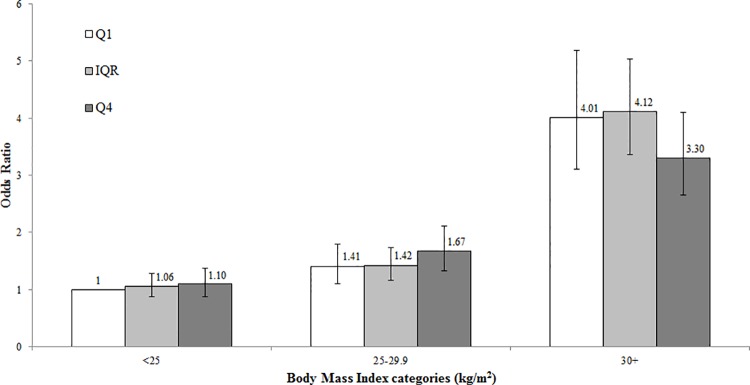
Genome-wide association studies (GWAS) have identified common variants that predispose individuals to a higher body mass index (BMI), an independent risk factor for endometrial cancer. Composite genotype risk scores (GRS) based on the joint effect of published BMI risk loci were used to explore whether endometrial cancer shares a genetic background with obesity. Genotype and risk factor data were available on 3,376 endometrial cancer case and 3,867 control participants of European ancestry from the Epidemiology of Endometrial Cancer Consortium GWAS. A BMI GRS was calculated by summing the number of BMI risk alleles at 97 independent loci. For exploratory analyses, additional GRSs were based on subsets of risk loci within putative etiologic BMI pathways. The BMI GRS was statistically significantly associated with endometrial cancer risk (P = 0.002). For every 10 BMI risk alleles a woman had a 13% increased endometrial cancer risk (95% CI: 4%, 22%). However, after adjusting for BMI, the BMI GRS was no longer associated with risk (per 10 BMI risk alleles OR = 0.99, 95% CI: 0.91, 1.07; P = 0.78). Heterogeneity by BMI did not reach statistical significance (P = 0.06), and no effect modification was noted by age, GWAS Stage, study design or between studies (P≥0.58). In exploratory analyses, the GRS defined by variants at loci containing monogenic obesity syndrome genes was associated with reduced endometrial cancer risk independent of BMI (per BMI risk allele OR = 0.92, 95% CI: 0.88, 0.96; P = 2.1 x 10⁻⁵). Possessing a large number of BMI risk alleles does not increase endometrial cancer risk above that conferred by excess body weight among women of European descent. Thus, the GRS based on all current established BMI loci does not provide added value independent of BMI. Future studies are required to validate the unexpected observed relation between monogenic obesity syndrome genetic variants and endometrial cancer risk.
全基因组关联研究(GWAS)已识别出一些常见变异,这些变异使个体具有更高的体重指数(BMI),而BMI是子宫内膜癌的一个独立危险因素。基于已发表的BMI风险位点的联合效应的复合基因型风险评分(GRS)被用于探究子宫内膜癌是否与肥胖症具有共同的遗传背景。来自子宫内膜癌联盟GWAS的3376例子宫内膜癌病例和3867例欧洲血统对照参与者的基因型和风险因素数据可用。通过对97个独立位点的BMI风险等位基因数量求和来计算BMI GRS。为了进行探索性分析,额外的GRS基于假定的病因性BMI途径内的风险位点子集。BMI GRS与子宫内膜癌风险具有统计学显著关联(P = 0.002)。女性每有10个BMI风险等位基因,患子宫内膜癌的风险就增加13%(95%置信区间:4%,22%)。然而,在对BMI进行校正后,BMI GRS与风险不再相关(每10个BMI风险等位基因的比值比为0.99,95%置信区间:0.91,1.07;P = 0.78)。按BMI分层的异质性未达到统计学显著性(P = 0.06),并且在年龄、GWAS阶段、研究设计或研究之间均未观察到效应修饰(P≥0.58)。在探索性分析中,由包含单基因肥胖综合征基因的位点处的变异定义的GRS与独立于BMI的降低的子宫内膜癌风险相关(每个BMI风险等位基因的比值比为0.92,95%置信区间:0.88,0.96;P = 2.1×10⁻⁵)。在欧洲血统女性中,拥有大量BMI风险等位基因并不会使子宫内膜癌风险高于超重所带来的风险。因此,基于所有当前已确定的BMI位点的GRS在独立于BMI的情况下并未提供额外价值。未来的研究需要验证单基因肥胖综合征遗传变异与子宫内膜癌风险之间意外观察到的关系。