Li Cheng-Wen, Li Yan-Dong, Tian Hai-Tao, Kong Xian-Gang, Chen Kui
Department of Anesthesiology, Jining No. 1 People's Hospital, Jining, Shandong 272011, China.
Chin Med J (Engl). 2015 Dec 5;128(23):3143-8. doi: 10.4103/0366-6999.170260.
Awake fiberoptic intubation (AFOI) is usually performed in the management of the predicted difficult airway. The aim of this study was to evaluate the feasibility of dexmedetomidine with midazolam (DM) and sufentanil with midazolam (SM) for sedation for awake fiberoptic nasotracheal intubation.
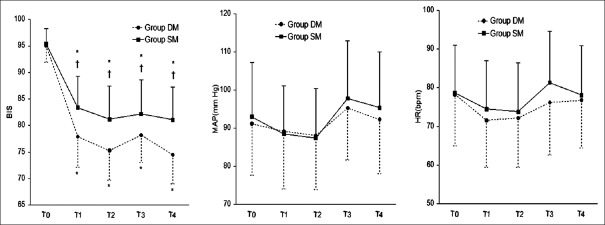
Fifty patients with limited mouth opening scheduled for AFOI were randomly assigned to two groups (n = 25 per group) by a computer-generated randomization schedule. All subjects received midazolam 0.02 mg/kg as premedication and airway topical anesthesia with a modified "spray-as-you-go" technique. Group DM received dexmedetomidine at a loading dose of 0.5 μg/kg over 10 min followed by a continuous infusion of 0.25 μg·kg-1·h-1, whereas Group SM received sufentanil at a loading dose of 0.2 μg/kg over 10 min followed by a continuous infusion of 0.1 μg·kg-1·h-1. As necessary, since the end of the administration of the loading dose of the study drug, an additional dose of midazolam 0.5 mg at 2-min intervals was given to achieve a modified Observers' Assessment of Alertness/Sedation of 2-3. The quality of intubation conditions and adverse events were observed.
The scores of ease of the AFOI procedure, patient's reaction during AFOI, coughing severity, tolerance after intubation, recall of the procedure and discomfort during the procedure were comparable in both groups (z = 0.572, 0.664, 1.297, 0.467, 0.895, and 0.188, respectively, P > 0.05). Hypoxic episodes similarly occurred in the two groups, but the first partial pressure of end-tidal CO2after intubation was higher in Group SM than that in Group DM (45.2 ± 4.2 mmHg vs. 42.2 ± 4.3 mmHg, t = 2.495, P < 0.05).
Both dexmedetomidine and sufentanil are effective as an adjuvant for AFOI under airway topical anesthesia combined with midazolam sedation, but respiratory depression is still a potential risk in the sufentanil regimen.
清醒纤维支气管镜引导插管(AFOI)通常用于预计困难气道的处理。本研究旨在评估右美托咪定联合咪达唑仑(DM)和舒芬太尼联合咪达唑仑(SM)用于清醒纤维支气管镜引导经鼻气管插管镇静的可行性。
将50例计划行AFOI且张口受限的患者通过计算机生成的随机分组方案随机分为两组(每组n = 25)。所有受试者均接受0.02 mg/kg咪达唑仑作为术前用药,并采用改良的“边走边喷”技术进行气道表面麻醉。DM组在10分钟内静脉注射负荷剂量0.5 μg/kg右美托咪定,随后以0.25 μg·kg-1·h-1的速度持续输注;而SM组在10分钟内静脉注射负荷剂量0.2 μg/kg舒芬太尼,随后以0.1 μg·kg-1·h-1的速度持续输注。必要时,自研究药物负荷剂量给药结束后,每隔2分钟追加0.5 mg咪达唑仑,以使改良的观察者警觉/镇静评分达到2 - 3分。观察插管条件质量和不良事件。
两组在AFOI操作的难易程度、AFOI期间患者的反应、咳嗽严重程度、插管后耐受性、对操作的回忆以及操作期间的不适评分方面相当(z分别为0.572、0.664、1.297、0.467、0.895和0.188,P > 0.05)。两组均出现了低氧发作,但SM组插管后首次呼气末二氧化碳分压高于DM组(45.2 ± 4.2 mmHg对42.2 ± 4.3 mmHg,t = 2.495,P < 0.05)。
在气道表面麻醉联合咪达唑仑镇静下,右美托咪定和舒芬太尼作为AFOI的辅助用药均有效,但舒芬太尼方案中呼吸抑制仍是潜在风险。