Yu Tsung, Hsu Yea-Jen, Fain Kevin M, Boyd Cynthia M, Holbrook Janet T, Puhan Milo A
Department of Epidemiology, Johns Hopkins Bloomberg School of Public Health, Baltimore, USA Epidemiology, Biostatistics, and Prevention Institute, University of Zurich, Zurich, Switzerland.
Health Policy and Management, Johns Hopkins Bloomberg School of Public Health, Baltimore, Maryland, USA.
BMJ Open. 2015 Nov 27;5(11):e007960. doi: 10.1136/bmjopen-2015-007960.
To evaluate, across a spectrum of diseases, how often surrogate outcomes are used as a basis for drug approvals by the US Food and Drug Administration (FDA), and whether and how the rationale for using treatment effects on surrogates as predictors of treatment effects on patient-centred outcomes is discussed.
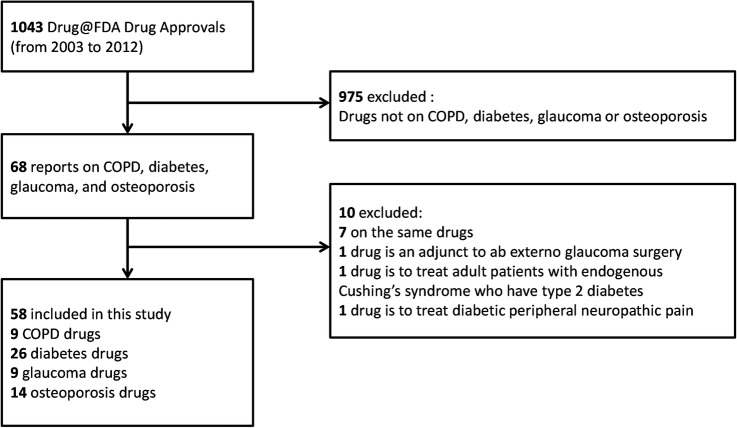
We used the Drugs@FDA website to identify drug approvals produced from 2003 to 2012 by the FDA. We focused on four diseases (chronic obstructive pulmonary disease (COPD), type 1 or 2 diabetes, glaucoma and osteoporosis) for which surrogates are commonly used in trials. We reviewed the drug labels and medical reviews to provide empirical evidence on how surrogate outcomes are handled by the FDA.
Of 1043 approvals screened, 58 (6%) were for the four diseases of interest. Most drugs for COPD (7/9, 78%), diabetes (26/26, 100%) and glaucoma (9/9, 100%) were approved based on surrogates while for osteoporosis, most drugs (10/14, 71%) were also approved for patient-centred outcomes (fractures). The rationale for using surrogates was discussed in 11 of the 43 (26%) drug approvals based on surrogates. In these drug approvals, we found drug approvals for diabetes are more likely than the other examined conditions to contain a discussion of trial evidence demonstrating that treatment effects on surrogate outcomes predict treatment effects on patient-centred outcomes.
Our results suggest that the FDA did not use a consistent approach to address surrogates in assessing the benefits and harms of drugs for COPD, type 1 or 2 diabetes, glaucoma and osteoporosis. For evaluating new drugs, patient-centred outcomes should be chosen whenever possible. If the use of surrogate outcomes is necessary, then a consistent approach is important to review the evidence for surrogacy and consider surrogate's usage in the treatment and population under study.
在一系列疾病中评估美国食品药品监督管理局(FDA)将替代指标作为药物批准依据的频率,以及是否讨论了将针对替代指标的治疗效果作为以患者为中心的结局的治疗效果预测指标的理由,若有讨论,是如何讨论的。
我们使用美国食品药品监督管理局(FDA)的Drugs@FDA网站,确定2003年至2012年期间FDA批准的药物。我们重点关注四种疾病(慢性阻塞性肺疾病(COPD)、1型或2型糖尿病、青光眼和骨质疏松症),这些疾病在试验中常用替代指标。我们审查了药品标签和医学审评文件,以提供关于FDA如何处理替代指标的实证证据。
在筛选的1043项批准中,有58项(6%)是针对上述四种相关疾病的。大多数用于慢性阻塞性肺疾病(COPD)(7/9,78%)、糖尿病(26/26,100%)和青光眼(9/9,100%)的药物是基于替代指标获批的,而对于骨质疏松症,大多数药物(10/14,71%)也是基于以患者为中心的结局(骨折)获批的。在基于替代指标获批的43项药物批准中,有11项(26%)讨论了使用替代指标的理由。在这些药物批准中,我们发现与其他研究的疾病相比,糖尿病的药物批准更有可能包含对试验证据的讨论,这些证据表明针对替代指标的治疗效果可预测以患者为中心的结局的治疗效果。
我们的结果表明,FDA在评估慢性阻塞性肺疾病(COPD)、1型或2型糖尿病、青光眼和骨质疏松症药物的益处和危害时,没有采用一致的方法来处理替代指标。在评估新药时,应尽可能选择以患者为中心的结局。如果必须使用替代指标,那么采用一致的方法来审查替代指标的证据,并考虑在研究的治疗方法和人群中使用替代指标非常重要。