PenTAG, Institute for Health Services Research, University of Exeter Medical School, University of Exeter, Exeter EX2 4SG, UK.
BMJ. 2013 Jan 29;346:f457. doi: 10.1136/bmj.f457.
To quantify and compare the treatment effect and risk of bias of trials reporting biomarkers or intermediate outcomes (surrogate outcomes) versus trials using final patient relevant primary outcomes.
Meta-epidemiological study.
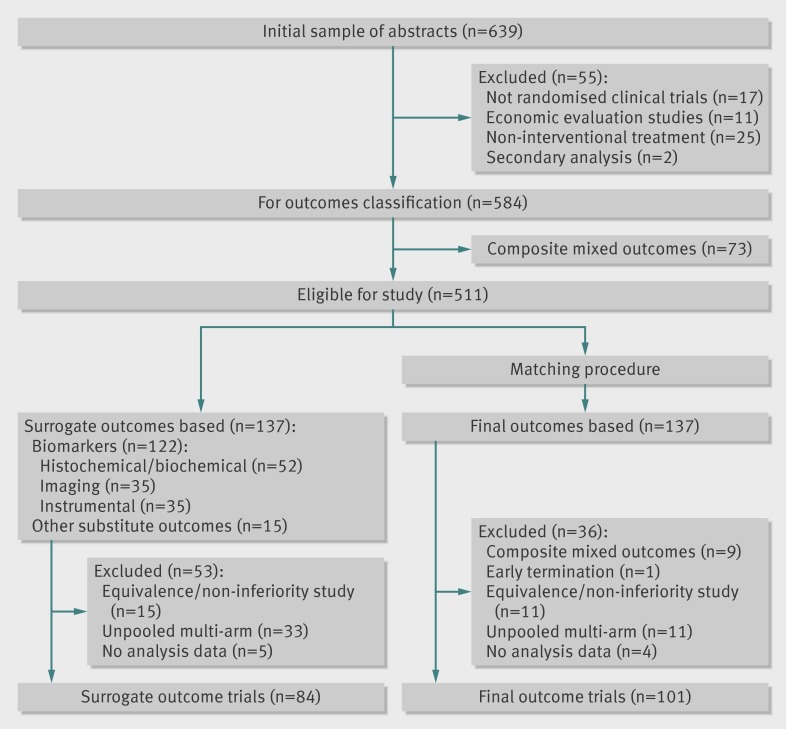
All randomised clinical trials published in 2005 and 2006 in six high impact medical journals: Annals of Internal Medicine, BMJ, Journal of the American Medical Association, Lancet, New England Journal of Medicine, and PLoS Medicine.
Two independent reviewers selected trials.
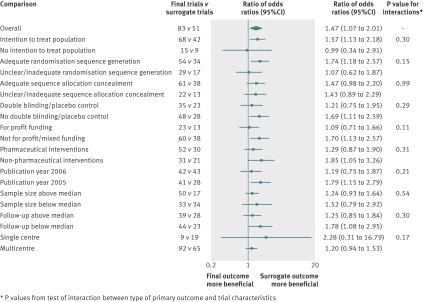
Trial characteristics, risk of bias, and outcomes were recorded according to a predefined form. Two reviewers independently checked data extraction. The ratio of odds ratios was used to quantify the degree of difference in treatment effects between the trials using surrogate outcomes and those using patient relevant outcomes, also adjusted for trial characteristics. A ratio of odds ratios >1.0 implies that trials with surrogate outcomes report larger intervention effects than trials with patient relevant outcomes.
84 trials using surrogate outcomes and 101 using patient relevant outcomes were considered for analyses. Study characteristics of trials using surrogate outcomes and those using patient relevant outcomes were well balanced, except for median sample size (371 v 741) and single centre status (23% v 9%). Their risk of bias did not differ. Primary analysis showed trials reporting surrogate endpoints to have larger treatment effects (odds ratio 0.51, 95% confidence interval 0.42 to 0.60) than trials reporting patient relevant outcomes (0.76, 0.70 to 0.82), with an unadjusted ratio of odds ratios of 1.47 (1.07 to 2.01) and adjusted ratio of odds ratios of 1.46 (1.05 to 2.04). This result was consistent across sensitivity and secondary analyses.
Trials reporting surrogate primary outcomes are more likely to report larger treatment effects than trials reporting final patient relevant primary outcomes. This finding was not explained by differences in the risk of bias or characteristics of the two groups of trials.
定量比较和分析报告生物标志物或中间结局(替代结局)与报告最终患者相关主要结局的试验的治疗效果和偏倚风险。
Meta 流行病学研究。
2005 年和 2006 年在六个高影响力医学期刊上发表的所有随机临床试验:《内科学年鉴》、《英国医学杂志》、《美国医学会杂志》、《柳叶刀》、《新英格兰医学杂志》和《公共科学图书馆医学》。
两位独立的评审员选择试验。
根据预定义的表格记录试验特征、偏倚风险和结局。两位评审员独立检查数据提取。比值比用于量化使用替代结局的试验和使用患者相关结局的试验之间治疗效果的差异程度,同时调整了试验特征。比值比>1.0 意味着使用替代结局的试验报告的干预效果大于使用患者相关结局的试验。
共考虑了 84 项使用替代结局的试验和 101 项使用患者相关结局的试验进行分析。使用替代结局的试验和使用患者相关结局的试验的研究特征基本平衡,除了中位数样本量(371 与 741)和单中心状态(23%与 9%)。它们的偏倚风险没有差异。主要分析显示,报告替代终点的试验具有更大的治疗效果(比值比 0.51,95%置信区间 0.42 至 0.60),而报告患者相关结局的试验(0.76,0.70 至 0.82),未调整比值比为 1.47(1.07 至 2.01),调整比值比为 1.46(1.05 至 2.04)。这一结果在敏感性分析和二次分析中是一致的。
报告替代主要结局的试验比报告最终患者相关主要结局的试验更有可能报告更大的治疗效果。这一发现不能用两组试验的偏倚风险或特征差异来解释。