Selbie Diana R, Lanigan Gary J, Laughlin Ronald J, Di Hong J, Moir James L, Cameron Keith C, Clough Tim J, Watson Catherine J, Grant James, Somers Cathal, Richards Karl G
Teagasc, Johnstown Castle, Environmental Research Centre, County Wexford, Ireland.
AgResearch, Ruakura Research Centre, Hamilton, New Zealand.
Sci Rep. 2015 Nov 30;5:17361. doi: 10.1038/srep17361.
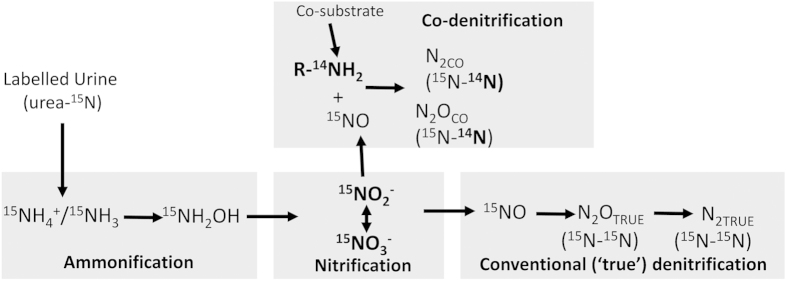
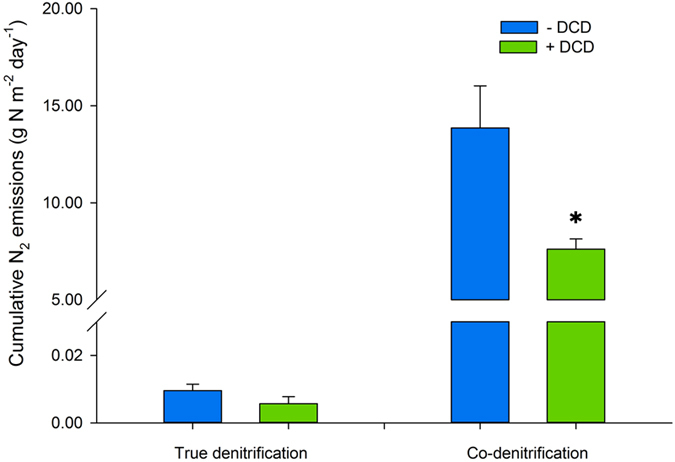
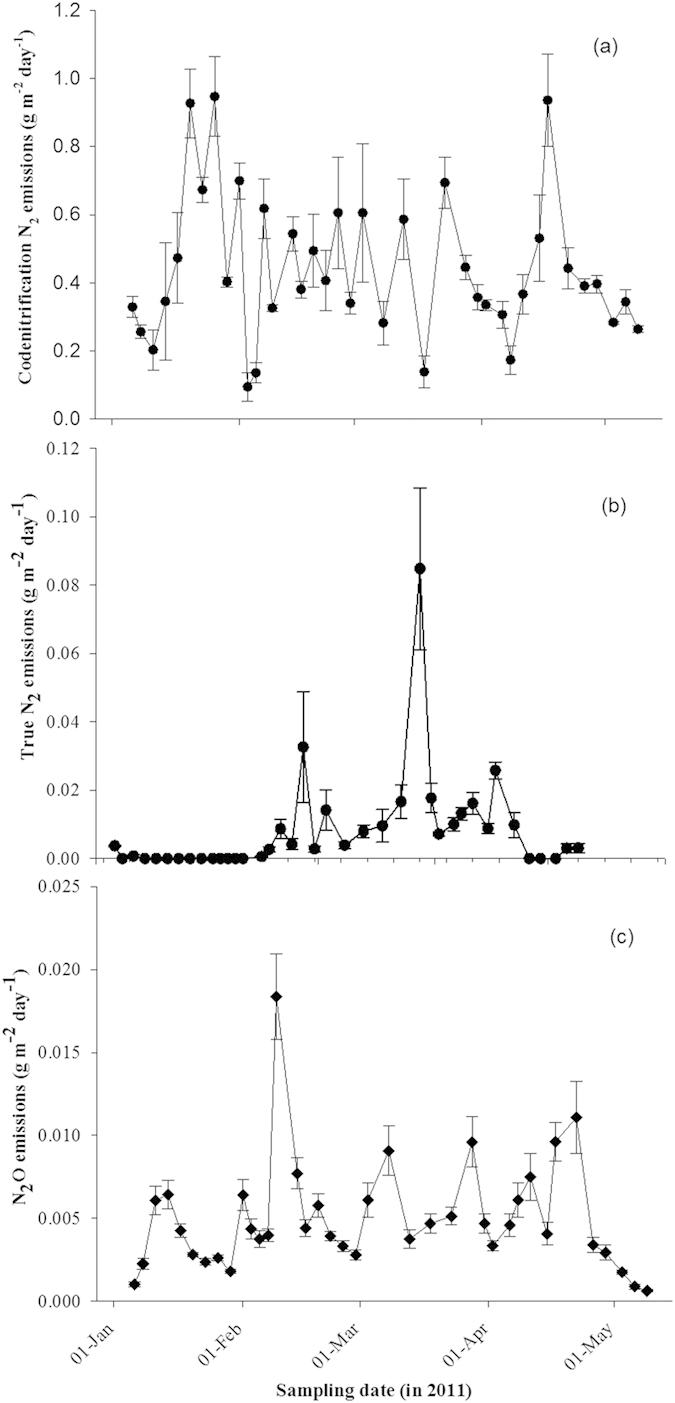
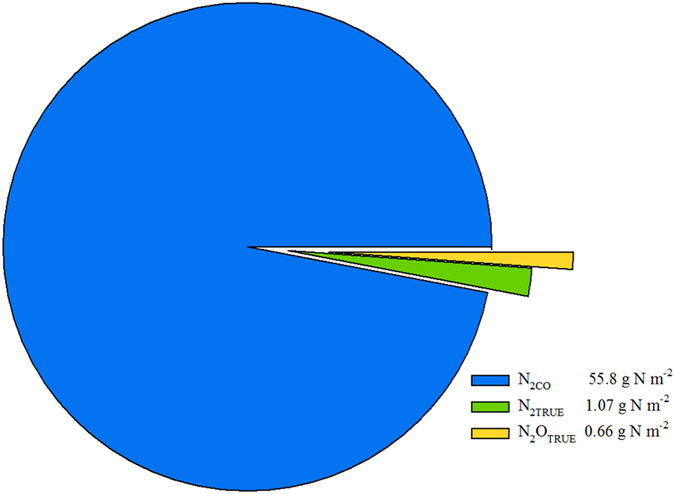
Pasture-based livestock systems are often associated with losses of reactive forms of nitrogen (N) to the environment. Research has focused on losses to air and water due to the health, economic and environmental impacts of reactive N. Di-nitrogen (N2) emissions are still poorly characterized, both in terms of the processes involved and their magnitude, due to financial and methodological constraints. Relatively few studies have focused on quantifying N2 losses in vivo and fewer still have examined the relative contribution of the different N2 emission processes, particularly in grazed pastures. We used a combination of a high (15)N isotopic enrichment of applied N with a high precision of determination of (15)N isotopic enrichment by isotope-ratio mass spectrometry to measure N2 emissions in the field. We report that 55.8 g N m(-2) (95%, CI 38 to 77 g m(-2)) was emitted as N2 by the process of co-denitrification in pastoral soils over 123 days following urine deposition (100 g N m(-2)), compared to only 1.1 g N m(-2) (0.4 to 2.8 g m(-2)) from denitrification. This study provides strong evidence for co-denitrification as a major N2 production pathway, which has significant implications for understanding the N budgets of pastoral ecosystems.
基于牧场的畜牧系统常常伴随着活性氮(N)向环境的流失。由于活性氮对健康、经济和环境的影响,研究主要集中在其向空气和水的流失方面。由于资金和方法上的限制,对于氮气(N₂)排放,无论是其涉及的过程还是排放量,目前仍了解甚少。相对较少的研究关注于体内N₂流失的量化,而更少的研究考察了不同N₂排放过程的相对贡献,特别是在放牧牧场中。我们结合使用高(¹⁵)N同位素富集的施氮以及通过同位素比率质谱法高精度测定(¹⁵)N同位素富集,来测量田间的N₂排放。我们报告称,在尿液沉积(100 g N m⁻²)后的123天里,牧区土壤通过共反硝化作用以N₂形式排放了55.8 g N m⁻²(95%,置信区间38至77 g m⁻²),相比之下,反硝化作用仅排放了1.1 g N m⁻²(0.4至2.8 g m⁻²)。这项研究为共反硝化作为主要的N₂产生途径提供了有力证据,这对于理解牧区生态系统的氮收支具有重要意义。