Chen Chih-Hao, Huang Pei-Wen, Tang Sung-Chun, Shieh Jiann-Shing, Lai Dar-Ming, Wu An-Yu, Jeng Jiann-Shing
Stroke Center and Department of Neurology, National Taiwan University Hospital, Taipei, Taiwan.
Division of Neurology, Department of Internal Medicine, Far-Eastern Memorial Hospital, New Taipei, Taiwan.
Sci Rep. 2015 Dec 1;5:17552. doi: 10.1038/srep17552.
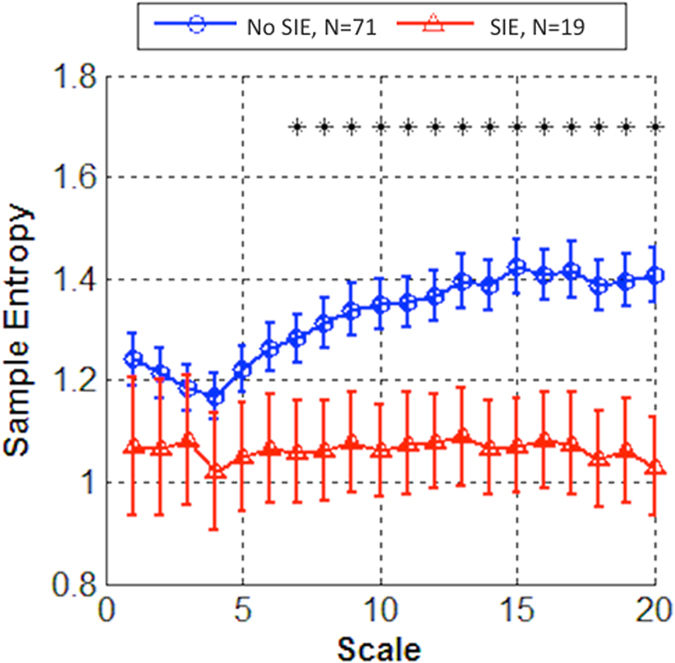
About one-third of acute stroke patients may experience stroke-in-evolution, which is often associated with a worse outcome. Recently, we showed that multiscale entropy (MSE), a non-linear method for analysis of heart rate variability (HRV), is an early outcome predictor in non-atrial fibrillation (non-AF) stroke patients. We aimed to further investigate MSE as a predictor of SIE. We included 90 non-AF ischemic stroke patients admitted to the intensive care unit (ICU). Nineteen (21.1%) patients met the criteria of SIE, which was defined as an increase in the National Institutes of Health Stroke Scale score of ≥2 points within 3 days of admission. The MSE of HRV was analyzed from 1-hour continuous ECG signals during the first 24 hours of admission. The complexity index was defined as the area under the MSE curve. Compared with patients without SIE, those with SIE had a significantly lower complexity index value (21.3 ± 8.5 vs 26.5 ± 7.7, P = 0.012). After adjustment for clinical variables, patients with higher complexity index values were significantly less likely to have SIE (odds ratio = 0.897, 95% confidence interval 0.818-0.983, P = 0.020). In summary, early assessment of HRV by MSE can be a potential predictor of SIE in ICU-admitted non-AF ischemic stroke patients.
约三分之一的急性中风患者可能会经历中风进展,这通常与更差的预后相关。最近,我们发现多尺度熵(MSE),一种用于分析心率变异性(HRV)的非线性方法,是非房颤(non-AF)中风患者的早期预后预测指标。我们旨在进一步研究MSE作为中风进展(SIE)预测指标的作用。我们纳入了90名入住重症监护病房(ICU)的非AF缺血性中风患者。19名(21.1%)患者符合SIE标准,其定义为入院3天内美国国立卫生研究院卒中量表评分增加≥2分。在入院的头24小时内,从1小时连续心电图信号中分析HRV的MSE。复杂性指数定义为MSE曲线下的面积。与无SIE的患者相比,有SIE的患者复杂性指数值显著更低(21.3±8.5 vs 26.5±7.7,P = 0.012)。在对临床变量进行校正后,复杂性指数值较高的患者发生SIE的可能性显著更低(比值比 = 0.897,95%置信区间0.818 - 0.983,P = 0.020)。总之,通过MSE对HRV进行早期评估可能是入住ICU的非AF缺血性中风患者SIE的潜在预测指标。