Sengelaub Caitlin A, Navrazhina Kristina, Ross Jason B, Halberg Nils, Tavazoie Sohail F
Laboratory of Systems Cancer Biology, Rockefeller University, New York, NY, USA.
Laboratory of Systems Cancer Biology, Rockefeller University, New York, NY, USA
EMBO J. 2016 Jan 4;35(1):62-76. doi: 10.15252/embj.201591973. Epub 2015 Nov 30.
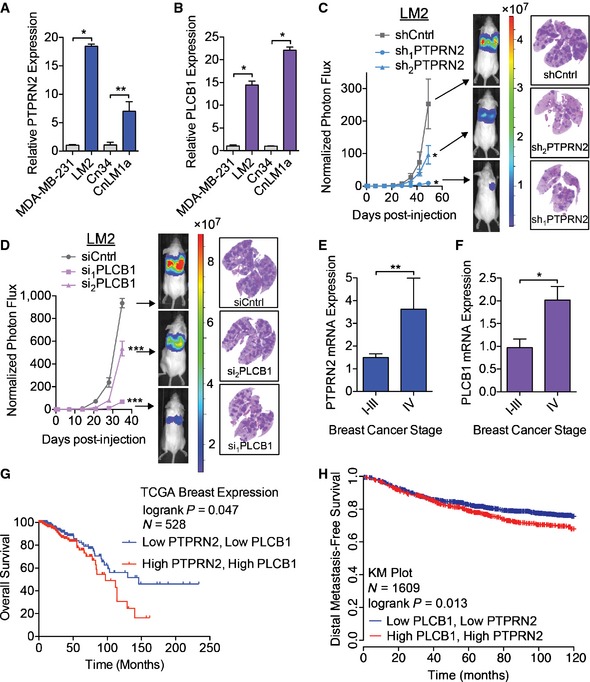
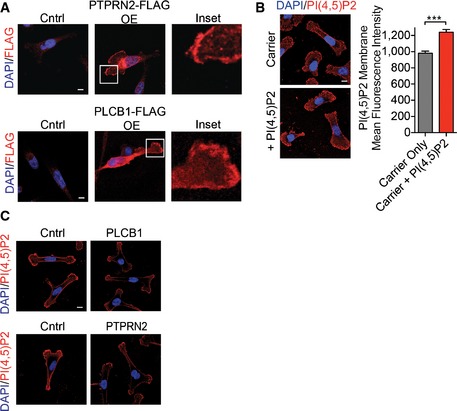
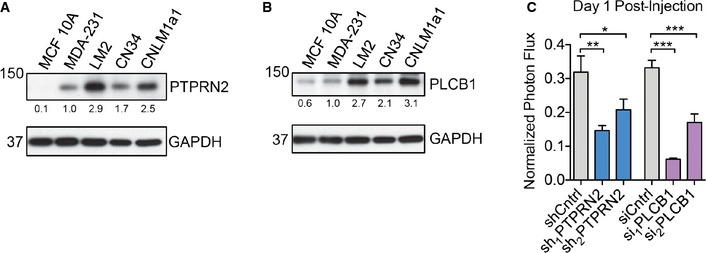
Altered abundance of phosphatidyl inositides (PIs) is a feature of cancer. Various PIs mark the identity of diverse membranes in normal and malignant cells. Phosphatidylinositol 4,5-bisphosphate (PI(4,5)P2) resides predominantly in the plasma membrane, where it regulates cellular processes by recruiting, activating, or inhibiting proteins at the plasma membrane. We find that PTPRN2 and PLCβ1 enzymatically reduce plasma membrane PI(4,5)P2 levels in metastatic breast cancer cells through two independent mechanisms. These genes are upregulated in highly metastatic breast cancer cells, and their increased expression associates with human metastatic relapse. Reduction in plasma membrane PI(4,5)P2 abundance by these enzymes releases the PI(4,5)P2-binding protein cofilin from its inactive membrane-associated state into the cytoplasm where it mediates actin turnover dynamics, thereby enhancing cellular migration and metastatic capacity. Our findings reveal an enzymatic network that regulates metastatic cell migration through lipid-dependent sequestration of an actin-remodeling factor.
磷脂酰肌醇(PIs)丰度的改变是癌症的一个特征。各种PIs标记正常细胞和恶性细胞中不同膜的特征。磷脂酰肌醇4,5-二磷酸(PI(4,5)P2)主要存在于质膜中,在质膜中它通过招募、激活或抑制质膜上的蛋白质来调节细胞过程。我们发现,蛋白酪氨酸磷酸酶受体N2型(PTPRN2)和磷脂酶Cβ1(PLCβ1)通过两种独立机制酶促降低转移性乳腺癌细胞质膜PI(4,5)P2水平。这些基因在高转移性乳腺癌细胞中上调,它们表达的增加与人类转移性复发相关。这些酶降低质膜PI(4,5)P2丰度,使PI(4,5)P2结合蛋白丝切蛋白从其无活性的膜相关状态释放到细胞质中,在细胞质中它介导肌动蛋白周转动力学,从而增强细胞迁移和转移能力。我们的研究结果揭示了一个酶网络,该网络通过对肌动蛋白重塑因子的脂质依赖性隔离来调节转移性细胞迁移。