Breakthrough Breast Cancer Research Unit, University of Manchester, Manchester M20 4BX, England, UK.
J Cell Biol. 2012 Feb 20;196(4):395-406. doi: 10.1083/jcb.201102147.
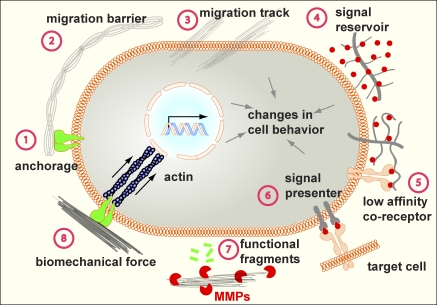
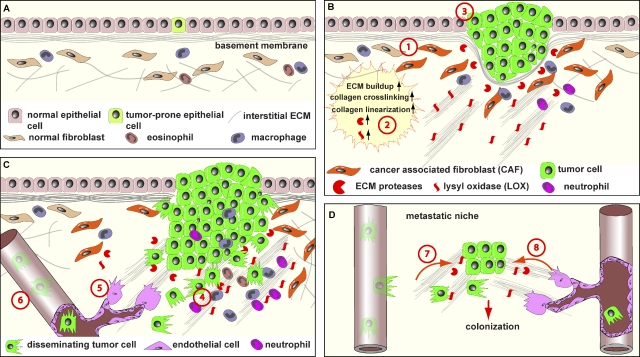
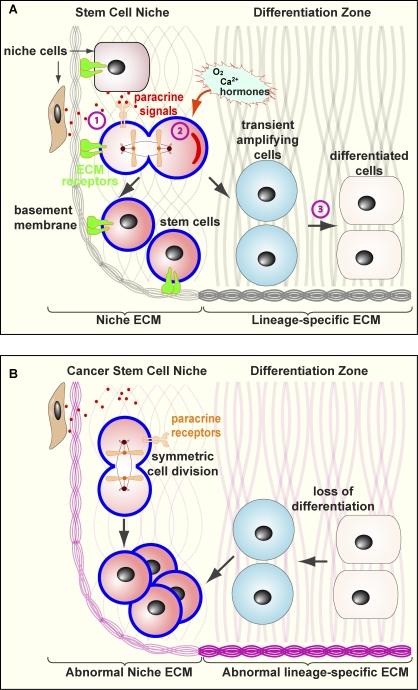
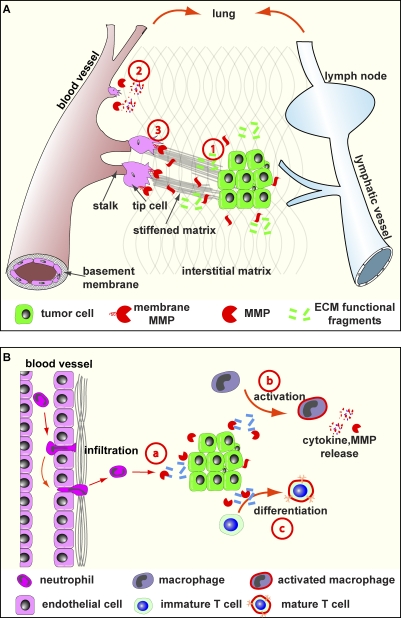
The local microenvironment, or niche, of a cancer cell plays important roles in cancer development. A major component of the niche is the extracellular matrix (ECM), a complex network of macromolecules with distinctive physical, biochemical, and biomechanical properties. Although tightly controlled during embryonic development and organ homeostasis, the ECM is commonly deregulated and becomes disorganized in diseases such as cancer. Abnormal ECM affects cancer progression by directly promoting cellular transformation and metastasis. Importantly, however, ECM anomalies also deregulate behavior of stromal cells, facilitate tumor-associated angiogenesis and inflammation, and thus lead to generation of a tumorigenic microenvironment. Understanding how ECM composition and topography are maintained and how their deregulation influences cancer progression may help develop new therapeutic interventions by targeting the tumor niche.
癌细胞的局部微环境( niche )在癌症发展中起着重要作用。 niche 的一个主要组成部分是细胞外基质(ECM),它是一种具有独特物理、生化和生物力学特性的大分子复杂网络。尽管在胚胎发育和器官稳态期间受到严格控制,但 ECM 在癌症等疾病中通常会失调并变得紊乱。异常的 ECM 通过直接促进细胞转化和转移来影响癌症的进展。然而,重要的是,ECM 异常也会使基质细胞的行为失调,促进肿瘤相关的血管生成和炎症,从而导致致瘤微环境的产生。了解 ECM 的组成和拓扑结构如何维持以及其失调如何影响癌症的进展,可能有助于通过靶向肿瘤 niche 开发新的治疗干预措施。