Baculis Brian Charles, Valenzuela Carlos Fernando
Department of Neurosciences, School of Medicine, University of New Mexico Health Sciences Center, Albuquerque, NM, 87131, USA.
J Negat Results Biomed. 2015 Dec 2;14:19. doi: 10.1186/s12952-015-0041-9.
Ethanol exposure during the rodent equivalent to the 3(rd) trimester of human pregnancy (i.e., first 1-2 weeks of neonatal life) has been shown to produce structural and functional alterations in the CA3 hippocampal sub-region, which is involved in associative memory. Synaptic plasticity mechanisms dependent on retrograde release of brain-derived neurotrophic factor (BDNF) driven by activation of L-type voltage-gated Ca(2+) channels (L-VGCCs) are thought to play a role in stabilization of both GABAergic and glutamatergic synapses in CA3 pyramidal neurons. We previously showed that ethanol exposure during the first week of life blocks BDNF/L-VGCC-dependent long-term potentiation of GABAA receptor-mediated synaptic transmission in these neurons. Here, we tested whether this effect is associated with lasting alterations in GABAergic and glutamatergic transmission.
Rats were exposed to air or ethanol for 3 h/day between postnatal days three and five in vapor inhalation chambers, a paradigm that produces peak serum ethanol levels near 0.3 g/dl. Whole-cell patch-clamp electrophysiological recordings of spontaneous inhibitory and excitatory postsynaptic currents (sIPSCs and sEPSCs, respectively) were obtained from CA3 pyramidal neurons in coronal brain slices prepared at postnatal days 13-17.
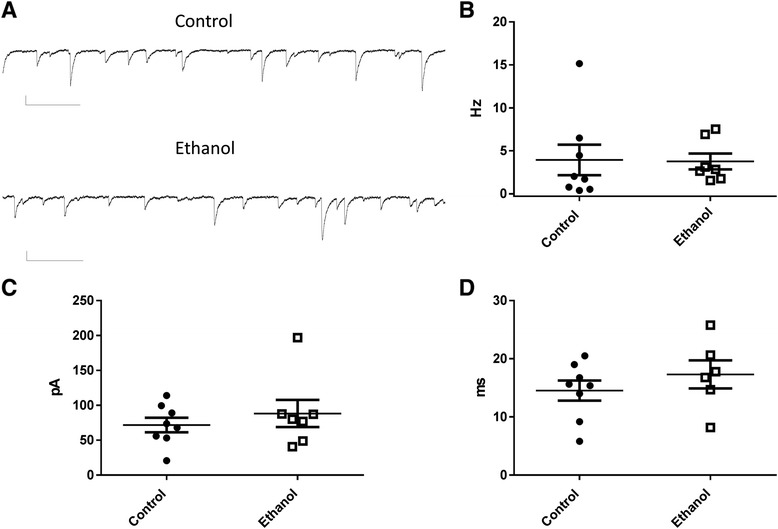
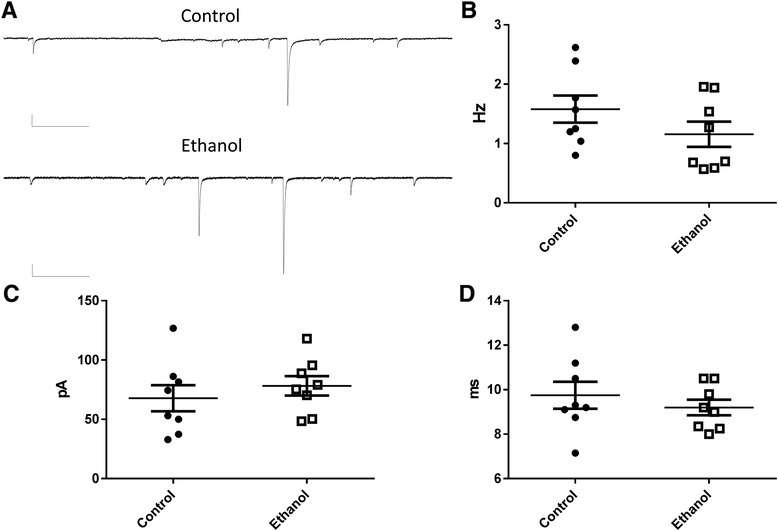
Ethanol exposure did not significantly affect the frequency, amplitude, rise-time and half-width of either sIPSCs or sEPSCs.
We show that an ethanol exposure paradigm known to inhibit synaptic plasticity mechanisms that may participate in the stabilization of GABAergic and glutamatergic synapses in CA3 pyramidal neurons does not produce lasting functional alterations in these synapses, suggesting that compensatory mechanisms restored the balance of excitatory and inhibitory synaptic transmission.
在啮齿动物出生后相当于人类妊娠晚期(即出生后第1 - 2周)暴露于乙醇,已被证明会在参与联想记忆的海马CA3亚区产生结构和功能改变。依赖于L型电压门控钙通道(L-VGCCs)激活驱动的脑源性神经营养因子(BDNF)逆行释放的突触可塑性机制,被认为在CA3锥体神经元中GABA能和谷氨酸能突触的稳定中起作用。我们先前表明,出生后第一周暴露于乙醇会阻断这些神经元中BDNF/L-VGCC依赖的GABAA受体介导的突触传递的长期增强。在此,我们测试了这种效应是否与GABA能和谷氨酸能传递的持久改变有关。
在出生后第3至5天,将大鼠置于蒸汽吸入室中,每天暴露于空气或乙醇3小时,这种模式可使血清乙醇水平峰值接近0.3g/dl。从出生后第13 - 17天制备的冠状脑片中的CA3锥体神经元获得自发抑制性和兴奋性突触后电流(分别为sIPSCs和sEPSCs)的全细胞膜片钳电生理记录。
乙醇暴露对sIPSCs或sEPSCs的频率、幅度、上升时间和半高宽均无显著影响。
我们表明,一种已知能抑制可能参与CA3锥体神经元中GABA能和谷氨酸能突触稳定的突触可塑性机制的乙醇暴露模式,不会在这些突触中产生持久的功能改变,这表明补偿机制恢复了兴奋性和抑制性突触传递的平衡。