Ramos-Miguel Alfredo, Hercher Christa, Beasley Clare L, Barr Alasdair M, Bayer Thomas A, Falkai Peter, Leurgans Sue E, Schneider Julie A, Bennett David A, Honer William G
Child and Family Research Institute, 938 West 28th Avenue, Vancouver, BC, V5Z 4H4, Canada.
Department of Psychiatry, University of British Columbia, 2255 Wesbrook Mall, Vancouver, BC, V6T 2A1, Canada.
Mol Neurodegener. 2015 Dec 2;10:65. doi: 10.1186/s13024-015-0061-4.
Presynaptic terminals contribute to cognitive reserve, balancing the effects of age-related pathologies on cognitive function in the elderly. The presynaptic protein Munc18-1, alternatively spliced into long (M18L) or short (M18S) isoforms, is a critical modulator of neurotransmission. While subtle alterations in Munc18-1 have been shown to cause severe neuropsychiatric disorders with cognitive impairment, little information is known regarding the specific roles of Munc18-1 splice variants. We first investigated functional and anatomical features evidencing the divergent roles of M18L and M18S, and then evaluated their contribution to the full range of age-related cognitive impairment in the dorsolateral prefrontal cortex of a large sample of participants from a community-based aging study, including subjects with no-(NCI, n = 90), or mild-(MCI, n = 86) cognitive impairment, or with clinical dementia (n = 132). Finally, we used APP23 mutant mice to study the association between M18L/S and the time-dependent accumulation of common Alzheimer's disease pathology.
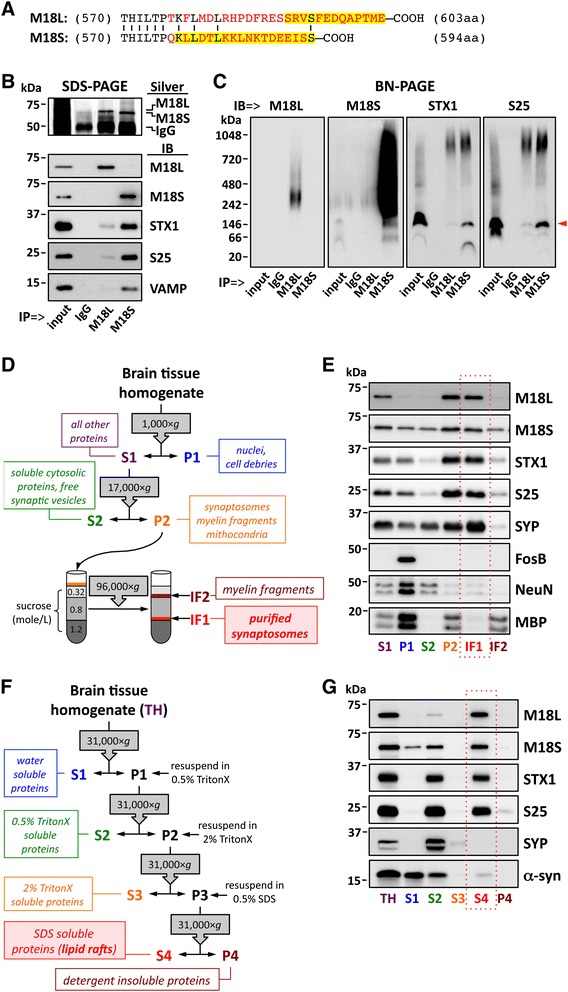
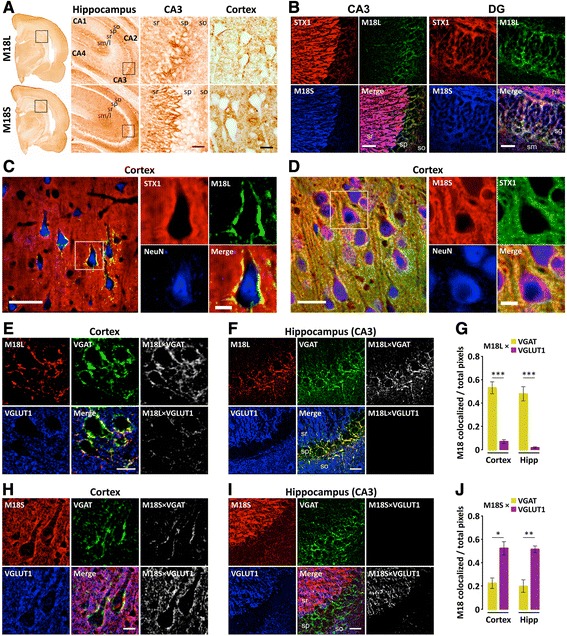
Using isoform-specific antibodies, M18L was localized to the synaptosomal fraction, with a distribution matching lipid raft microdomains. M18S was found widely across cytosolic and synaptosomal compartments. Immunocytochemical studies identified M18L in perisomatic, GABAergic terminals, while M18S was broadly distributed in GABAergic and glutamatergic terminals. Using regression models taking into account multiple age-related pathologies, age, education and sex, global cognitive function was associated with the level of M18L (p = 0.006) but not M18S (p = 0.88). Mean M18L in dementia cases was 51 % lower than in NCI cases (p < 0.001), and each unit of M18L was associated with a lower likelihood of dementia (odds ratio = 0.68, 95 % confidence interval = 0.50-0.90, p = 0.008). In contrast, M18S balanced across clinical and pathologically diagnosed groups. M18L loss may not be caused by age-related amyloid pathology, since APP23 mice (12- and 22-months of age) had unchanged cortical levels of M18L/S compared with wild-type animals.
M18L was localized to presynaptic inhibitory terminals, and was associated with cognitive function and protection from dementia in an elderly, community-based cohort. Lower M18L in inhibitory presynaptic terminals may be an early, independent contributor to cognitive decline.
突触前终末对认知储备有贡献,可平衡与年龄相关的病理学变化对老年人认知功能的影响。突触前蛋白Munc18-1可选择性剪接成长(M18L)或短(M18S)异构体,是神经传递的关键调节因子。虽然已表明Munc18-1的细微改变会导致伴有认知障碍的严重神经精神疾病,但关于Munc18-1剪接变体的具体作用知之甚少。我们首先研究了证明M18L和M18S不同作用的功能和解剖学特征,然后在一项基于社区的衰老研究的大量参与者样本的背外侧前额叶皮质中,评估了它们对与年龄相关的全范围认知障碍的贡献,这些参与者包括无认知障碍(NCI,n = 90)、轻度认知障碍(MCI,n = 86)或临床痴呆(n = 132)的受试者。最后,我们使用APP23突变小鼠研究M18L/S与常见阿尔茨海默病病理学随时间积累之间的关联。
使用异构体特异性抗体,M18L定位于突触体部分,其分布与脂筏微区匹配。M18S广泛存在于胞质和突触体区室中。免疫细胞化学研究在躯体周围的GABA能终末中鉴定出M18L,而M18S广泛分布于GABA能和谷氨酸能终末中。使用考虑多种与年龄相关的病理学、年龄、教育程度和性别的回归模型,整体认知功能与M18L水平相关(p = 0.006),而与M18S水平无关(p = 0.88)。痴呆病例中的平均M18L比NCI病例低51%(p < 0.001),且M18L的每一个单位与患痴呆的可能性较低相关(优势比 = 0.68,95%置信区间 = 0.50 - 0.90,p = 0.008)。相比之下,M18S在临床和病理诊断组中分布均衡。M18L的缺失可能不是由与年龄相关的淀粉样蛋白病理学引起的,因为与野生型动物相比,APP23小鼠(12个月和22个月大)皮质中M18L/S水平未发生变化。
M18L定位于突触前抑制性终末,在一个基于社区的老年队列中与认知功能及预防痴呆相关。抑制性突触前终末中较低的M18L可能是认知衰退的一个早期独立因素。