Andreucci Carla B, Cecatti José G, Pacagnella Rodolfo C, Silveira Carla, Parpinelli Mary A, Ferreira Elton C, Angelini Carina R, Santos Juliana P, Zanardi Dulce M, Bussadori Jamile C, Cecchino Gustavo N, Souza Renato T, Sousa Maria H, Costa Maria L
Department of Obstetrics and Gynaecology, School of Medical Sciences, University of Campinas, Campinas, SP, Brazil.
Federal University of Sao Carlos (UFSCar), Sao Carlos, SP, Brazil.
PLoS One. 2015 Dec 2;10(12):e0143581. doi: 10.1371/journal.pone.0143581. eCollection 2015.
to assess Female Sexual Function Index (FSFI) scores and delay to resume sexual activity associated with a previous severe maternal morbidity.
This was a multidimensional retrospective cohort study. Women who gave birth at a Brazilian tertiary maternity between 2008 and 2012 were included, with data extraction from the hospital information system. Those with potentially life-threatening conditions and maternal near miss episodes (severe maternal morbidity) were considered the exposed group. The control group was a random sample of women who had had uncomplicated pregnancy. Female sexual function was evaluated through FSFI questionnaire, and general and reproductive aspects were addressed through specific questions. Statistical analyses were performed using Mann-Whitney and Pearson´s Chi-square for bivariate analyses. Logistic regression was used to identify variables independently associated with lower FSFI scores.
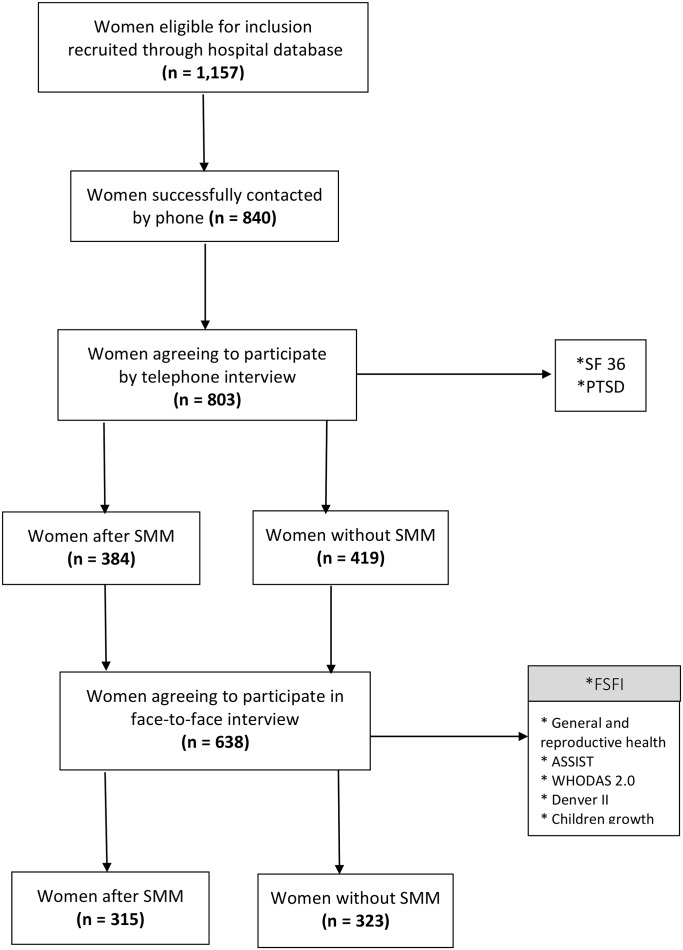
638 women were included (315 at exposed and 323 at not exposed groups). The majority of women were under 30 years-old in the control group and between 30 and 46 years-old in the exposed group (p = 0.003). Women who experienced severe maternal morbidity (SMM) had statistically significant differences regarding cesarean section (82.4% versus 47.1% among deliveries without complications, p<0.001), and some previous pathological conditions. FSFI mean scores were similar among groups ranging from 24.39 to 24.42. It took longer for exposed women to resume sexual activity after index pregnancy (mean 84 days after SMM and 65 days for control group, p = 0.01). Multiple analyses showed no significant association of FSFI below cut-off value with any predictor.
FSFI scores were not different in both groups. However, they were lower than expected. SMM delayed resumption of sexual activity after delivery, beyond postpartum period. However, the proportion of women in both groups having sex at 3 months after delivery was similar. Altered sexual response may be evaluated as one of possible long-term consequences after SMM episodes. Further studies on the growing population of women surviving severe maternal conditions might be worth for improvement of care for women.
评估女性性功能指数(FSFI)得分以及与既往严重孕产妇发病相关的恢复性活动的延迟情况。
这是一项多维度回顾性队列研究。纳入了2008年至2012年期间在巴西一家三级产科医院分娩的女性,并从医院信息系统中提取数据。患有潜在危及生命状况和孕产妇接近死亡事件(严重孕产妇发病)的女性被视为暴露组。对照组是妊娠未出现并发症的女性的随机样本。通过FSFI问卷评估女性性功能,并通过特定问题探讨一般和生殖方面的情况。使用Mann-Whitney检验和Pearson卡方检验进行双变量分析。采用逻辑回归来确定与较低FSFI得分独立相关的变量。
共纳入638名女性(暴露组315名,非暴露组323名)。对照组中大多数女性年龄在30岁以下,而暴露组中女性年龄在30至46岁之间(p = 0.003)。经历严重孕产妇发病(SMM)的女性在剖宫产方面存在统计学显著差异(82.4% 对比无并发症分娩中的47.1%,p<0.001),以及一些既往病理状况方面也有差异。各组FSFI平均得分相似,范围在24.39至24.42之间。暴露组女性在本次妊娠后恢复性活动所需时间更长(SMM后平均84天,对照组为65天,p = 0.01)。多因素分析显示,FSFI低于临界值与任何预测因素均无显著关联。
两组的FSFI得分无差异。然而,得分低于预期。严重孕产妇发病延迟了产后性活动的恢复,超出了产后期。然而,两组中产后3个月进行性行为的女性比例相似。性反应改变可被视为严重孕产妇发病事件后可能的长期后果之一。对越来越多从严重孕产妇状况中存活下来的女性进行进一步研究可能有助于改善对女性的护理。